
TL;DR — Quick Summary
Visible, well-documented injuries can make an injury case more compelling, but juror sympathy is not a winning strategy. Judges instruct jurors to decide on the evidence, not sympathy, and jurors tend to punish anything that looks exaggerated. What persuades them is credibility: consistent medical records, honest testimony, and clear evidence of how the injury changed daily life. In New York, a civil verdict needs five of six jurors. Most cases settle, but insurers price every offer on how a jury is likely to react.
People often assume a jury will side with whoever looks most hurt. The reality of juror sympathy in personal injury cases is more complicated. Jurors do respond to real suffering, but they are told not to let sympathy decide the case, and they are quick to turn on a plaintiff who seems to overstate it.
This guide explains how injuries actually influence a jury, and why it matters even if your case never reaches a courtroom.
Jurors Are Told to Set Sympathy Aside
Before deliberations, the judge instructs the jury to decide the case on the evidence and the law, and not on sympathy or prejudice for either side. Jurors take that instruction seriously. Sympathy can make them pay closer attention, but it will not carry a weak case on liability.
In New York civil cases, the verdict does not have to be unanimous: under CPLR § 4113, five of the six jurors must agree.
What Actually Persuades a Jury
| What jurors respond to | Why |
|---|---|
| Consistent medical records | They show the injury is real and was treated from the start |
| Honest, measured testimony | Credibility matters more than emotion |
| Before-and-after witnesses | Family and coworkers describe how life changed |
| Clear evidence of fault | Sympathy does not replace proof of liability |
| Specific daily-life examples | Missed events and lost abilities are easier to value than general pain |
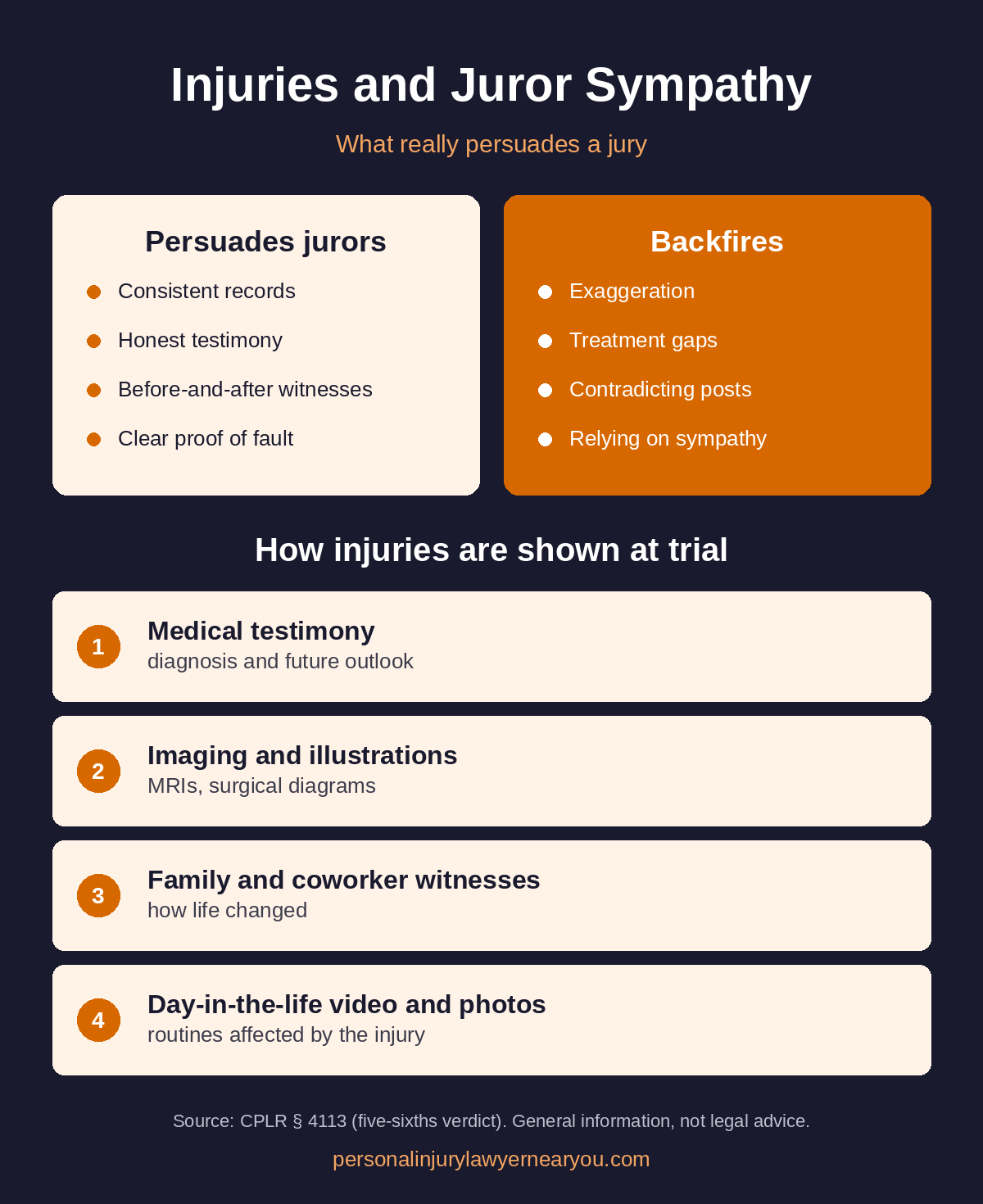
How Injuries Are Presented at Trial
Lawyers do not rely on the courtroom appearance of the injured person alone. They show the injury through evidence the jury can trust:
- Medical testimony explaining the diagnosis and future outlook
- Imaging and medical illustrations, such as MRIs and surgical diagrams
- Before-and-after witnesses, like family, friends and coworkers
- Day-in-the-life video showing routines affected by the injury
- Photographs of injuries, scars and recovery over time
The categories of loss the jury can award are covered in our guide to damages in a New York personal injury claim.
Why Exaggeration Backfires
Juries are skeptical. Surveillance footage of the plaintiff carrying groceries, a social media post from a beach, or a treatment history that does not match the testimony can undo months of work. Insurers know this, which is why they look for it; see how insurers use surveillance to catch exaggerated claims. Honest testimony that admits good days as well as bad days is far more persuasive.
Visible vs Invisible Injuries
| Visible injuries | Invisible injuries | |
|---|---|---|
| Examples | Fractures, scars, amputations, burns | Back and neck pain, brain injury, PTSD |
| Juror understanding | Immediate | Needs explanation |
| Key evidence | Photos, medical records | Imaging, expert testimony, treatment history, witnesses |
| Main defense attack | Value of the injury | Whether the injury is real or accident-related |
Invisible injuries are no less real, but they need more documentation for a jury to accept them. That is one reason consistent treatment records matter from day one.
Why This Matters Even If You Never Go to Trial
Only a small share of cases reach a verdict; see what percentage of personal injury cases go to trial. But every settlement offer is built on a prediction of what a jury would do. A credible plaintiff with well-documented injuries gets better offers, because the insurer fears the verdict. That is also why the deposition is so important: it is the insurer’s first chance to see how you will come across, as explained in do personal injury cases settle after the deposition.
For a broader look at what decides outcomes, read our guide to the chances of winning a personal injury case. If your case is in the Bronx and heading toward litigation, a Bronx personal injury lawyer can explain how a local jury is likely to view it.
Frequently Asked Questions
Does juror sympathy help in a personal injury case?
Somewhat, but it is not a strategy. Judges instruct jurors to decide on the evidence, not sympathy, and jurors often punish anything that looks exaggerated. Credible, well-documented injuries persuade more than emotion.
How many jurors must agree in a New York civil case?
Five of the six jurors must agree for a civil verdict in New York under CPLR § 4113, so a unanimous verdict is not required.
What persuades a jury in a personal injury case?
Consistent medical records, honest testimony, clear proof of fault, and witnesses who can describe how the injury changed the person’s daily life.
Do invisible injuries like back pain or brain injury get lower verdicts?
They can be harder to prove, because jurors cannot see them. Imaging, expert testimony, consistent treatment and witnesses who describe the changes help juries understand them.
Can social media hurt my personal injury case?
Yes. Posts that seem to contradict your injuries can be shown to the jury and damage your credibility, even if they are taken out of context.
Why does jury sympathy matter if my case settles?
Because insurers base settlement offers on how a jury would likely react. A credible plaintiff with well-documented injuries usually receives better offers.
Key Takeaways
✅ Jurors are told to decide on evidence, not sympathy
✅ Credibility persuades more than emotion
✅ Exaggeration is quickly punished
✅ Invisible injuries need extra documentation
✅ Settlement offers are priced on how a jury would react
Worried About How Your Case Would Look to a Jury?
The way your injury is documented today shapes every offer you receive. A free case review looks at your records and explains how an insurer, and a jury, is likely to see them.
Want to Know How Strong Your Case Is? Ask Us
Free case review. No win, no fee. No upfront cost.
Want more NYC injury guides and legal news from PILNY in your Google results?
