
TL;DR — Quick Summary
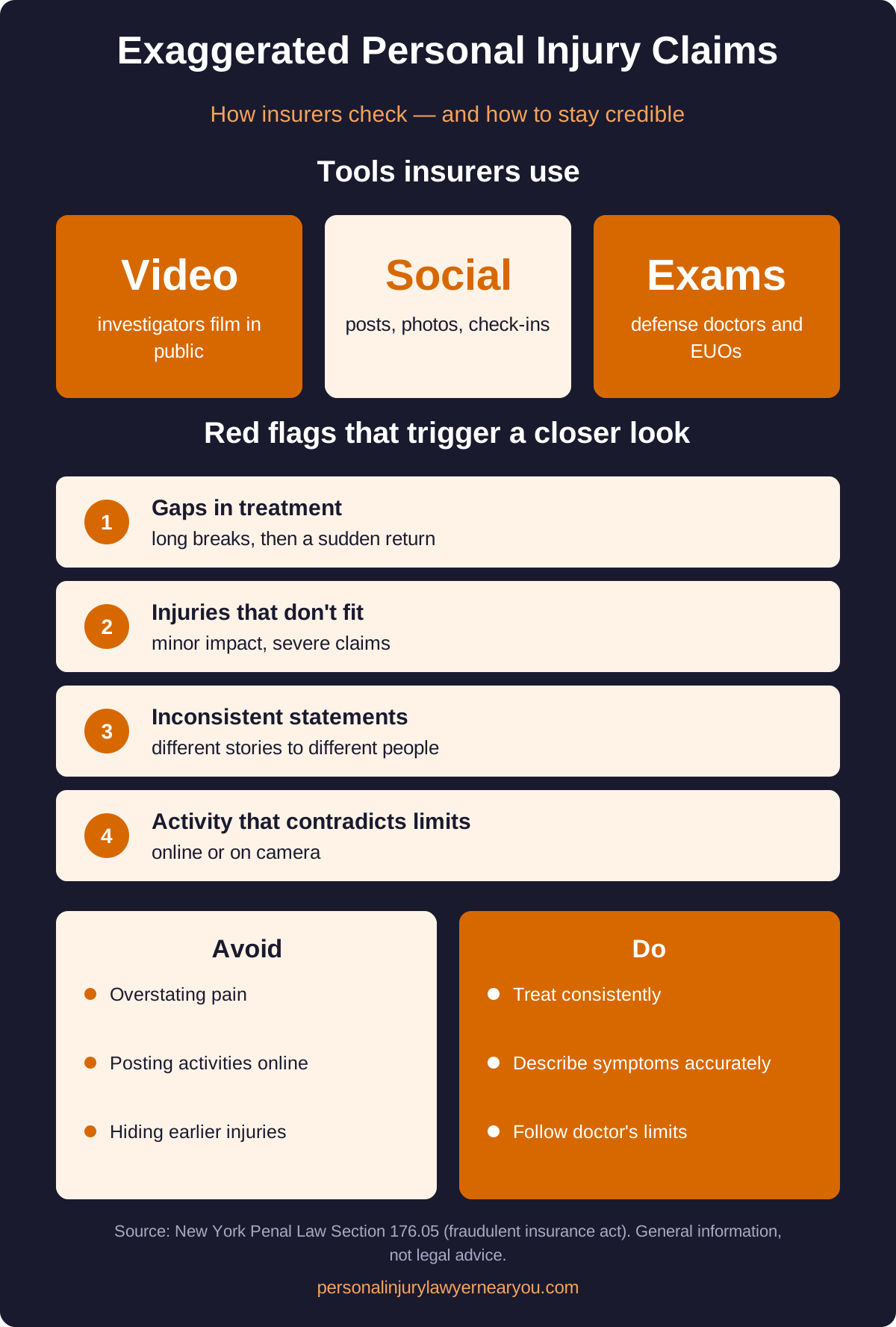
Insurers watch closely for exaggeration, and in larger claims they often use surveillance video, social media checks, claims databases and defense medical exams to test your story. Being caught overstating an injury can destroy the value of a real claim, and knowingly lying to an insurer can be insurance fraud under New York law. Honest, consistent claimants still get flagged sometimes, so the best protection is simple: treat consistently, describe symptoms accurately, follow medical advice and keep your activity off social media.
Exaggerated personal injury claims are what insurance companies are most on guard against, and they spend real money hunting for them. That matters even if you are completely honest. A genuine injury can still look exaggerated to an adjuster if your treatment has gaps, your statements don’t line up, or a video shows you on a good day.
This guide explains how insurers look for exaggeration, how surveillance in personal injury cases actually works, what the legal consequences are, and how to make sure a real claim reads as a real claim.
Why Insurers Focus on Exaggerated Personal Injury Claims
Insurers pay for injuries based on how serious they are and how long they last. A claim that adds a few months of treatment or an extra diagnosis can change the value a lot, so adjusters are trained to look for signs that symptoms are being overstated. Most large insurers have a special investigations unit, or SIU, whose job is to review suspicious claims.
There is an important difference between exaggeration and fraud. Overstating pain in a conversation is a credibility problem. Knowingly submitting false information to get paid is a crime. Under New York Penal Law, a fraudulent insurance act includes knowingly presenting false or misleading information to an insurer with intent to defraud, as well as staging a motor vehicle accident.
Red Flags That Trigger an Investigation
| Red flag | Why it worries the insurer |
|---|---|
| Injuries that don’t fit the crash | A very minor impact with very severe claimed injuries |
| Delayed treatment | First doctor visit weeks after the accident |
| Gaps in treatment | Long breaks, then a sudden return to care |
| Symptoms that keep growing | New complaints that appear months later without explanation |
| Inconsistent statements | Different stories to police, doctors, adjusters and at deposition |
| Prior similar claims | Earlier injury claims found in industry databases |
| Activity that contradicts limits | Social media or video showing activities you said you can’t do |
None of these proves exaggeration. People heal unevenly, some injuries worsen over time, and many people delay care because of work or cost. But each one makes an insurer look harder.
How Surveillance in Personal Injury Cases Works
Video surveillance
In bigger claims, insurers hire private investigators to film claimants in public: leaving home, shopping, carrying groceries, working, exercising. Footage is usually short and selective. A few minutes of you lifting a bag on a good day can be presented without the context of the bad days before and after.
Social media
Defense teams routinely look at public profiles, and in a lawsuit they can ask for relevant posts in discovery. Vacation photos, gym check-ins, sports or even friends tagging you at an event can be used to argue your injuries are less serious than claimed.
Claims databases
Insurers share claim information through industry databases. A history of earlier injuries or claims will be found, so it’s far better to tell your own lawyer and doctors about it upfront.
Defense medical exams
In a lawsuit, the defense will usually send you to an independent medical examination with a doctor it chooses. These doctors look for inconsistencies and “non-physiological” findings. Answer honestly, don’t overstate or minimize pain, and tell your lawyer afterwards what happened in the exam.
New York No-Fault: Exams Under Oath and IMEs
After a New York car crash, scrutiny can start long before any lawsuit. No-fault insurers can require you to attend independent medical examinations and, in some cases, an examination under oath, a recorded interview where you answer questions about the accident, your injuries and your treatment. Missing these appointments without a good reason can be grounds to deny no-fault benefits.
Treat both as seriously as a deposition. Bring accurate information, answer only what is asked and don’t guess. Our guide to New York no-fault insurance covers the deadlines and documents involved.
What to Do If You Think You’re Being Watched
- Don’t change your honest routine. Living normally within your doctor’s limits is exactly what the footage should show.
- Don’t confront the investigator. Note the date, time and vehicle if you can, and tell your lawyer.
- Don’t try to “perform” an injury. Exaggerating for a camera is the fastest way to lose credibility.
- Ask your lawyer about discovery. In a New York lawsuit, the defense generally has to disclose surveillance it plans to use before trial, so your side can review it and give context.
What Happens If a Claim Is Found to Be Exaggerated?
- Credibility collapses. Once a jury or adjuster believes one part of your story is overstated, they discount everything else, including the real parts.
- Settlement value drops. Offers fall sharply or disappear, and a case that was worth a fair amount can become very hard to settle.
- Claims can be denied. No-fault and liability insurers can deny benefits based on misrepresentation.
- Fraud consequences. Knowingly false claims can lead to criminal charges, repayment demands and civil suits from the insurer.
- Your lawyer may withdraw. Lawyers can’t present evidence they know is false.
That is why the “what not to say” advice matters from day one. Small exaggerations in early calls are a common way honest people damage good claims; our guide to what not to say to an insurance adjuster covers the phrases to avoid.
Real Injuries That Can Look Exaggerated
In fall cases, the same doubts appear in a different form, with insurers questioning whether the fall happened the way you describe; our article on apartment slip and fall claims in NYC shows how those cases are proven. Some genuine injuries are especially likely to be questioned because they don’t show up clearly on scans: soft-tissue neck and back injuries, concussions and mild brain injuries, chronic pain and psychological injuries such as post-traumatic stress. In New York car cases, these injuries also face the serious injury threshold, which got stricter in 2026, as our article on the serious injury threshold explains.
For these injuries, consistent treatment records, objective testing where possible, and doctors who explain the link to the accident are what carry the claim. Our guide to damages in a New York personal injury claim shows how each category is proven.
How to Keep a Real Claim Out of the Exaggerated Personal Injury Claims Pile
Most claimants are honest. The goal is to make sure the file shows it. These habits protect you.
Get treated early and stay consistent
See a doctor quickly after the accident and keep every appointment. Gaps are the single most common reason insurers argue an injury isn’t serious.
Describe symptoms accurately, not dramatically
Tell doctors exactly what hurts, when and how it limits you. Don’t round up and don’t play it down. Your records should read the same way you would describe your injury at a deposition.
Follow your doctor’s restrictions
If you are told not to lift or run, don’t. Apart from your recovery, doing restricted activities is exactly what surveillance is designed to catch.
Tell your lawyer about earlier injuries
A prior back injury doesn’t end a claim. New York law lets you recover when an accident makes an existing condition worse. Hiding it is what creates the problem.
Go quiet online
Set profiles to private, stop posting about activities and the case, and ask friends not to tag you. Don’t delete old posts without speaking to your lawyer, because deleting evidence can cause its own trouble.
Be careful with work and side jobs
If you are claiming lost wages, any work you do, even informal or cash jobs, should be disclosed to your lawyer. Undisclosed work is one of the most common things investigators document, and it can undo a wage claim entirely.
Keep a simple pain journal
A short daily note about pain levels, sleep and what you couldn’t do builds an honest record that explains the good days and the bad ones.
Be honest about good days
If you have days when you feel almost normal, say so. Claimants who admit that symptoms come and go are usually more believable than those who describe constant, unchanging pain, and good-day footage then fits the story instead of contradicting it.
Insurers will always look for exaggerated personal injury claims. A consistent, well-documented claimant gives them nothing to find, and that is what keeps settlement value where it belongs.
Should You Handle the Claim Yourself?
If your injury is minor and fault is clear, some people settle directly with the insurer, as our guide to a personal injury claim without a lawyer explains. If you have been told your claim looks suspicious, have a prior injury, or know you are under surveillance, it’s a good time to get advice.
Frequently Asked Questions
What happens if you exaggerate a personal injury claim?
If an insurer or jury believes you exaggerated, your credibility collapses and the value of the whole claim drops, often to nothing. A knowingly false statement to an insurer can also be insurance fraud under New York law, which is a crime, and the insurer may refuse to pay or sue to recover money already paid.
Do insurance companies use surveillance in personal injury cases?
Yes. In larger claims, insurers commonly hire investigators to film claimants in public places, check social media and search claims databases. Surveillance is most often used when the claimed injuries are serious, the treatment is long, or something in the file looks inconsistent.
Is it legal for an insurance company to follow me?
Generally, yes, in public places. Investigators can film you on the street, in a parking lot or at a gym open to the public. They cannot trespass, enter your home, wiretap you or record private conversations, and surveillance that crosses those lines can be challenged.
Can social media posts hurt my personal injury claim?
Yes. Photos, check-ins and comments are often reviewed by defense lawyers and can be requested in discovery. A single picture taken out of context, such as you lifting a child or at a party, can be used to argue your injuries are exaggerated.
How do insurers decide a claim might be exaggerated?
They look for mismatches: injuries that don’t fit the crash, gaps in treatment, sudden increases in symptoms, inconsistent statements, past similar claims and activity on social media or surveillance that contradicts what you’ve reported.
How do I avoid my injury claim looking exaggerated?
Report symptoms honestly and consistently, keep all medical appointments, follow your doctor’s restrictions, don’t overstate or understate limitations, mention earlier injuries to your lawyer and stay off social media until the case is resolved.
Key Takeaways
✅ Insurers actively look for exaggeration, especially in larger claims
✅ Surveillance video, social media, databases and defense exams are the main tools
✅ Being caught exaggerating can wipe out the value of a genuine claim
✅ Knowingly lying to an insurer can be insurance fraud under New York law
✅ Consistent treatment and honest, accurate reporting are the best protection
Being Questioned by an Insurer?
If an adjuster suggests your injuries are exaggerated, or you think you are being watched, a free case review can help you respond the right way and protect the value of a genuine claim.
Insurer Doubting Your Injury? Get a Free Case Review
Free case review. No win, no fee. No upfront cost.
Want more NYC injury guides and legal news from PILNY in your Google results?
