
TL;DR — Quick Summary
Your chances depend mostly on the type of case and the strength of your evidence. In national state-court data, plaintiffs won about half of tort trials — around 64% of motor vehicle trials but only about 23% of medical malpractice trials. Most cases never reach trial, so for most people “winning” means a fair settlement. Advertised “success rates” are not standardised and are hard to compare. What actually moves your odds: clear fault, consistent medical records, documented losses, your credibility, and enough insurance to pay.
People searching for a personal injury lawyer success rate usually want one number: what are the chances of winning a personal injury case? The honest answer is that it depends — but not in a vague way. The factors that decide personal injury cases are well understood, and many of them are within your control.
What the Data Says About Winning at Trial
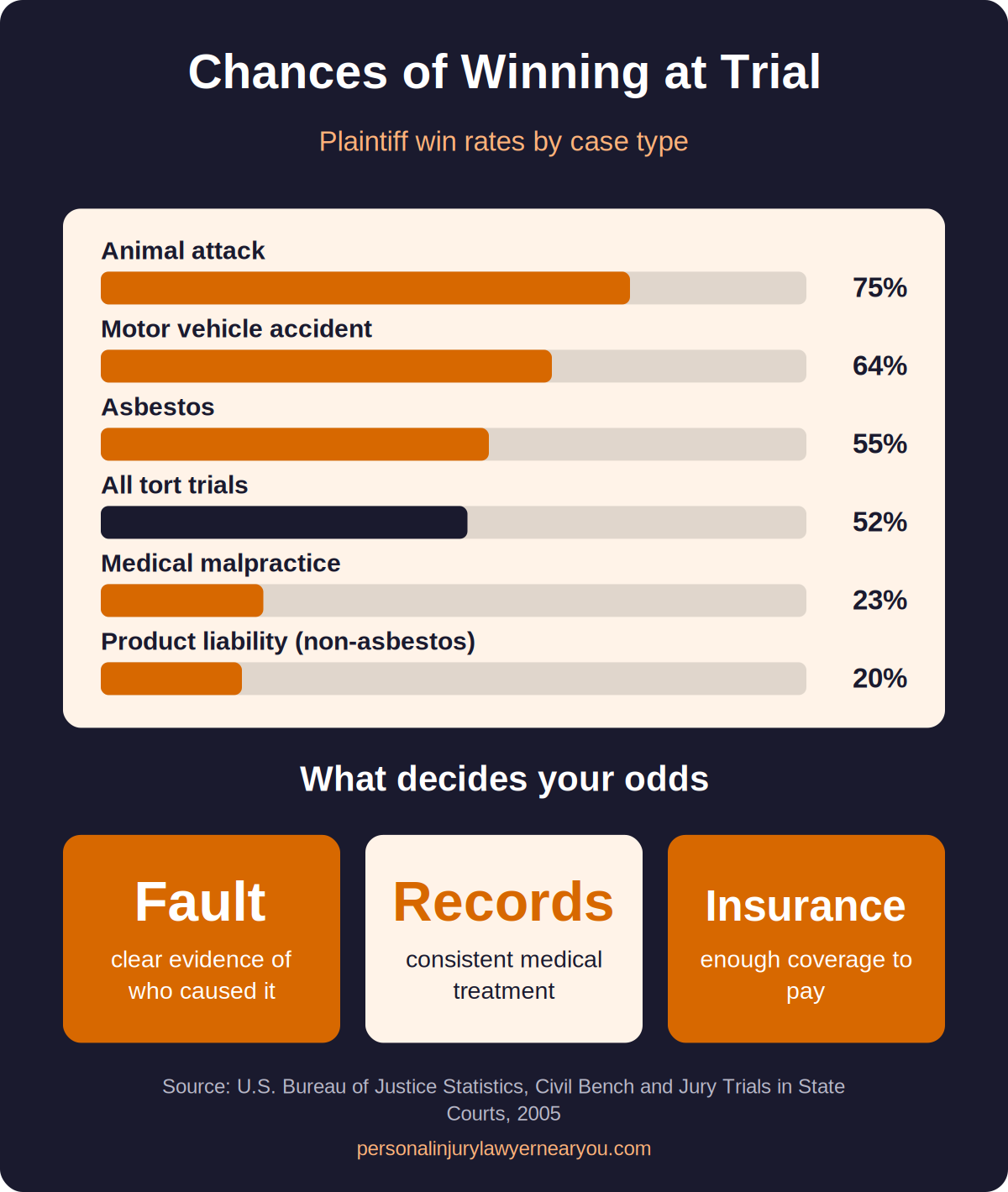
The most detailed national figures come from the Bureau of Justice Statistics study of civil trials in state courts. It found that plaintiffs won 52% of tort trials overall, with big differences by case type:
| Type of tort trial | Plaintiff win rate |
|---|---|
| Animal attack | 75% |
| Motor vehicle accident | 64% |
| Asbestos | 55% |
| All tort trials | 52% |
| Medical malpractice | 23% |
| Product liability (non-asbestos) | 20% |
Two cautions. First, these are trial results, and only a small fraction of cases go to trial — the ones that do are often the closest calls. Second, “winning” at trial can still mean a modest award. For most injured people, the realistic goal is a fair settlement, not a verdict.
Why “Success Rate” Claims Are Hard to Compare
There is no standard definition. One firm counts any case that paid anything; another only counts trial wins; another quietly declines hard cases to keep its numbers high. A “98% success rate” tells you very little. If you want to compare personal injury lawyers, ask questions that are harder to dress up:
- How many cases like mine have you handled in the last few years?
- How many have you taken to verdict, and what happened?
- How did your final results compare with the insurer’s first offers?
- Who will actually work on my file?
Our guide on how to find a personal injury lawyer covers the rest — and why a firm that settles everything fast, a settlement mill, can have a high “success rate” and still leave money on the table.
What Actually Decides Your Chances
| Factor | Strong case | Weak case |
|---|---|---|
| Fault | Rear-end crash, video, admitted mistake | Conflicting stories, no witnesses |
| Medical evidence | Same-day treatment, consistent records | Weeks before seeing a doctor, gaps in care |
| Causation | Clear link between accident and injury | Prior injuries to the same body part, unexplained |
| Credibility | Consistent account from day one | Changing story, exaggeration, social media posts |
| Collectibility | Commercial or well-insured defendant | Uninsured defendant with no assets |
Your own share of fault matters too. Under comparative fault rules, it can reduce what you recover — and in some states it can bar recovery entirely past a certain point.
How to Strengthen Your Personal Injury Case
- Get treated quickly, and keep going. Follow your doctor’s plan. Gaps are the defense’s favourite argument.
- Document every loss. Bills, receipts, missed workdays, and a short journal of pain and limitations.
- Preserve evidence. Photos, witness names, damaged property — and ask for video to be preserved quickly.
- Watch what you say. Know what not to say to an insurance adjuster, and stay off social media about the accident. Insurers check posts and use surveillance, as our guide to exaggerated personal injury claims explains.
- Do not settle early. Wait until doctors know how far you will recover.
- Bring in a lawyer early. Evidence and deadlines are easiest to protect at the start.
Maximising What a Strong Case Is Worth
Winning on liability is half the job. The other half is proving the full value of your losses — future treatment, lost earning capacity, and pain and suffering, not just the bills you already have. Our guide to personal injury damages lists every category, and the personal injury settlement calculator gives a rough starting range.
How Lawyers Estimate the Chances of Winning a Personal Injury Case
When a lawyer reviews your file, they are quietly answering two questions: how likely is a win on liability, and what would a win be worth? Together those decide the chances of winning a personal injury case and what a sensible settlement looks like.
Step 1: Liability
They look at the evidence of fault — reports, video, witnesses, admissions — and how a jury might see your own conduct. A rear-end crash with video might be close to certain; a disputed intersection collision with no witnesses might be closer to a coin flip.
Step 2: Damages
Next comes the realistic range of a verdict, based on your medical records, lost income, the permanence of the injury, and how similar cases have fared in your court.
Step 3: Putting them together
An illustrative example: if liability looks about 70% likely and a fair verdict might be around $200,000, the case has a rough risk-adjusted value of $140,000 before costs. That is not a prediction, but it explains why a lawyer may recommend accepting a solid offer on a shaky-liability case, and holding out on a clear one.
Factors that shift the estimate
- Venue — juries in different counties react differently to the same facts.
- Your credibility — consistency between your testimony and your records.
- The defendant — a sympathetic individual versus a corporation with poor safety records.
- Insurance limits — a strong case is still capped by what can actually be collected.
Ask any lawyer you meet to walk you through their view of these steps. A clear explanation of your chances of winning a personal injury case is worth far more than an advertised success rate.
Frequently Asked Questions
What are the chances of winning a personal injury lawsuit?
It depends heavily on the type of case. In a Bureau of Justice Statistics study of state court trials, plaintiffs won about half of tort trials overall, around 64% of motor vehicle trials, and only about 23% of medical malpractice trials. Most cases settle before trial.
What is a personal injury lawyer’s success rate?
There is no standard way to measure it, so firms’ advertised success rates are hard to compare. More useful questions are how many cases like yours the lawyer has handled, how many went to trial, and how the results compared with the insurer’s first offers.
What makes a personal injury case strong?
Clear evidence that someone else was at fault, consistent medical records linking the injury to the accident, documented financial losses, credible testimony, and enough insurance or assets to pay the claim.
How can I strengthen my personal injury case?
Get medical care quickly and follow your treatment plan, keep records of every expense and missed day of work, preserve photos and witness details, avoid recorded statements and social media posts about the accident, and involve a lawyer early.
Why do medical malpractice cases have lower win rates?
They are harder to prove. You must show the doctor fell below the accepted standard of care and that this caused your harm, which usually requires expert testimony, and the defense typically has strong experts of its own.
Does winning at trial guarantee I get paid?
Not always. The defendant may appeal, the award can be reduced, and collecting depends on available insurance or assets. That is one reason many people prefer a settlement they can count on.
Key Takeaways
✅ Plaintiffs win about half of tort trials — 64% in motor vehicle, 23% in medical malpractice
✅ Most cases settle, so “winning” usually means a fair settlement
✅ Advertised success rates are not standardised — ask about results instead
✅ Fault, medical records, credibility and insurance decide most cases
✅ Quick treatment and careful documentation strengthen any claim
Find Out How Strong Your Case Really Is
Statistics describe thousands of cases. Yours depends on your facts. A free personal injury consultation gives you an honest view of your strengths, weaknesses and likely value — before you decide anything.
Wondering If You Can Win? Get an Honest Answer
Free case review. No win, no fee. No upfront cost.
Want more NYC injury guides and legal news from PILNY in your Google results?
