
TL;DR — Quick Summary
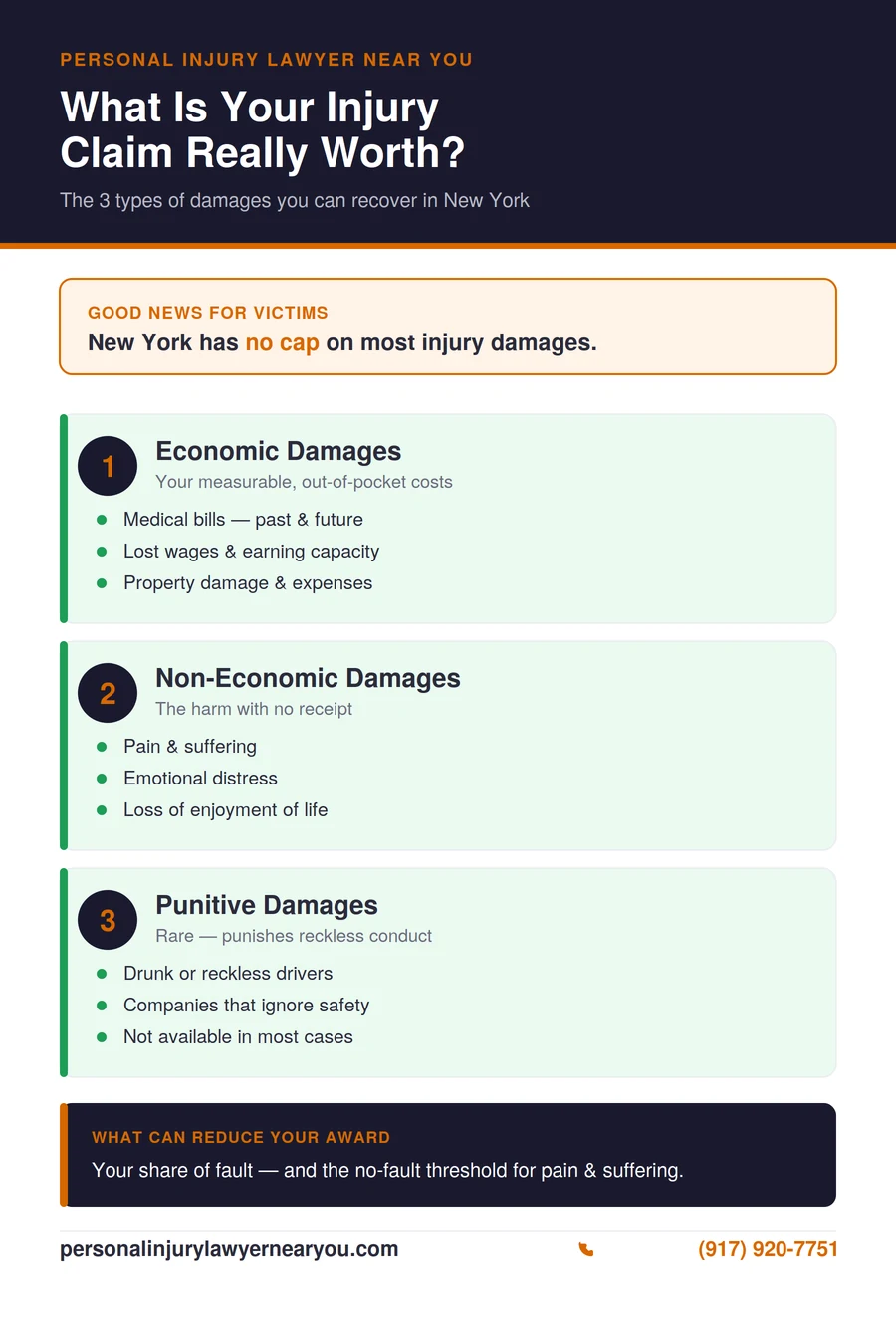
In a New York personal injury claim, you can recover far more than your medical bills. Personal injury damages fall into three main buckets: economic damages (medical costs, lost wages, future care), non-economic damages (pain and suffering, loss of enjoyment of life), and in rare cases punitive damages. New York has no cap on injury damages — but your recovery can be reduced by your share of fault, and auto cases must meet the “serious injury” threshold to claim pain and suffering. Here’s everything you may be owed.
Most injury victims dramatically underestimate what their case is worth — and insurance companies count on it. The truth is that personal injury damages in New York go well beyond the bills piling up on your kitchen table. They’re meant to make you whole for everything the injury cost you, both financially and personally.
This guide breaks down every category of damages you may be able to recover in a New York injury claim, what can reduce them, and how they’re actually proven.
Economic Damages — Your Hard Costs
Economic damages cover the measurable, out-of-pocket losses caused by your injury. These are the costs you can add up with bills, receipts, and pay stubs:
- Medical expenses — emergency care, surgery, hospital stays, physical therapy, medication, and medical devices.
- Lost wages — income you missed while recovering.
- Lost earning capacity — reduced ability to earn in the future if your injury is lasting.
- Property damage — repair or replacement of your vehicle or belongings.
- Out-of-pocket costs — transportation to treatment, household help, and other accident-related expenses.
Because these are documented, they form the backbone of your claim. A free personal injury settlement calculator can help you estimate them before you talk to an adjuster.
Non-Economic Damages — Pain, Suffering, and Loss
Non-economic damages compensate you for the harm that doesn’t come with a receipt — and in serious cases, they’re often the largest part of a claim. In New York, these include:
- Pain and suffering — physical pain and discomfort from the injury and treatment.
- Emotional distress — anxiety, depression, and psychological trauma.
- Loss of enjoyment of life — being unable to do the activities and hobbies you once could.
- Loss of consortium — the impact of your injury on your spouse and family relationships.
- Disfigurement and scarring — the lasting effect of permanent physical changes.
Unlike some states, New York places no cap on these damages in most injury cases. But there’s a catch for car accidents — you generally can’t recover pain and suffering unless your injury meets the state’s “serious injury” threshold, a rule tied to New York no-fault insurance. A Brooklyn personal injury lawyer can tell you whether your injury clears that bar.
Future Damages — What You’ll Still Need
Serious injuries don’t stop hurting when the case settles. New York law lets you recover for losses you’ll continue to face, including future medical treatment, ongoing therapy, future surgeries, and future lost income if you can’t return to the same work.
These future damages are often the difference between a settlement that barely covers today’s bills and one that actually protects you long term. They usually require medical and economic experts to project — which is exactly why accepting a quick offer before your prognosis is clear can be so costly.
Punitive Damages — The Rare Extra
In a small number of cases, New York allows punitive damages — money meant not to compensate you, but to punish the wrongdoer and deter similar conduct. These are reserved for truly egregious behavior, such as a drunk driver or a company that recklessly disregarded safety.
Punitive damages are the exception, not the rule, and most ordinary negligence cases don’t qualify. But where the conduct was especially reckless, they can significantly increase what you recover.
What Can Reduce Your Damages
Two things commonly shrink an injury award in New York:
- Comparative negligence — New York follows a comparative negligence rule, so if you were partly at fault, your damages are reduced by your percentage of responsibility. Being 20% at fault means a 20% reduction, not a denial.
- The no-fault threshold — in auto cases, you must meet the serious injury threshold to recover non-economic damages like pain and suffering.
Insurers aggressively use both to cut what they pay. Knowing how they apply to your case — and pushing back — is where experienced representation makes the biggest difference. A Manhattan personal injury lawyer can protect the full value of your claim.
How Damages Are Proven
Damages aren’t just claimed — they’re documented. Economic damages are shown with medical records, bills, and wage statements. Non-economic damages are proven through medical testimony, your own account of how the injury changed your life, and sometimes testimony from family and experts. Future damages rely on medical prognoses and economic projections.
The stronger and more complete your documentation, the harder it is for an insurer to lowball you. For a sense of how these numbers play out in real cases, our guide to average personal injury settlement amounts in New York is a useful reference.
Key Takeaways
✅ Personal injury damages in New York include economic, non-economic, and rarely punitive damages
✅ Economic damages cover medical bills, lost wages, and future care and income
✅ Non-economic damages cover pain and suffering, emotional distress, and loss of enjoyment of life
✅ New York has no cap on injury damages, but comparative negligence can reduce your recovery
✅ Auto cases require meeting the serious injury threshold to recover pain and suffering
Frequently Asked Questions
What damages can I recover in a New York personal injury claim?
You can recover economic damages like medical bills, lost wages, and future care, plus non-economic damages like pain and suffering, emotional distress, and loss of enjoyment of life. In rare cases involving reckless conduct, punitive damages may also be available.
Can I recover pain and suffering after a car accident in New York?
Yes, but only if your injury meets New York’s serious injury threshold. Because New York is a no-fault state, pain and suffering is only recoverable in auto cases when the injury is serious enough to step outside the no-fault system.
Is there a cap on personal injury damages in New York?
No. Unlike some states, New York does not cap most personal injury damages. However, your total recovery can still be reduced by your share of fault under the state’s comparative negligence rule.
What are punitive damages and when are they awarded?
Punitive damages are meant to punish especially reckless or malicious conduct rather than compensate the victim. They are rare in New York and reserved for egregious cases, such as a drunk driver or a company that knowingly ignored safety.
How is pain and suffering calculated?
There is no fixed formula. Pain and suffering depends on the severity and permanence of your injury, the length of your recovery, and how it affects your daily life. It is proven through medical testimony and your own account, and it is often the largest part of a serious claim.
Get a Free Case Review
Wondering what your injury is really worth? Most people leave money on the table because they never learn everything they’re owed. Get a free, no-obligation case review today and find out the full value of your claim — before you accept any offer.
Find Out What Your Injury Claim Is Really Worth
Free case review. No win, no fee. No upfront cost.
Want more NYC injury guides and legal news from PILNY in your Google results?
