
Hurt in a Manhattan Slip and Fall? Property Owners Are Protected. Now You Should Be Too.
Manhattan’s sidewalks, subway stations, retail stores, and apartment buildings see thousands of slip and fall accidents every year. Property owners know their legal exposure — and they have insurance teams ready to minimize what they pay. We connect injured Manhattan victims with experienced slip and fall lawyers who fight back.
Free Consultation - No Obligation
Response within 2 hours.
Slip and Fall Accidents in Manhattan Are More Serious — and More Legally Complex — Than Most People Realize
Manhattan’s density creates hazards that exist nowhere else. Wet lobby floors in luxury apartment buildings. Broken subway station stairs. Uneven Midtown sidewalks. Ice-covered building entrances that property managers knew about and ignored.
When you fall in Manhattan, you don’t just suffer physical injuries. You enter a legal environment where the property owner’s insurance team moves fast — and where your ability to recover depends entirely on how quickly you act.
Slip and Fall or Trip and Fall in Manhattan — Does the Difference Matter?
Legally, no. Both are premises liability claims judged by the same standard: did the owner create the hazard, or know about it and fail to fix it within a reasonable time?
Practically, the words just describe the mechanism. A slip is a loss of traction on a wet, greasy, or icy surface. A trip and fall is catching a foot on something raised, broken, or obstructing the path — uneven sidewalk flags, raised tree well edges, cellar doors, worn thresholds, torn lobby carpeting. A Manhattan slip and trip fall lawyer builds both the same way. The mechanism only changes what your photographs need to show.
Common Manhattan Slip and Fall Scenarios Include:
The location of your fall determines who is liable — and how your claim is built.
- Wet floors in Manhattan retail stores, restaurants, and hotel lobbies
- Broken or uneven sidewalks — in most of Manhattan the abutting property owner is liable, not the City
- Icy building entrances and poorly maintained steps in residential and commercial properties
- Defective subway station stairs and platforms maintained by the MTA
- Unmarked hazards in Midtown office buildings and commercial spaces
- Construction zone hazards — exposed surfaces, debris, and poor lighting
Our Best Personal Injury Practices in Manhattan, NY
PILNY connects slip and fall victims with experienced attorneys across every personal injury case type in Manhattan — no fees, no pressure, no obligation.
The Property Owner's Insurance Team Opened Your File Before You Left the Scene
The moment a slip and fall is reported in Manhattan — whether in a retail store, apartment building, or city sidewalk — an insurance adjuster gets involved.
Their job is not to help you recover. Their job is to find every reason to deny your claim or reduce what they pay.
They will question whether the hazard actually existed. They will argue you were not paying attention. They will claim the property was properly maintained. And they will move fast — before you have legal representation, before you understand your rights, and before you know what your case is actually worth.
A personal injury lawyer in Manhattan changes that dynamic completely — from day one.


Premises Liability Law
In New York, property owners have a legal duty to maintain safe conditions for visitors. When they fail — through negligence, delayed repairs, or ignored hazards — they are liable for injuries that result. Proving this duty was breached is the foundation of every successful Manhattan slip and fall claim.
Who Owns the Sidewalk Changes Everything
Since 2003, NYC Administrative Code § 7-210 has shifted sidewalk liability from the City to the owner of the abutting property. In most of Manhattan — commercial buildings, apartment towers, mixed-use properties — your claim is against that owner, and you have three years to file. The City remains liable only in narrow situations, such as owner-occupied one-to-three family homes, city-owned land, and parks, where a Notice of Claim is due within 90 days. Identifying the right defendant early is the whole ballgame.
Evidence Disappears Immediately
Wet floor signs get removed. Surveillance footage is often recorded over within days. Hazardous conditions get repaired before anyone documents them. An attorney acting immediately can preserve the evidence that proves your case before it disappears.
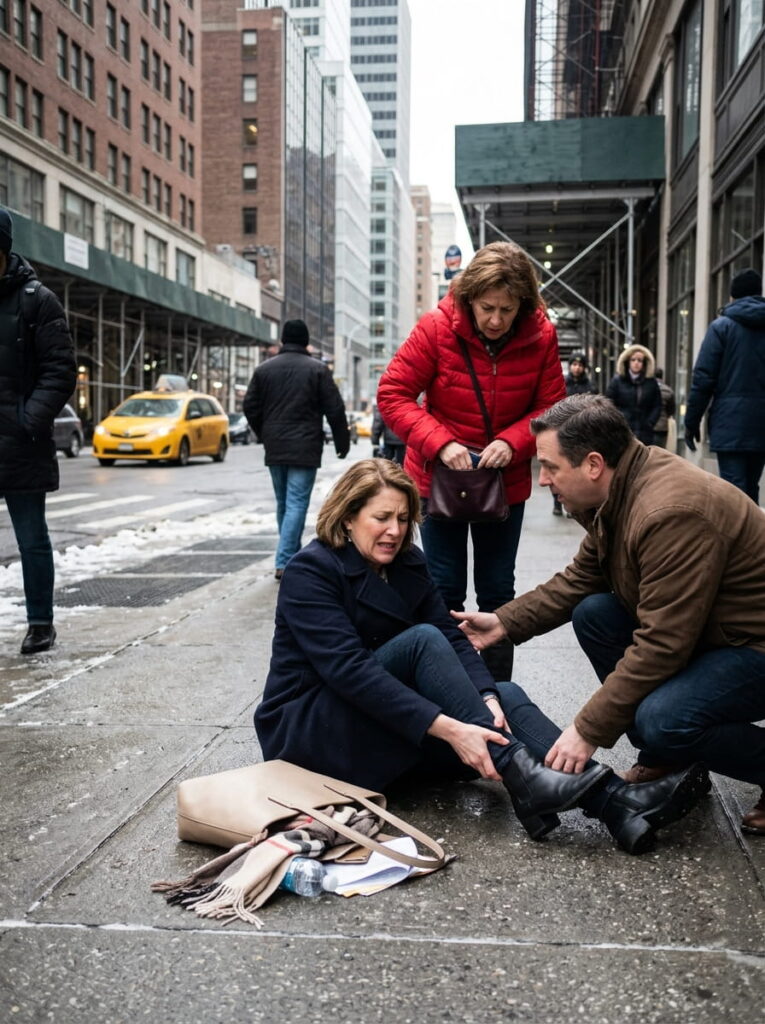
One Fall. A Financial Burden That Lasts Far Longer Than the Bruises.
A Manhattan slip and fall does not just cause physical pain. It creates financial pressure that builds fast — and that property owners are counting on you being too overwhelmed to fight.
Emergency room visits. Orthopedic specialists. Physical therapy that stretches for months. Missed workdays. Lost freelance income. And medical bills from Manhattan hospitals — among the highest in the country.
The property owner’s insurer will offer a fast settlement. It will feel like relief. It is not relief — it is a strategy to close your claim permanently before you understand its full value.
Every day without legal representation is a day the property owner’s team gets stronger — and unlike a car crash, where a Manhattan car accident lawyer can lean on no-fault PIP, a fall victim has no automatic coverage, so the pressure to settle cheap is worse.
Common Causes of Slip and Fall Accidents in Manhattan
Manhattan slip and fall accidents follow specific patterns — and experienced attorneys know exactly how to document each one.
Common causes include:
- Wet or slippery floors without warning signs in stores, lobbies, and restaurants
- Uneven or cracked sidewalks — particularly in high-foot-traffic Midtown corridors
- Ice and snow accumulation on building entrances and steps
- Poor lighting in stairwells, parking garages, and building common areas
- Defective handrails and broken steps in residential and commercial buildings
- Construction zone hazards — debris, exposed surfaces, and unmarked drop-offs
- MTA subway station hazards — wet platforms, broken stairs, and poor maintenance
Whatever caused your fall, acting fast matters — the same hazards a Bronx slip and fall injury lawyer documents across the borough line, especially if the City of New York is involved.
Injuries After a Manhattan Slip and Fall Accident
Slip and fall injuries in Manhattan are frequently more severe than victims initially realize — and they often worsen significantly without early treatment.
Common injuries include:
- Hip fractures — particularly serious for older victims, often requiring surgery
- Knee injuries — torn ligaments and cartilage damage from impact and twisting
- Wrist and arm fractures from instinctive attempts to break the fall
- Traumatic brain injuries from head strikes against floors or steps
- Spinal injuries — herniated discs and nerve damage from sudden impact
- Shoulder injuries — rotator cuff tears and dislocations
- Soft tissue injuries that don't appear on immediate scans but cause lasting pain
These injuries carry costs that extend far beyond the initial emergency room visit. Know what your case may be worth — use our personal injury settlement calculator before accepting anything from any insurer.
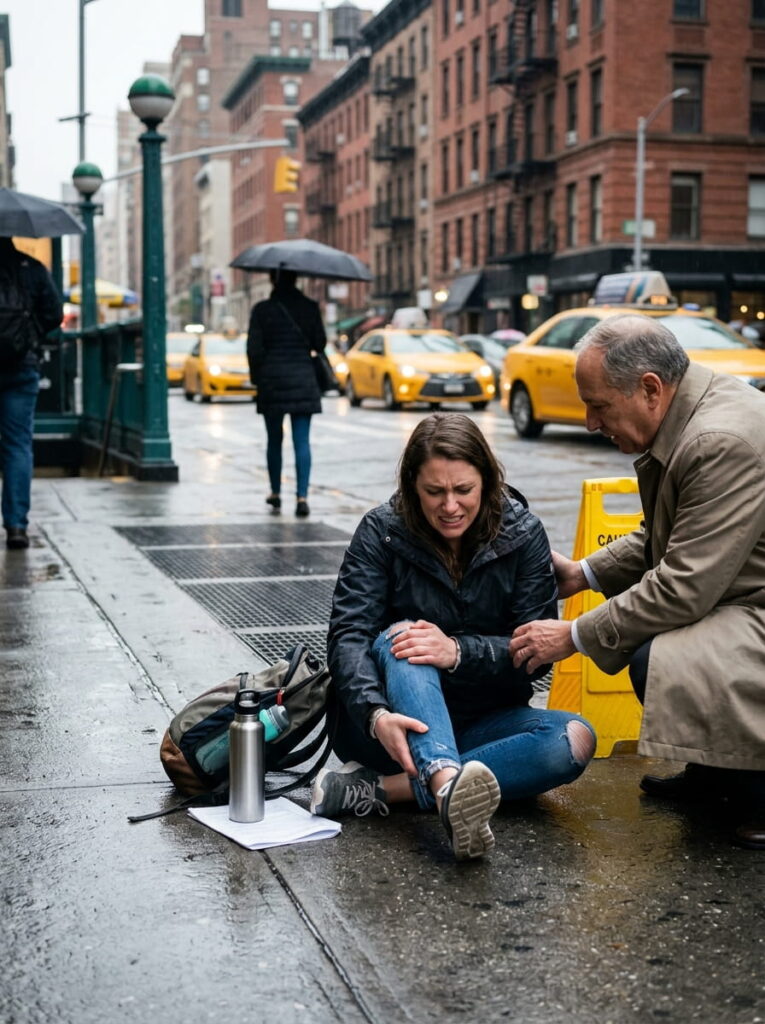
What to Do After a Slip and Fall Accident in Manhattan
How you respond in the first few hours after a Manhattan slip and fall shapes your entire claim — the same first-hours discipline in our guide on what to do after a car accident in Manhattan applies to a fall, too.
- Report the incident immediately — to the store manager, building supervisor, or property owner
- Request a written incident report — and get a copy before you leave
- Photograph the hazard that caused your fall — before it is cleaned up or repaired
- Photograph your injuries — visible bruising, swelling, and cuts
- Collect witness names, phone numbers, and email addresses
- Seek medical attention the same day — even if pain feels minor
- Do not sign any document from the property owner or their insurer
- Contact a Manhattan slip and fall lawyer before making any statement

Who Is Responsible for Your Manhattan Slip and Fall?
Liability in a Manhattan slip and fall depends on who owned, controlled, or maintained the property where you fell — and whether they knew or should have known about the hazard.
Property owners, retail businesses, restaurants, landlords, and the City of New York can all be held liable depending on where your accident occurred. New York’s comparative fault law means partial fault does not eliminate your claim — your compensation reduces by your percentage of fault, but you can still recover.
Sidewalks are the most misunderstood category. Since 2003, NYC Administrative Code § 7-210 has placed that duty on the owner of the abutting property, so in most of Manhattan your claim runs against a building owner and you have three years. The 90-day Notice of Claim applies only where the City or the MTA is genuinely the responsible party — a subway station, a park, or city-owned land. Getting the defendant right early is why a Manhattan personal injury claim lawyer matters from day one.
What Compensation May Cover After a Manhattan Slip and Fall
Compensation in a Manhattan slip and fall case may include:
- Emergency treatment, surgeries, and hospital costs
- Ongoing medical care and specialist consultations
- Lost wages — including freelance and gig income
- Pain and suffering — physical and emotional
- Long-term rehabilitation and physical therapy
- Future medical expenses for permanent injuries
- Loss of enjoyment of life in severe cases
Before you accept anything, the average personal injury settlement amounts in New York show what your slip and fall case may be worth.
Dealing With Property Owners and Insurance Companies in Manhattan
Manhattan property owners — from luxury building landlords to retail chains to the City of New York — carry liability insurance specifically designed to handle slip and fall claims. These policies are managed by experienced claims teams whose job is to pay as little as possible.
You may face pressure to give recorded statements, accept early offers, or sign documents that permanently close your claim. Never do any of these things without a Manhattan slip and fall attorney reviewing your case first.
Learn more about what to expect from a personal injury attorney consultation in New York — and what questions to ask before you hire anyone.
Who to Claim Against After a Manhattan Fall
In Manhattan the right defendant depends almost entirely on where you fell:
| Where you fell | Usually responsible | Deadline to watch |
|---|---|---|
| Store, restaurant or office lobby | The owner or the tenant in control of the space | 3 years |
| Sidewalk in front of a commercial or large residential building | The building owner, under Administrative Code § 7-210 | 3 years |
| Apartment building stairs or hallway | The landlord or managing agent | 3 years |
| Subway station stairs or platform | The MTA / New York City Transit | 90-day notice of claim |
| NYCHA building or City property | NYCHA or the City of New York | 90-day notice of claim |
Manhattan slip and fall lawsuits are filed in New York State Supreme Court, New York County, at 60 Centre Street. Our guide to Manhattan sidewalk falls and § 7-210 goes deeper on sidewalk cases.
Manhattan Construction Site Slip, Trip, and Fall Accidents
Construction sites follow a different set of rules entirely. Manhattan runs thousands of active sites at any moment, and where you were standing when you fell decides which law applies to your claim.
If You Were Working on the Site
New York Labor Law gives construction workers protection that exists nowhere else in the country:
- Labor Law § 240, the Scaffold Law — absolute liability on owners and general contractors for gravity-related injuries: falls from scaffolds, ladders, roofs, and floor openings, or being struck by unsecured falling objects. You do not have to prove negligence, your own carelessness is not a defense, and the duty cannot be contracted away.
- Labor Law § 241(6) — covers wider site hazards such as slippery surfaces, debris, poor lighting, and unguarded openings, but requires pointing to a specific Industrial Code violation rather than a general safety complaint.
- Workers’ compensation is not your only option — a Labor Law claim runs alongside it and reaches pain and suffering and full lost wages, which comp does not cover. Electricians, plumbers, painters, cleaners, and demolition crews all qualify when the work fits the statute.
If You Were Just Walking Past
A fall on a scaffold-covered sidewalk, uneven steel plating, hoses, or debris is a different claim. The Scaffold Law does not apply, but the contractor, site owner, or permit holder may still be liable. DOB permit records identify exactly who controlled that area on the day you fell — and conditions on an active site change daily, so the hazard that injured you may not exist tomorrow.
Either way, a Manhattan personal injury claim involving a construction site needs an investigator on it early, while the site still looks the way it did when you fell.
Frequently Asked Questions
Three years for standard premises liability claims. Most Manhattan sidewalk falls fall into this category, because NYC Administrative Code § 7-210 makes the abutting property owner — not the City — responsible for the sidewalk. The 90-day Notice of Claim deadline applies only where the City or the MTA is actually the responsible party, such as a subway station, a park, or city-owned land.
Liability depends on who owned or controlled the property. Retail stores, landlords, building managers, restaurants, and the City of New York can all be held responsible depending on where and how the accident occurred.
New York's comparative fault law allows you to recover even with partial responsibility. Your compensation reduces by your fault percentage — but partial fault does not eliminate your claim.
Surveillance footage, incident reports, maintenance records, and witness accounts can all establish that the hazard existed. An attorney can subpoena these records before they are destroyed.
Injury severity, medical costs, lost income, and long-term impact all determine your number. Manhattan cases often carry significant value — particularly when serious injuries like hip fractures, spinal damage, or TBI are involved.
Yes. Premises liability cases involve specific legal standards, strict filing deadlines, and insurance companies experienced at minimizing claims. An attorney ensures your rights are protected from day one.
Never sign anything from the property owner or their insurer. Never give a recorded statement without legal counsel. Never accept a first settlement offer before understanding your case's full value.
Get Help From a Manhattan Slip and Fall Lawyer — Today
The property owner is already protected. Their insurer is already working. Every day you wait, the evidence gets harder to preserve and the other side gets stronger.
One conversation with a Manhattan slip and fall attorney costs nothing — and protects everything.
Call Now — No Fee Unless You Win