
TL;DR — Quick Summary
Yes — depositions are one of the most common turning points for settlement. Once both sides have heard the key witnesses under oath, most of the guesswork about trial disappears, and insurers re-value the claim. Many cases settle in the weeks or months after depositions, often at mediation. Your own testimony matters: a calm, consistent, honest deposition tends to raise the offer, while contradictions and exaggeration give the defense a reason to cut it.
Do personal injury cases settle after deposition? Very often, yes. The deposition is usually the first time the insurer’s lawyer sees you answer questions under oath — and the first time your lawyer pins down the other driver or property owner’s version of events. After that, both sides know far more about how a jury would react.
Here is what a deposition is, why it moves cases toward settlement, how long things usually take afterwards, and how your testimony affects the number.
What Is a Deposition in a Personal Injury Case?
A deposition is sworn testimony given outside the courtroom, during the discovery stage of a lawsuit. The opposing lawyer asks questions, you answer under oath, and a court reporter records every word. There is no judge or jury present. Defendants and key witnesses are deposed too.
In federal court, Rule 30 of the Federal Rules of Civil Procedure limits a deposition to one day of seven hours unless the parties agree otherwise or the court orders more, and gives the witness 30 days to review the transcript and note corrections if review is requested. State courts have their own rules, but the process looks much the same. Depositions only happen once a lawsuit is filed — one stage in the overall personal injury claim process.
Why So Many Cases Settle After Depositions
Before depositions, each side is valuing the case partly on assumptions. Afterwards, they are valuing it on evidence. Four things change:
- Credibility is tested. The defense lawyer now knows whether you come across as honest and sympathetic — exactly what a jury would judge.
- Stories are locked in. Sworn testimony is hard to change later. If the defendant admits to looking at a phone or ignoring a spill, that admission stays.
- Weak points surface. Both sides learn which arguments will hold up and which will not.
- Trial costs come into view. After depositions come expert reports, medical examinations and trial preparation — all expensive. Settling now avoids them.
| Whose deposition | What it tells the other side |
|---|---|
| Yours | How believable you are, how the injury affects daily life, and whether your account matches your records |
| The defendant’s | Admissions about speed, distraction, inspections or warnings — and how they would hold up on cross-examination |
| Witnesses | Whether independent people back up your version of events |
| Company staff (in business cases) | What policies existed, whether they were followed, and what records were kept |
How Long After a Deposition Does a Case Settle?
There is no fixed timeline, but a typical sequence looks like this:
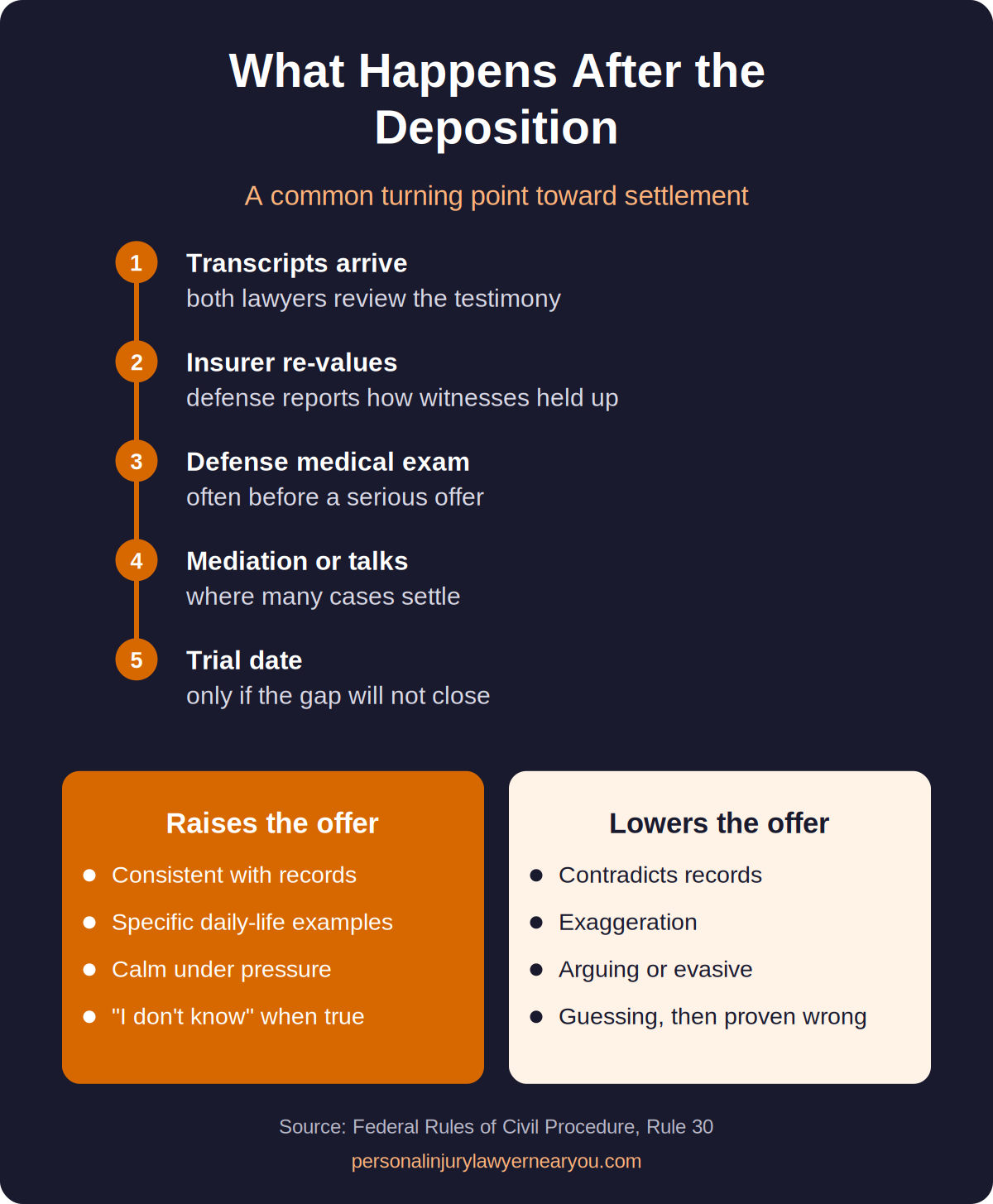
- Transcripts arrive. The court reporter prepares the written record, and both lawyers review it.
- The insurer re-values the claim. The defense lawyer reports to the insurance company on how the depositions went.
- A medical examination may follow. The defense often has its own doctor examine you before making a serious offer.
- Mediation or direct negotiation. This is where many post-deposition settlements actually happen.
Some cases settle within weeks. Others take several months, especially when experts are involved or several defendants have to agree on how to split the payment.
How Your Deposition Affects the Settlement Offer
| Tends to raise the offer | Tends to lower the offer |
|---|---|
| Clear, consistent account that matches the records | Answers that contradict medical records or earlier statements |
| Specific, concrete examples of how the injury changed daily life | Exaggeration that the defense can disprove |
| Calm, polite demeanour under pressure | Arguing with the lawyer or appearing evasive |
| Saying “I don’t know” or “I don’t remember” when that is true | Guessing, then being proven wrong |
Consistency starts long before the deposition. Everything you told the insurance company early on can be read back to you, which is why it matters what you say to an insurance adjuster in the first days after an accident. Insurers also compare your testimony with surveillance video and social media, which is how most exaggerated personal injury claims are caught.
Your testimony about pain, limits and missed work is also how the defense measures the non-economic side of your claim — the part covered in our guide to personal injury damages.
What If the Case Doesn’t Settle After Depositions?
Then the case keeps moving: expert reports, any remaining discovery, often a court-ordered or voluntary mediation, and eventually a trial date. Settlement remains possible at every step — many cases resolve shortly before trial, once both sides face the real cost and risk of a verdict. For a sense of how injury, liability and insurance shape the final figure, see what an accident case is worth.
Five Rules for Your Own Deposition
- Prepare with your lawyer. Review your medical records, your timeline and any earlier statements.
- Listen to the whole question. Pause before answering, and answer only what was asked.
- Never guess. “I don’t know” is a complete answer when it is true.
- Be specific about your injuries. Real examples are more convincing than general complaints.
- Stay calm. The defense lawyer may be testing how you would handle cross-examination at trial.
Do Personal Injury Cases Settle After Deposition Every Time?
No. Depositions often move a case toward settlement, but some situations keep the two sides apart even after everyone has testified. Knowing them helps you set realistic expectations.
When settlement usually waits
- The insurer wants its own medical exam first. Many defense teams will not make a serious offer until their doctor has examined you.
- Causation is disputed. If the defense argues your injury came from an earlier accident or a degenerative condition, both sides may need expert reports before they can value the case.
- Several defendants disagree on who pays. Even when liability is clear overall, co-defendants can take months to agree on their shares.
- Coverage is in question. If an insurer is disputing whether its policy applies at all, settlement talks often stall until that is resolved.
Signs a settlement may be close
- The defense lawyer asks for updated medical bills or lost-wage records.
- A mediation date is proposed or ordered.
- The insurer increases its offer without being asked.
- The defense stops scheduling further depositions or discovery.
So do personal injury cases settle after deposition? Many do, and the deposition is often the moment the numbers start to move. But if your case is in one of the situations above, a pause is normal, not a bad sign. Ask your lawyer which hurdle is left and roughly how long it should take to clear.
Frequently Asked Questions
Do personal injury cases settle after deposition?
Often, yes. Depositions show both sides how the key witnesses come across under oath, which removes much of the guesswork about trial. Many cases settle in the weeks or months after depositions, frequently at mediation, though there is no guarantee.
How long after a deposition does a case settle?
There is no set timeline. Some cases settle within weeks, once the transcripts are reviewed and the insurer re-values the claim. Others need a medical examination, mediation or more discovery first, which can take several months.
Can a bad deposition hurt my settlement?
Yes. Answers that contradict your medical records or earlier statements, exaggeration, or guessing instead of saying you do not know can give the defense grounds to lower its offer. Careful preparation with your lawyer is the best protection.
How long does a personal injury deposition last?
Many take a few hours. In federal court, a deposition is limited to one day of seven hours unless the parties agree otherwise or the court orders more. State rules vary.
Who attends a deposition?
Usually you, your lawyer, the defense lawyer and a court reporter who records everything under oath. Sometimes a videographer or other parties’ lawyers attend too. There is no judge or jury in the room.
Is a deposition a sign my case is going to trial?
No. Depositions are a normal part of almost every lawsuit’s discovery stage. They are used to gather evidence and test the case, and most cases that go through depositions still settle before trial.
Key Takeaways
✅ Depositions are one of the most common turning points toward settlement
✅ Sworn testimony replaces guesswork, so insurers re-value the claim
✅ Settlement can follow within weeks or take several months
✅ Consistent, honest, specific testimony tends to raise the offer
✅ A deposition does not mean your case is headed to trial
Deposition Coming Up? Don’t Go In Unprepared
A few hours under oath can move your settlement up or down. If you are facing a deposition — or an insurer is still stalling after one — a free personal injury consultation is the place to find out where your case really stands.
Case Stuck After Depositions? Get a Straight Answer
Free case review. No win, no fee. No upfront cost.
Want more NYC injury guides and legal news from PILNY in your Google results?
