
TL;DR — Quick Summary
Very few personal injury cases go to trial — about 4% of tort cases in a national study of state courts. Most settle, either before a lawsuit is filed or somewhere along the way: after depositions, at mediation, or even on the courthouse steps. A case usually goes to trial only when fault is genuinely disputed or the insurer’s offer is far below what the injuries are worth. The lawyers who get the best settlements are the ones insurers believe will actually go to trial.
What percentage of personal injury cases go to trial? Far fewer than most people expect. Television makes every injury case look like a courtroom drama, but the real work of a personal injury claim happens in records requests, depositions and negotiations — and the large majority end in a settlement.
That does not mean trial is irrelevant. The possibility of a jury is what gives a settlement its value. Here is how often cases really go to trial, why most do not, and what changes if yours does.
What Percentage of Personal Injury Cases Go to Trial?
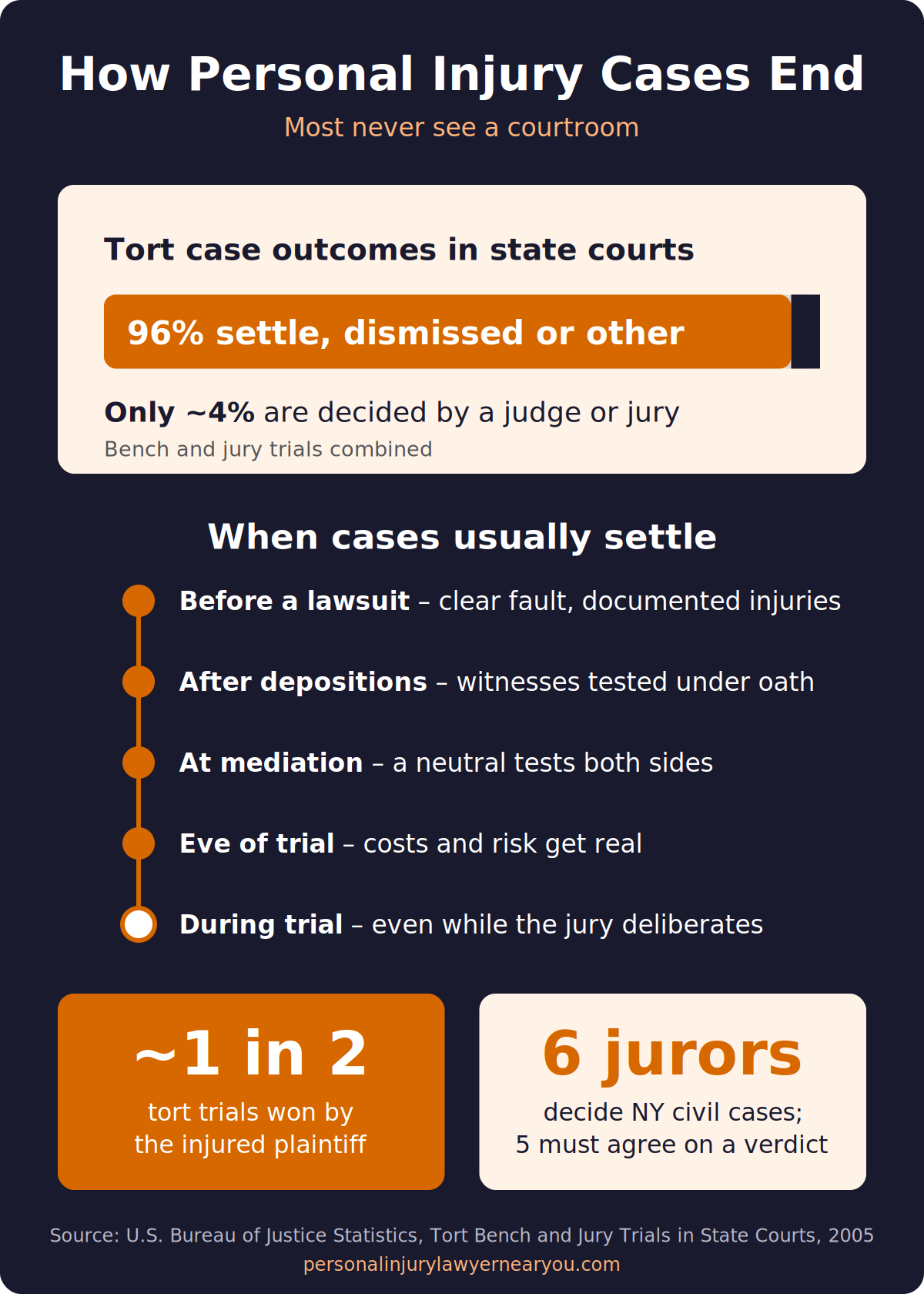
The best national data comes from the Bureau of Justice Statistics study of tort trials in state courts. It found that bench and jury trials together accounted for an estimated 4% of all tort case outcomes. The other 96% settled, were dismissed, or ended some other way.
Even that figure overstates the real-world trial rate, because it only counts cases where a lawsuit was filed. A large share of personal injury claims settle with the insurance company before anyone goes to court at all. The study also found that plaintiffs won only about half of the tort trials that did happen — one reason both sides work so hard to settle.
Why Do Most Personal Injury Cases Settle?
| Factor | Settlement | Trial |
|---|---|---|
| Outcome | Guaranteed amount you agree to | Could be more, less, or nothing |
| Speed | Paid within weeks of agreeing | Months or years waiting for a trial date, plus possible appeals |
| Cost | Lower case expenses | Expert witnesses and trial preparation add up; fee percentage is often higher |
| Privacy | Terms often confidential | Public courtroom and public record |
| Control | You decide whether to accept | Six strangers decide |
Insurers have their own reasons to settle: trials are expensive for them too, and a sympathetic plaintiff in front of a jury is a risk they cannot price. That is why the bulk of cases settle once both sides have enough information to value them — usually after medical treatment has stabilised and the key evidence has been exchanged. If you want to see where those stages fall, our step-by-step guide on how to file a personal injury claim maps the whole process.
Why Do Some Personal Injury Cases Go to Trial?
A case goes to trial when the two sides cannot close the gap between them. The usual reasons are:
- Disputed liability. The defendant genuinely believes it was not at fault, or that you were mostly to blame.
- A big valuation gap. The insurer values pain and suffering far lower than your lawyer does — common with injuries that do not show on an X-ray.
- A hard-line insurer. Some insurers make low offers on principle and wait to see whether the plaintiff’s lawyer will really try the case.
- Credibility questions. Gaps in treatment, prior injuries, or inconsistent statements give the defense something to argue.
- A point of law. Occasionally a case needs a court to decide a legal question, such as who owed a duty of care.
Some of those risks start on day one. A casual recorded statement can become the defense’s best exhibit, which is why it pays to know what not to say to an insurance adjuster.
Will My Personal Injury Case Go to Trial?
Probably not — but filing a lawsuit is not the same as going to trial. Lawyers often file suit simply to stop the statute of limitations from running out, or to get access to evidence through discovery. Settlement chances rise at several points along the way:
| Stage | Why cases often settle here |
|---|---|
| Before a lawsuit | Clear fault and documented injuries leave little to argue about |
| After depositions | Both sides have seen how the witnesses come across under oath |
| At mediation | A neutral mediator tests each side’s weak points |
| Eve of trial | Trial costs become real and the risk is suddenly close |
| During trial or deliberations | Testimony shifts the odds, or a high-low agreement caps both sides’ risk |
What Happens If Your Case Does Go to Trial?
In New York, a personal injury trial is usually decided by a jury of six, and a verdict needs agreement from five of them. The trial runs in a familiar order: jury selection, opening statements, the plaintiff’s witnesses and experts, the defense case, closing arguments, and deliberations. Many injury trials are split into two parts — first liability, then, if the defendant is found responsible, damages.
You will almost certainly testify. Your lawyer will prepare you, and the questions will be familiar from your deposition. The jury then decides fault and, if you win, the amount of damages for medical costs, lost income and pain and suffering. Either side can appeal, which can add more time before any money changes hands.
Trial Lawyers vs Settlement Lawyers
Insurers keep track of which firms try cases and which never do. A lawyer with a real trial record gets better offers, because the insurer knows a lowball number will end up in front of a jury. A high-volume firm that settles everything quickly — a settlement mill — gets offers that reflect that.
So do personal injury lawyers go to court? The good ones do, when they need to. Ask any lawyer you are considering how many cases they have taken to verdict, and what happened.
What Percentage of Personal Injury Cases Go to Trial — and Why It Shapes Your Offer
Knowing what percentage of personal injury cases go to trial is useful for one reason: it explains how insurers price risk. Because so few cases reach a jury, adjusters build their offers on an assumption that yours will settle too. The question in their mind is not “will this go to trial?” but “is this lawyer actually prepared to take it there?”
Signs your case is being built for trial
- Evidence is preserved early — video, vehicle data and witness statements, not just medical bills.
- Experts are retained when needed — a treating doctor who will testify, and where the case calls for it, an economist or accident reconstructionist.
- Deadlines are met on time, so the defense never gets a procedural win.
- You are prepared for your deposition as if it were trial testimony.
A file with those features gets a different valuation from one that is clearly heading for a quick settlement. That is the practical meaning of the statistic: the small percentage of personal injury cases that go to trial sets the price for the large majority that do not.
Should you want your case to go to trial?
Usually not. A verdict can be higher than a settlement, but it can also be lower, or zero — and appeals can delay payment further. The decision to settle or go to trial is always yours, and a good lawyer will set out both options plainly: the realistic verdict range, the cost of getting there, and the risk of losing. The goal is the best net result for you, not a day in court for its own sake.
Frequently Asked Questions
What percentage of personal injury cases go to trial?
Only a small share. A Bureau of Justice Statistics study of state courts found that trials accounted for about 4% of tort case outcomes. The rest settled, were dismissed or ended some other way, and many claims settle before a lawsuit is ever filed.
Do most personal injury cases settle?
Yes. Settlement is faster, cheaper and certain, so both sides usually prefer it. Most cases settle before a lawsuit is filed or during the lawsuit, often after depositions or at mediation, well before a jury is chosen.
Why would a personal injury case go to trial?
The most common reasons are a genuine dispute over who was at fault, a large gap between what the insurer offers and what the injuries are worth, or an insurer that simply refuses to pay a fair amount. Trial becomes the only way to get a decision.
Can a personal injury case still settle once trial starts?
Yes. Cases settle on the courthouse steps, during jury selection, mid-trial and even while the jury is deliberating. Some parties also agree a high-low deal, which sets a minimum and maximum payment whatever the verdict.
Do I have to testify if my case goes to trial?
Almost always. As the injured person, you are usually the most important witness on how the accident happened and how the injuries affect your life. Your lawyer will prepare you, and you will already have given similar testimony at your deposition.
How many jurors decide a personal injury case in New York?
Six. New York civil juries have six jurors, and a verdict needs agreement from five of the six. The jury decides both whether the defendant is liable and how much compensation to award.
Key Takeaways
✅ Only about 4% of tort cases end in a trial — most settle
✅ Filing a lawsuit is not the same as going to trial
✅ Trials happen when fault is disputed or the offer is far too low
✅ Cases can settle at any point, even while the jury deliberates
✅ A lawyer willing to go to trial usually gets better settlement offers
The Threat of Trial Is What Gets You Paid
You probably will not see the inside of a courtroom. But the insurer has to believe you might. A free personal injury consultation is the place to ask whether a lawyer is prepared to take your case all the way — and what your claim is likely to be worth if they do.
Insurer Offering Too Little? Talk to a Lawyer Who Will Fight
Free case review. No win, no fee. No upfront cost.
Want more NYC injury guides and legal news from PILNY in your Google results?
