
TL;DR — Quick Summary
What to do after a motorcycle accident in Staten Island: insist on a police report, photograph the road and every vehicle yourself, and ask nearby homes and shops about doorbell and security cameras the same day — on the island’s long suburban roads, that is often the only footage that exists. Riders get no no-fault benefits, so medical bills come from health insurance and the at-fault side. And because the island mixes City streets, State expressways, an MTA bridge and three Port Authority bridges, your first deadline can be 60 days, 90 days or one year depending on where you went down.
Knowing what to do after a motorcycle accident in Staten Island means planning for a crash with fewer witnesses and fewer cameras than anywhere else in the city. Traffic moves faster here, distances are longer, and on a quiet stretch of Arthur Kill Road or the West Shore Expressway nobody may stop at all.
This guide covers what to do at the scene when the evidence is thin, the crash patterns that decide fault on Staten Island roads, how riders get paid without no-fault, and the road-owner deadlines that are unique to the island.
At the Scene: Build the Evidence Yourself
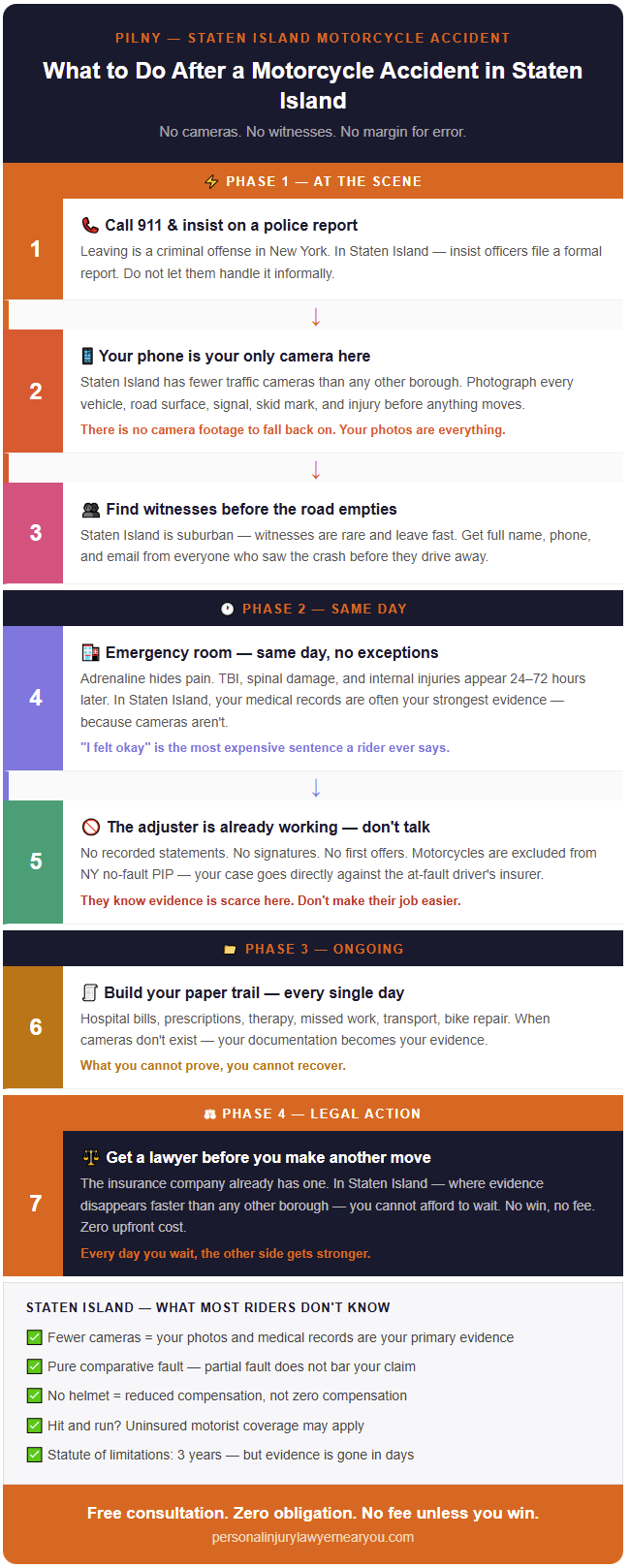
In Manhattan a crash usually happens in front of a dozen building cameras. On Hylan Boulevard or Richmond Avenue you may be outside a row of houses and a strip mall. That changes what matters in the first hour:
- Insist on a police report. Call 911 and make sure a report is actually taken, even if the other driver wants to “just swap details”. Note the precinct — the 120th, 121st, 122nd or 123rd — and the report number.
- Photograph position, not just damage. Your lane, the other vehicle’s lane, turn signals, the curb and any driveway or parking lot exit the car came from.
- Photograph the road surface. Gravel, sand, potholes, steel plates and worn paint matter more on Staten Island’s faster roads.
- Knock on doors. Residential doorbell cameras and shop security systems along the route are the island’s most common source of footage. Ask that day; many systems record over within days.
- Get witness details. On a suburban road, drivers who stop are rare. Take a name and number from anyone who does.
Get treated the same day, even if you walked away. Seriously injured riders are often taken to Staten Island University Hospital North, the island’s Level 1 trauma center. The first medical record is the foundation of the injury claim.
The Crash Patterns That Decide Fault on Staten Island
| Crash type | Where it happens | What usually decides it |
|---|---|---|
| Left turn across the rider | Hylan Boulevard, Richmond Avenue, Victory Boulevard | A turning driver must yield to oncoming traffic; expect a “rider was speeding” defense |
| Car pulling out of a lot or driveway | Strip malls and side streets along Hylan and Richmond Avenue | Sight lines, parked vehicles blocking the view, the exit’s stop sign |
| Lane change or merge | Staten Island Expressway, West Shore Expressway, bridge approaches | VTL § 1252 gives a motorcycle the full use of a lane; truck blind spots often matter |
| Single-bike crash on a curve | Arthur Kill Road, Richmond Road, roads around the Greenbelt | Road defects, gravel, missing signs — a possible claim against the road owner |
| Deer strike | South Shore, the Greenbelt and areas near parkland | No other driver, so recovery usually comes from your own coverage |
Left-turn crashes are the classic rider case, and the defense is almost always speed. That is why the photos of your bike’s final position, the skid marks and the other car’s damage point matter so much — they let a reconstruction expert rebuild what happened when no camera did. If the driver fled, our guide to a hit and run accident on Staten Island covers the UM and MVAIC routes and their short deadlines.
Who Owns the Road Decides Your First Deadline
No other borough packs so many road owners into one place. Your claim against the driver who hit you generally runs three years. But if a road defect, a public vehicle or a bridge condition played any part, a second claim against the owner has a much shorter clock:
| Where you crashed | Owner | First deadline |
|---|---|---|
| Hylan Blvd, Richmond Ave, Arthur Kill Rd, local streets | City of New York | Notice of claim within 90 days; prior written notice of the defect is usually required |
| Staten Island Expressway, West Shore Expressway | State of New York | Court of Claims notice of intention within 90 days |
| Verrazzano-Narrows Bridge | MTA Bridges and Tunnels | Statutory notice of claim rules apply |
| Goethals, Outerbridge, Bayonne bridges | Port Authority of NY & NJ | Notice of claim at least 60 days before suing; lawsuit within one year |
The Port Authority rule catches people most, because one year is so much shorter than the three years everyone has heard of. Our guide to crashes on the Goethals and Outerbridge explains it in detail, and who owns the road you crashed on maps every authority on the island. The rules are the same whether a truck or a motorcycle was involved.
How Riders Get Paid Without No-Fault
A car occupant hurt on Staten Island files with their own no-fault insurer first. A rider cannot. The Department of Financial Services’ no-fault FAQ confirms that motorcycle operators and passengers are excluded from no-fault benefits. In practice:
- Your health insurance pays first, and usually claims reimbursement from any settlement.
- The at-fault driver’s liability policy is the main source for medical bills, lost wages and pain and suffering. The vehicle owner, and an employer if the driver was working, can be liable too.
- Your own UM/SUM coverage matters if the driver had little insurance or fled.
- In a deer strike or a solo crash, there may be no other driver to claim against. Your own motorcycle policy’s physical damage coverage and your health insurance are the main sources, unless a road defect or another vehicle also played a part.
The Serious Injury Rule Works Differently for Riders
Car occupants in New York must prove a “serious injury” before recovering for pain and suffering. Riders are in a better position here. Appeals from Staten Island go to the Appellate Division, Second Department, which held in Jung v Glover (2019) that a motorcycle passenger was not a “covered person” under the no-fault law, so whether she had a serious injury was immaterial.
The 2026 reform adds a new question. Since 26 May 2026, motor vehicle injury actions “subject to” the no-fault article bar recovery where the claimant’s fault is greater than the defendants’ combined share. Whether that reaches riders, who sit outside no-fault, has not yet been settled by the courts. In ordinary cases a rider’s damages are still reduced by any share of fault — which is why the scene evidence above matters so much.
The First Two Weeks
- Get the police report from the precinct that responded.
- File the DMV MV-104 within 10 days if anyone was hurt or damage exceeds $1,000.
- Tell your own motorcycle insurer, especially if UM, SUM or physical damage coverage may apply.
- Decline recorded statements to the other driver’s insurer until you have advice.
- Follow up on cameras at the homes and businesses you noted before footage is recorded over.
- Diary a road-owner deadline if the road surface or a bridge played any part.
The full list of filing steps is in our guide to filing a motorcycle accident claim in New York. A Staten Island lawsuit is normally filed in Richmond County Supreme Court at 26 Central Avenue in St. George.
What a Staten Island Motorcycle Claim Can Include
Because there is no no-fault layer, a rider’s claim can include every medical bill from the first ambulance ride, lost wages and future earnings, future treatment, damage to the bike and gear, and pain and suffering. Helmets are required for riders and passengers in New York; riding without one does not bar a claim, but the defense may argue it made a head injury worse. For how adjusters put a number on all of this, see what an accident case is worth in Staten Island.
Frequently Asked Questions
What should I do right after a motorcycle accident in Staten Island?
Call 911 and insist on a police report, photograph lane positions, the road surface and every vehicle, ask nearby homes and businesses about doorbell or security cameras, and get treated the same day.
How long do I have to file a motorcycle accident claim in Staten Island?
Generally three years to sue a private driver. But if a City street, State expressway or bridge authority shares the blame, a notice may be due within 60 or 90 days, and Port Authority claims must be sued within one year.
Does no-fault insurance cover a motorcycle accident on Staten Island?
No. Motorcycle operators and passengers are excluded from New York no-fault benefits, so bills are paid by health insurance first and recovered from the at-fault party or your own UM/SUM coverage.
Do Staten Island riders have to prove a serious injury?
Usually not. The Appellate Division, Second Department, which hears Staten Island appeals, held in Jung v Glover (2019) that a motorcycle passenger was not a covered person under the no-fault law, so serious injury was immaterial.
What if I hit a deer on Staten Island?
With no other driver there is usually no liability claim. Your own motorcycle policy’s physical damage coverage and your health insurance are the main sources, unless a road defect or another vehicle also played a part.
Where is a Staten Island motorcycle accident lawsuit filed?
Usually in Richmond County Supreme Court at 26 Central Avenue in St. George, with appeals going to the Appellate Division, Second Department.
Key Takeaways
✅ Staten Island has fewer cameras — ask homes and shops for doorbell and security footage the same day
✅ Left turns, lot exits and expressway merges cause most rider crashes; document position
✅ Riders get no no-fault benefits — bills come from health insurance and the at-fault side
✅ Road and bridge owners bring 60-day, 90-day and one-year deadlines
✅ The Second Department has held riders need not prove serious injury
Talk to Someone About Your Staten Island Crash
A free case review can tell you who is liable, which policies apply and which deadline comes first. Learn how we connect riders with a Staten Island motorcycle accident lawyer.
Hurt Riding on Staten Island? Get a Free Case Review
No win, no fee. No upfront cost.
