
TL;DR — Quick Summary
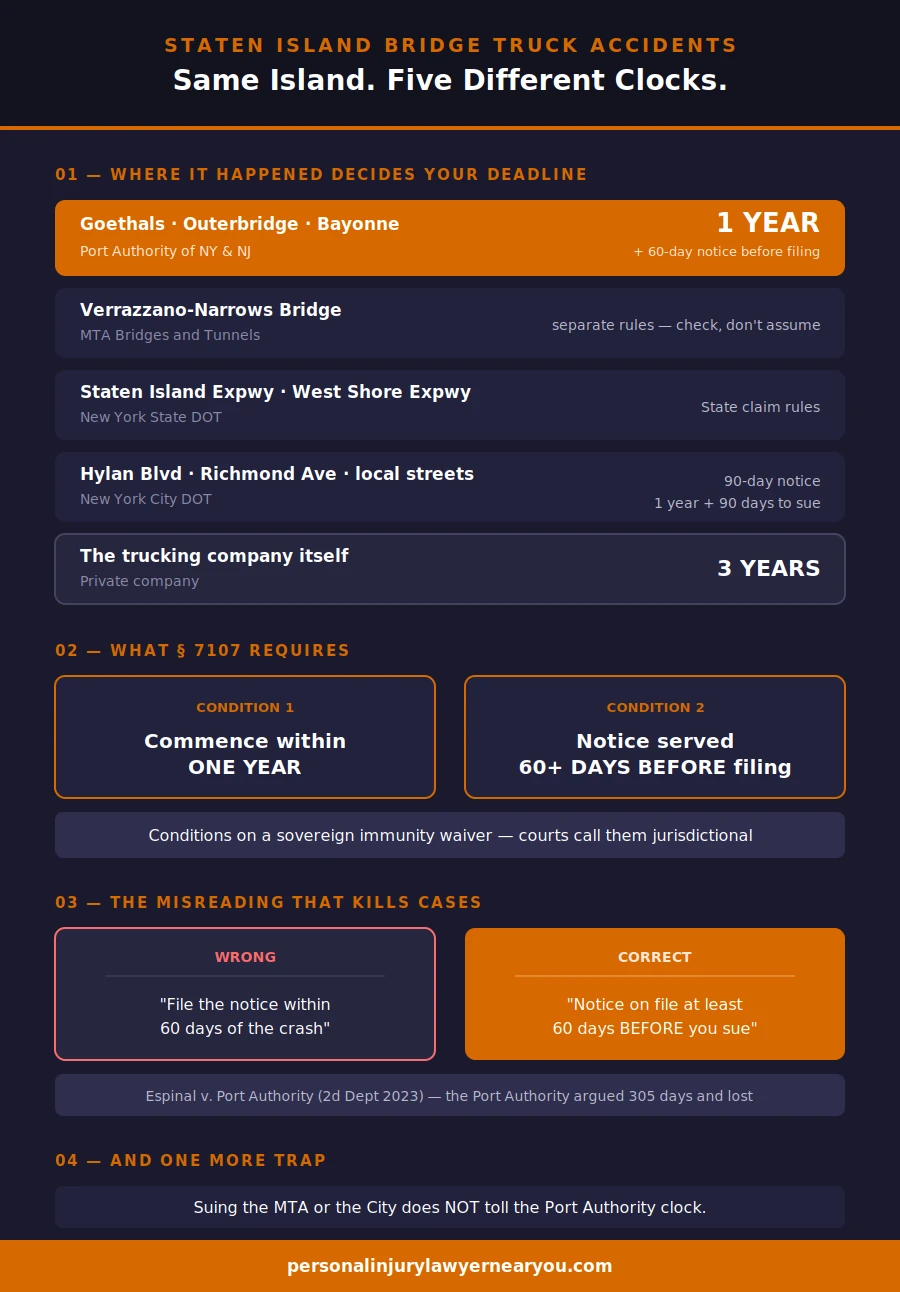
The Goethals Bridge, Outerbridge Crossing and Bayonne Bridge belong to the Port Authority of New York and New Jersey — not to New York City, and not to the State. That changes your deadline completely. Under NY Unconsolidated Laws § 7107 you have one year to commence suit, not three, and a notice of claim must be served at least 60 days before you file. Courts treat these as jurisdictional and will not excuse a miss. Cross the Verrazzano instead and a different authority applies again. On Staten Island, where the crash happened decides how long you have.
A Staten Island bridge truck accident feels like any other crash while it is happening. A tractor-trailer, a lane change, an impact. You call your insurer, you start treatment, and you assume there is time to sort out the legal side.
On these particular bridges, there is far less time than you think — and the clock started the moment it happened.
Staten Island Is Surrounded by Four Different Authorities
No other borough has this problem. Staten Island is an island, every truck reaching it crosses a bridge, and those bridges are not all owned by the same body.
| Where the crash happened | Who owns it | Deadline to sue |
|---|---|---|
| Goethals Bridge Outerbridge Crossing Bayonne Bridge |
Port Authority of NY & NJ | 1 year, with notice served at least 60 days before filing |
| Verrazzano-Narrows Bridge | MTA Bridges and Tunnels | Its own separate notice and limitation rules — must be checked, not assumed |
| Staten Island Expressway West Shore Expressway |
New York State DOT | State claim rules apply where the road itself is at issue |
| Hylan Blvd, Richmond Ave, local streets | New York City DOT | 90-day Notice of Claim; suit within 1 year and 90 days |
| The trucking company itself | Private company | 3 years, no notice of claim required |
Read the top row against the bottom row. Same island, same kind of crash, and the window is a third as long.
What Section 7107 Actually Requires
The Port Authority was created in 1921 by a compact between New York and New Jersey. As an agency of two sovereign states it could not be sued at all until both legislatures waived that immunity in 1950 — and the waiver came with conditions attached. In New York those conditions live at McKinney’s Unconsolidated Laws §§ 7101 to 7112.
Section 7107 sets two of them:
- The action must be commenced within one year after the cause of action accrues
- A notice of claim must be served on the Port Authority at least 60 days before the action is commenced
Because these are conditions on a waiver of sovereign immunity rather than ordinary procedural rules, courts construe them strictly. New York courts have held the notice requirement to be jurisdictional and incapable of being waived — a defective or missing notice ends the case, regardless of how strong the underlying claim is.
The 60-Day Rule Is Widely Misunderstood
This is worth spelling out, because the Port Authority itself has argued the point in litigation and lost.
The requirement is not that you file a notice of claim within 60 days of your injury. It is that the notice must be on file at least 60 days before you commence suit. Those are different rules with very different consequences.
In Espinal v. Port Authority of New York and New Jersey, decided by the Appellate Division, Second Department in 2023, the Port Authority argued that section 7107 effectively required the notice to be served no later than 305 days after the claim accrued — one year minus sixty days. The court rejected that reading and held the plaintiff’s interpretation correct.
The practical effect is that the sixty days is a waiting period before filing, not a deadline from the date of injury. But it still compresses everything: if the notice has not been served, you cannot file, and the one-year window keeps running while you wait. Serving late does not extend the year — it simply eats it.
Naming the Wrong Defendant Does Not Stop the Clock
This is the trap that catches people on Staten Island specifically, because the bridges sit so close together and look so similar from the roadway.
Port Authority claims route to the Port Authority Law Department. Filing against the MTA, against Bridges and Tunnels, against the City, or against one of the two states does not satisfy section 7107 and does not toll anything. A year later, the correct defendant is simply time-barred while the paperwork sits with the wrong agency.
Which is why the first question in one of these cases is not what happened. It is: which structure were you on, and in which direction were you travelling?
Why These Bridges Concentrate Truck Traffic
Staten Island carries a freight burden that is wildly out of proportion to its population, and it is a matter of geography rather than policy.
The Goethals Bridge and Outerbridge Crossing are the road links between New Jersey and Staten Island, and from there the Staten Island Expressway and the Verrazzano-Narrows carry that traffic into Brooklyn. For a great deal of freight moving between New Jersey and the rest of New York City, this is the route. Add the container terminals on the western shore and the industrial corridor along the West Shore Expressway, and the result is a small borough absorbing a very large volume of heavy commercial vehicles.
Most of those trucks have neither an origin nor a destination on Staten Island — they are passing through, which brings the through-route obligations discussed in our post on truck route violations into play alongside everything else.
What to Establish Immediately
| What to establish | Why it matters |
|---|---|
| The exact structure and milepost | Decides which authority — and therefore which deadline — applies |
| Which agency responded | Port Authority Police, NYPD and State Police each generate different reports |
| The carrier’s USDOT number | Opens the private claim, which runs on a separate three-year track |
| Toll and gantry records | Timestamps the crossing and places the vehicle precisely |
| Roadway condition and signage | Only relevant if the owning authority is a defendant — hence the urgency |
One point worth being clear about: if the truck driver alone was at fault and the roadway played no part, your claim is against the carrier on the ordinary three-year timeline and section 7107 never enters the picture. The difficulty is that you rarely know which of those you have in the first weeks — and by the time you do, the shorter clock may have run. That is why these cases are assessed against the shortest applicable deadline from day one.
The New York Rules That Still Apply
Whoever the defendant turns out to be, the underlying framework does not change. You still have 30 days to file your no-fault application. The serious injury threshold under Insurance Law § 5102(d) still governs pain and suffering in a motor vehicle case. Comparative negligence still reduces recovery by your share of fault, and under the 2026 reform a plaintiff found mostly at fault cannot recover non-economic damages at all. Our settlement calculator gives you a range to work from before any offer is discussed, and the general sequence is covered in our guide on what to do after a truck accident in New York.
Frequently Asked Questions
Who owns the Goethals Bridge and the Outerbridge Crossing?
Both are owned and operated by the Port Authority of New York and New Jersey, as is the Bayonne Bridge. The Verrazzano-Narrows Bridge is operated by MTA Bridges and Tunnels, a different authority with its own separate claim requirements. The Staten Island Expressway and West Shore Expressway are State highways.
How long do I have to sue the Port Authority?
Under McKinney’s Unconsolidated Laws § 7107, an action against the Port Authority must be commenced within one year after the cause of action accrues, and a notice of claim must be served on the Port Authority at least 60 days before the action is commenced. Both are conditions on the waiver of sovereign immunity and courts enforce them strictly.
Do I have to file the notice of claim within 60 days of the accident?
No — that is a common misreading. The notice must be served at least 60 days before suit is commenced, not within 60 days of the injury. In Espinal v. Port Authority of New York and New Jersey the Appellate Division rejected the Port Authority’s argument that the notice had to be served within 305 days of accrual. The sixty days functions as a waiting period before filing, while the one-year limitation period continues to run.
What if I sue the trucking company instead of the Port Authority?
A claim against a private carrier follows the ordinary three-year personal injury period with no notice of claim required. If the roadway, signage or bridge conditions contributed to the crash, however, the owning authority becomes a necessary defendant on its own much shorter timeline. Because that is often unclear early on, these claims are usually worked to the shortest applicable deadline.
Does filing against the MTA or the City protect my Port Authority claim?
No. Claims against the Port Authority must be directed to the Port Authority itself under sections 7106 and 7107. Naming a different agency does not satisfy the notice requirement and does not toll the one-year period, so the correct defendant can become time-barred while a claim sits with the wrong body.
Does it matter that the crash happened on the New Jersey side?
The Port Authority is a bistate agency and both states passed parallel consent-to-suit legislation in 1950, so a one-year limitation and a 60-day notice requirement apply on either side. Which state’s courts and which state’s substantive law govern is a separate question that depends on where the crash occurred and where suit is brought, and it should be assessed early because it affects everything downstream.
Key Takeaways
✅ Goethals, Outerbridge and Bayonne are Port Authority — one year, not three
✅ Notice of claim must be served at least 60 days BEFORE you file suit
✅ The Verrazzano is MTA Bridges and Tunnels — different rules again
✅ Suing the wrong agency does not toll the Port Authority clock
✅ Courts treat these as jurisdictional — they cannot be waived or excused
Find Out Which Clock You Are On
If a truck hit you on a Staten Island bridge, the single most urgent question is which authority owned the structure you were on — because one answer gives you three years and another gives you one. That is answerable within days, and it decides everything that follows. Speak to a Staten Island truck accident lawyer before the shorter clock does any more damage. The framework is the same as any Staten Island personal injury claim, with a jurisdictional question sitting in front of it. The case review is free, and there is no fee unless you win.
Talk to a Staten Island Truck Accident Lawyer Today
Free case review. No win, no fee. No upfront cost.
