
TL;DR — Quick Summary
Your Staten Island accident case value comes from one formula: documented losses × an injury multiplier. Medical bills, lost wages, and out-of-pocket costs get added up, then multiplied by 1.5× to 8× depending on how serious your injuries are. But there’s a gate first — in a motor vehicle case you cannot recover pain and suffering at all unless your injury clears New York’s serious injury threshold. And the number you’re quoted is not the number you keep: after a one-third attorney fee, case expenses, and medical liens, a $150,000 settlement typically nets around $85,000.
Every Staten Island accident victim asks the same question within about 48 hours of the crash: what is my case actually worth? The answers you find online are usually useless — either a vague “every case is different” or an inflated number designed to get you on the phone. Neither helps you decide whether the $12,000 an adjuster just offered is fair or insulting.
This is the real math. Not a range pulled from thin air, but the actual formula insurance adjusters run internally before they call you, plus the two things that determine whether you can use it at all.
The Formula: How Staten Island Case Value Is Actually Calculated
Case value has two halves. The first half is easy because it has receipts behind it — these are your special damages:
- Medical bills, past and reasonably projected future treatment
- Lost wages, including gig, freelance, and self-employed income
- Property damage
- Out-of-pocket costs: transport to appointments, medical equipment, home help
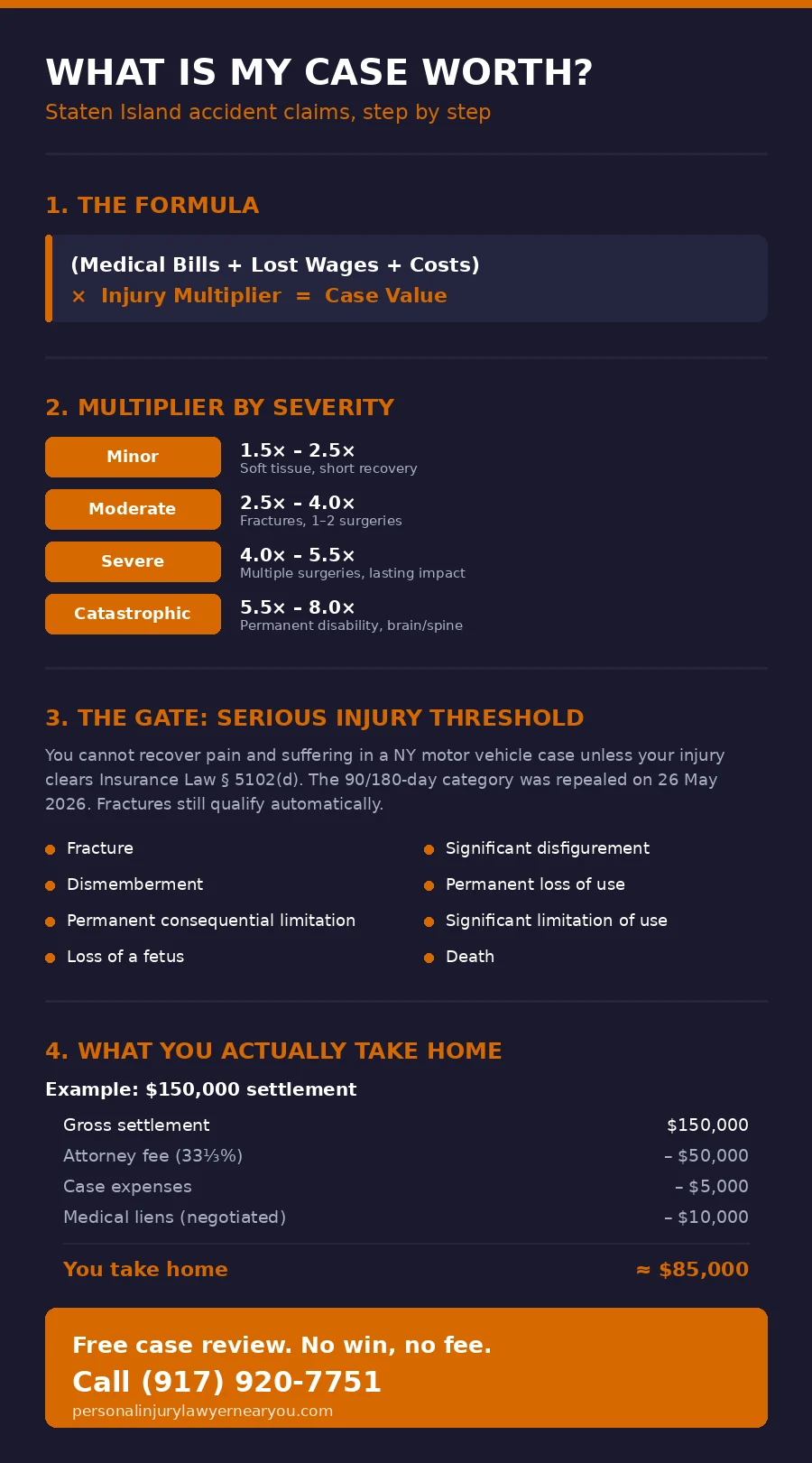
The second half has no receipts. Pain, sleeplessness, the surgery you now need, the things you can no longer do with your kids. Adjusters quantify this by applying a multiplier to your special damages — roughly 1.5× to 2.5× for minor soft-tissue injuries, 2.5× to 4× for fractures and surgery, 4× to 5.5× for severe injuries with lasting impact, and 5.5× to 8× for catastrophic cases involving permanent disability or brain and spinal cord damage.
| Injury severity | Typical multiplier | Estimated case value on $28,000 in bills and lost wages |
|---|---|---|
| Minor soft-tissue injury | 1.5× – 2.5× | $70,000 – $98,000 |
| Fracture or surgery | 2.5× – 4× | $98,000 – $140,000 |
| Severe injury with lasting impact | 4× – 5.5× | $140,000 – $182,000 |
| Catastrophic (permanent disability, brain or spinal cord) | 5.5× – 8× | $182,000 – $252,000 |
Estimated value = documented losses plus (documented losses × multiplier). These are negotiating ranges, not guarantees, and in a motor vehicle case they only apply once the serious injury threshold is met.
So $20,000 in medical bills and $8,000 in lost wages, with a moderate injury at a 3× multiplier, lands somewhere near $112,000. You can run your own numbers through our free personal injury settlement calculator in about thirty seconds.
One caution before you get attached to a number: the multiplier is not a law. It is a negotiating convention. A well-documented case with clear liability lands at the top of the range. A thin file lands at the bottom, or below it. Which is why an experienced Staten Island car accident lawyer spends most of their effort on documentation, not argument.
The Gate: New York’s Serious Injury Threshold
This is the part that surprises people, and it applies to every motor vehicle claim on Staten Island.
New York is a no-fault state. Your own policy pays up to $50,000 in basic economic loss — medical bills and lost wages — regardless of who caused the crash. That is the good news. The catch is that no-fault also blocks you from suing the at-fault driver for pain and suffering unless your injury qualifies as a “serious injury” under New York Insurance Law § 5102(d).
The statute lists specific categories, including:
- A fracture — this qualifies automatically, even a small one that heals cleanly
- Significant disfigurement or scarring
- Dismemberment, or loss of a fetus
- Permanent loss of use of a body organ, member, function, or system
- Permanent consequential limitation, or significant limitation, of use
- Death
Important: New York Removed the 90/180 Category in 2026
If you have read about the “90/180 rule” elsewhere, that information is out of date. New York previously allowed a ninth qualifying category: a medically determined non-permanent injury that prevented you from performing substantially all your usual daily activities for at least 90 of the 180 days after the crash. It was often the route used in borderline soft-tissue and whiplash cases.
Part EE of Chapter 58 of the Laws of 2026 eliminated that category, effective for actions and proceedings commenced on or after 26 May 2026. The New York Department of Financial Services confirmed the change in Insurance Circular Letter No. 3. Note that the filing date matters here, not the accident date.
The practical effect is significant, and it hits exactly the people who used to have the weakest path: injuries that were genuinely disabling for months but ultimately healed. Those claims must now fit one of the remaining categories, or they cannot recover pain and suffering at all. Our guide to the serious injury threshold on Staten Island walks through each remaining category. A great deal of the legal content still online has not been updated for this.
Everything above the no-fault ceiling depends on clearing this gate. If you don’t, your case is worth your no-fault benefits and very little else — no matter how much the crash disrupted your life. Insurers know this and fight hard on threshold, which is why objective proof like MRI findings and consistent treatment records matters more than how much pain you describe.
Note that the threshold applies to motor vehicle cases. A Staten Island personal injury claim arising from a sidewalk fall or a property hazard is not gated the same way.
What Makes Staten Island Cases Different
Borough matters, and not for the reason most people assume.
Staten Island is the most car-dependent borough in the city. That shapes claims in concrete ways: crashes on Hylan Boulevard, Richmond Avenue, and the Staten Island Expressway happen at higher speeds than the stop-start collisions typical of Manhattan, which tends to mean more serious injuries. It also means losing your car and your ability to drive hits harder here — the lost-wage and transport-cost components of a Staten Island claim are often larger than an equivalent case in a transit-dense borough.
Cases here are filed in Richmond County Supreme Court. Among New York practitioners, Staten Island juries are generally regarded as more conservative on damages than Bronx or Brooklyn juries. I want to be straight with you that this is professional consensus rather than something I can put a hard number on — but it matters practically, because it means insurers price Staten Island cases with that in mind, and settlement posture should account for it.
The practical takeaway: documentation carries more weight here, not less. A case that would carry itself on sympathy elsewhere needs the paperwork on Staten Island.
What You Actually Take Home
The settlement figure is not the figure that reaches your account. Three things come out first, and nobody explains this clearly before you sign a retainer.
- Attorney fee — the standard New York personal injury contingency fee is one third (33⅓%). Medical malpractice follows a lower sliding scale.
- Case expenses — filing fees, medical records, expert witnesses, court reporters. Typically $1,000 to $5,000, higher in litigated cases.
- Medical liens — your no-fault carrier, health insurer, Medicaid, or Medicare may claim reimbursement. These are frequently negotiable.
On a $150,000 settlement: a $50,000 fee leaves $100,000, roughly $5,000 in expenses leaves $95,000, and $10,000 in negotiated liens leaves you near $85,000.
| Item | Amount |
|---|---|
| Gross settlement | $150,000 |
| Attorney fee (one third) | − $50,000 |
| Case expenses | − $5,000 |
| Medical liens (after negotiation) | − $10,000 |
| What you take home | ≈ $85,000 |
One detail worth knowing before you sign anything: New York lets the fee be calculated two different ways — off the gross recovery, or off the net after expenses. The difference is real money, and it changes who carries the expense risk if the case loses. The New York City Bar Association explains both structures. Read that clause in your retainer.
What Raises and Lowers Your Staten Island Case Value
Two cases with identical medical bills can settle $60,000 apart. These are the reasons why.
Pushes value up: clear liability with a police citation against the other driver; a fracture or surgery that removes any threshold argument; consistent treatment with no gaps; high policy limits on the at-fault side; documented permanent effects on your work or daily life; independent evidence like camera footage or a credible witness.
Pulls value down: a delay before your first medical visit; a gap in treatment that lets the insurer argue you recovered; social media posts that contradict your claimed limitations; shared fault, which since the 2026 reform can bar non-economic damages entirely for a mostly-at-fault driver in a motor vehicle case; pre-existing conditions in the same body part; a minimum-limits policy that caps what is available no matter what your case is worth.
Case type shifts the range too. A Staten Island truck accident lawyer works with commercial policies that dwarf personal auto limits (see what a Staten Island truck accident case is worth), while a Staten Island slip and fall injury lawyer is fighting mainly over notice — whether the property owner knew about the hazard and ignored it. And if the driver fled, a hit and run accident on Staten Island routes through your uninsured motorist coverage or MVAIC instead, both of which carry lower ceilings.
Frequently Asked Questions
What is the average accident settlement in Staten Island?
There is no reliable average, and any site quoting one is guessing. Settlements track documented losses, injury severity, liability clarity, and available insurance — variables that swing results enormously. A soft-tissue case with $6,000 in bills and a fracture case with $80,000 in bills and surgery are not on the same scale. Run your own numbers rather than trusting an average.
How long does a Staten Island injury case take to settle?
Clear-liability cases with completed treatment often settle in three to six months. Moderate cases run six to twelve. Severe cases, or anything that goes into litigation in Richmond County Supreme Court, can take twelve to twenty-four months or more. Settling before your treatment is complete almost always costs you money, because future care cannot be valued yet.
Should I accept the first offer from the insurance company?
First offers are usually well below what the insurer is prepared to pay later. They open low because unrepresented victims under financial pressure often accept quickly. Counter with documentation. Most cases settle after two to four rounds.
What if I was partly at fault for the accident?
This is another area New York changed in 2026. Historically New York used pure comparative negligence, meaning you recovered even at 90 percent fault, just reduced by your share. Part EE added CPLR § 1411(b), a modified comparative-fault rule that applies to motor vehicle personal injury actions under Article 51. Under it, a plaintiff who is found mostly at fault is barred from recovering non-economic damages in those cases. Below that line, your award is still reduced by your exact percentage — thirty percent at fault on a $100,000 case still means $70,000. The reform also added a narrow $100,000 cap on non-economic loss for certain at-fault drivers, such as those operating uninsured vehicles they were responsible for insuring. Your fault percentage is negotiable and frequently disputed, and it now carries more weight than it used to.
Do I need a lawyer to find out what my Staten Island case is worth?
No — you can estimate the range yourself from your bills, lost wages, and injury severity. What you cannot easily assess alone is whether you clear the serious injury threshold, what insurance is actually available, and whether the liens can be reduced. Since Staten Island personal injury attorneys work on contingency, a case review costs nothing to find out.
Key Takeaways
✅ Case value = documented losses × an injury multiplier of roughly 1.5× to 8×
✅ In a motor vehicle case you must clear the serious injury threshold to recover pain and suffering at all
✅ A fracture clears the threshold automatically — soft tissue often does not
✅ Staten Island’s car-dependent layout tends to mean higher-speed crashes and larger lost-wage claims
✅ A $150,000 settlement typically nets around $85,000 after fee, expenses, and liens
Find Out What Your Staten Island Case Is Actually Worth
An estimate tells you whether an offer is fair. It cannot tell you whether you clear the threshold, how much insurance is really available, or how far the liens can be negotiated down — and those three answers often move the number more than the multiplier does. A Staten Island personal injury attorney can review all three at no cost, with no fee unless you win.
Get Connected With a Staten Island Personal Injury Lawyer Today
Free case review. No win, no fee. No upfront cost.
