
TL;DR — Quick Summary
On Staten Island the deadline for your truck accident claim depends on who owns the piece of road you were on — and the range runs from 60 days to three years. Five different owners control the island’s truck corridors, each with its own notice requirement, its own limitation period, and in one case its own court with no jury. Serving the wrong one does not protect you and does not stop the clock. This is the map: what applies where, how to work out which, and what to do when the answer is genuinely unclear.
Every Staten Island truck accident deadline question starts in the same place, and it is not the question people expect. Before fault, before injuries, before insurance: whose road was that?
Nowhere else in New York City does that question carry this much weight, because nowhere else are five different owners stacked along a single journey.
The Full Map
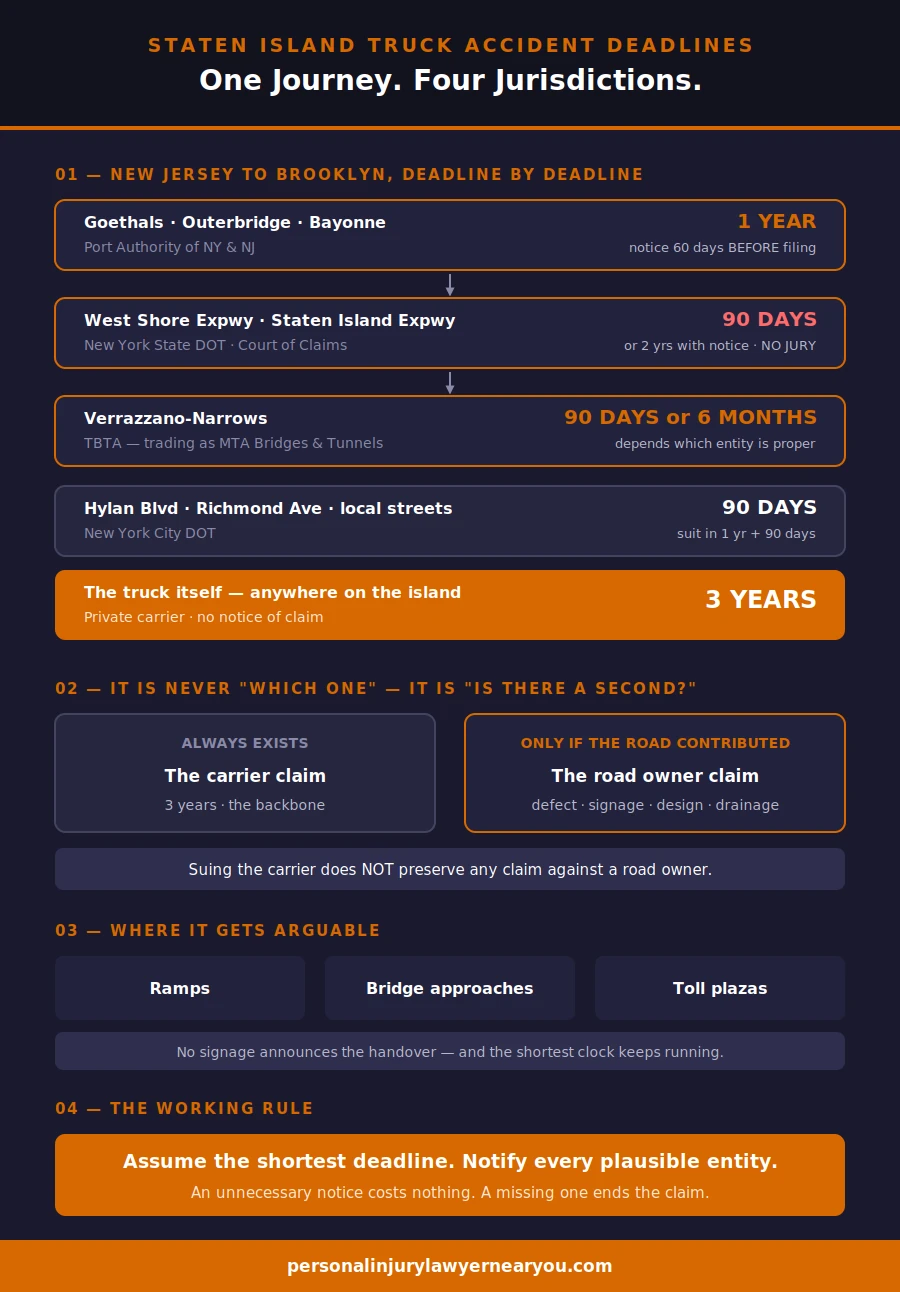
Here is every deadline that can apply to a truck crash on Staten Island, side by side.
| Where | Owner | Notice requirement | Time to sue |
|---|---|---|---|
| Goethals · Outerbridge · Bayonne | Port Authority | Served at least 60 days before filing | 1 year |
| Verrazzano-Narrows | TBTA / MTA | 90 days or six months — depends which entity is proper | 1 year, or 1 year and 90 days |
| Staten Island Expwy · West Shore Expwy | NYS DOT | File claim in 90 days, or serve a Notice of Intention on the Attorney General in 90 days | 90 days, or 2 years with the notice — Court of Claims, no jury |
| Hylan Blvd · Richmond Ave · local streets | NYC DOT | Notice of Claim in 90 days | 1 year and 90 days |
| The truck itself, anywhere | Private carrier | None | 3 years |
Read the first column top to bottom. That is one continuous journey — New Jersey to Brooklyn — and the deadline changes four times along it.
Two Claims, Not One
The table above hides something important, so it is worth stating plainly.
The bottom row — the claim against the trucking company — always exists. It runs on three years, it needs no notice of claim, and it is the backbone of almost every case. The rows above it are additional defendants that become available when the road itself contributed: a defect, missing or obscured signage, a badly designed merge, inadequate barriers, standing water.
So the practical question is never “which one do I sue?” It is “is there a second defendant, and has its much shorter window already closed while I was dealing with the first?”
What Each One Turns On
Each of these regimes has a feature that catches people out, and they are all different.
- Port Authority — the 60 days is a waiting period before you file, not a deadline from the date of injury. Courts treat it as jurisdictional. Our post on Goethals and Outerbridge crashes covers the case law on this directly.
- The Verrazzano — “MTA Bridges and Tunnels” is a trading name, not a legal entity, and a court has called the labelling confusing. Which entity is proper changes the notice period. See our post on who you are actually suing on the Verrazzano.
- The State expressways — the Notice of Intention is served on the Attorney General, not filed with the court, and there is no jury in the Court of Claims. Our post on Staten Island Expressway crashes sets out the two-step and the seasonal highway defect rule.
- The truck — on a container move, the chassis may belong to a different company with its own USDOT number and its own federal duties, covered in our post on port chassis claims.
The Boundary Problem
Here is the part no chart solves, and it is the most common real-world situation.
Authorities meet somewhere. A bridge does not stop at the water — it has approaches, ramps, toll plazas and merges, and ownership of those transitional stretches is not always where a driver would guess. The approach to the Goethals runs into the West Shore Expressway. The Verrazzano toll plaza sits at the eastern end of the Staten Island Expressway. Ramps connect State highway to City street with no signage announcing the handover.
A crash on one of those stretches can be genuinely arguable, and it will not be resolved in the first week. Meanwhile the shortest clock — sixty days on one side, ninety on another — is running.
There is no clever answer to this. There is only a working one.
The Working Rule
| Step | Why |
|---|---|
| 1. Fix the location precisely | Structure, milepost, direction, and which side of any toll plaza — this is the single fact everything else depends on |
| 2. Note which agency responded | Port Authority Police, Bridge and Tunnel Officers, NYPD and State Police each point to a different owner |
| 3. Assume the shortest deadline | Work to 60 days, not three years, until ownership is confirmed |
| 4. Notify every plausible entity | The errors are not symmetrical. An unnecessary notice costs nothing. A missing one ends the claim |
| 5. Preserve the road condition | Defects get repaired — that is the whole basis of any claim against an owner |
Step four is the one that matters most and the one people resist, because notifying four entities feels excessive when only one can be right. It is not excessive. It is the only response that fits the shape of the risk.
The New York Rules That Apply Regardless
Whoever the defendant turns out to be, three things do not change. You have 30 days to file your no-fault application, or your own insurer can deny medical bills and lost wages regardless of fault. The serious injury threshold under Insurance Law § 5102(d) governs whether pain and suffering is available at all. And comparative negligence reduces recovery by your share of fault, with a plaintiff found mostly at fault in a motor vehicle case unable to recover non-economic damages under the 2026 reform.
Our free settlement calculator gives you a working range before any offer is discussed.
Frequently Asked Questions
How long do I have to file a truck accident claim on Staten Island?
Against the trucking company, three years, with no notice of claim required. Against a road owner it is far shorter and depends who owns that stretch — one year for the Port Authority bridges with notice served at least 60 days before filing, 90 days for the State expressways or City streets, and 90 days or six months on the Verrazzano depending which entity is the proper defendant.
Why are there so many different deadlines on one island?
Because Staten Island’s truck corridors are owned by five different bodies. The western bridges belong to the Port Authority, the Verrazzano to the Triborough Bridge and Tunnel Authority, the expressways to New York State, local streets to New York City, and the truck itself to a private company. Each has its own statutory claim regime.
What if I do not know which authority owned the road?
Work to the shortest applicable deadline and notify every plausible entity rather than choosing between them. Serving a notice on a body that turns out not to be liable costs nothing. Failing to serve the one that is liable ends that part of the claim permanently, and those two outcomes are not equivalent.
Does suing the trucking company protect my claim against the road owner?
No. They are entirely separate claims against separate defendants with separate deadlines. A timely action against a private carrier does nothing to preserve a claim against the Port Authority, the State, the City or a bridge authority, and none of those notice periods are tolled by it.
What if the crash happened on a ramp or at a toll plaza?
Those transitional stretches are exactly where ownership becomes arguable, and signage does not announce the handover. The location needs to be fixed precisely — structure, milepost, direction and which side of the plaza — and until ownership is confirmed the shortest deadline should be treated as running.
Is the road owner liable just because the crash happened there?
No. An owner becomes a defendant only where the roadway itself contributed — a defect, inadequate or obscured signage, a dangerous design, missing barriers or a drainage failure — and usually only where it knew or should have known. If the driver alone caused the crash, the claim is against the carrier on the ordinary three-year timeline.
Key Takeaways
✅ Five owners control Staten Island’s truck corridors — deadlines run 60 days to 3 years
✅ The claim against the carrier always exists — road owners are additional defendants
✅ Suing the carrier does not preserve any claim against a road owner
✅ Ramps, approaches and toll plazas are where ownership becomes arguable
✅ Work to the shortest clock and notify everyone — the errors are not symmetrical
Work Out Which Clock Is Running
This is a question with a documented answer, and it can usually be settled within days. What it cannot survive is being left for later — because on some of these roads “later” means sixty days. Speak to a Staten Island truck accident lawyer while every option is still open. The framework is the same as any Staten Island personal injury claim, with a jurisdictional question sitting in front of everything else. The case review is free, and there is no fee unless you win.
Talk to a Staten Island Truck Accident Lawyer Today
Free case review. No win, no fee. No upfront cost.
