
TL;DR — Quick Summary
A hit and run accident on Staten Island does not end your claim — it changes the route. If the driver is never identified, two sources can still pay: your own uninsured motorist (UM) coverage, and MVAIC, New York’s state fund for victims of unidentified and uninsured drivers. The catch is the clock. You generally need a police report within 24 hours, your no-fault application within 30 days, and an MVAIC notice of intention within 90 days. Miss those windows and the compensation disappears even though your injuries don’t.
The worst part of a hit and run accident on Staten Island usually isn’t the impact. It’s the silence afterward — taillights disappearing down Amboy Road, no plate number, no witness, and the sinking feeling that nobody is going to pay for what just happened to you. Most people in that moment assume they are out of luck. They are almost always wrong. New York built two separate systems for exactly this situation, and both of them work whether or not the driver is ever caught.
Why Hit-and-Run Crashes Are a Staten Island Problem
Staten Island is the most car-dependent borough in New York City, and its road layout creates the exact conditions drivers flee in. Long suburban stretches like Amboy Road and Arthur Kill Road run dark and thinly trafficked after midnight. Hylan Boulevard and Richmond Avenue carry heavy volume through intersections where a driver can be three blocks away before anyone processes what happened. And unlike Midtown, large parts of the borough simply do not have the camera density that makes fleeing pointless.
That combination — speed, darkness, and thin witness coverage — is why hit-and-run collisions here so often leave victims with no immediate way to identify who hit them. It is also why an experienced Staten Island car accident lawyer treats the first 48 hours as the whole case.
What to Do in the First Hour After a Hit-and-Run
What you do immediately shapes everything that follows. The general steps in our guide on what to do after a car accident in Staten Island still apply, but a hit-and-run adds steps that are genuinely time-critical:
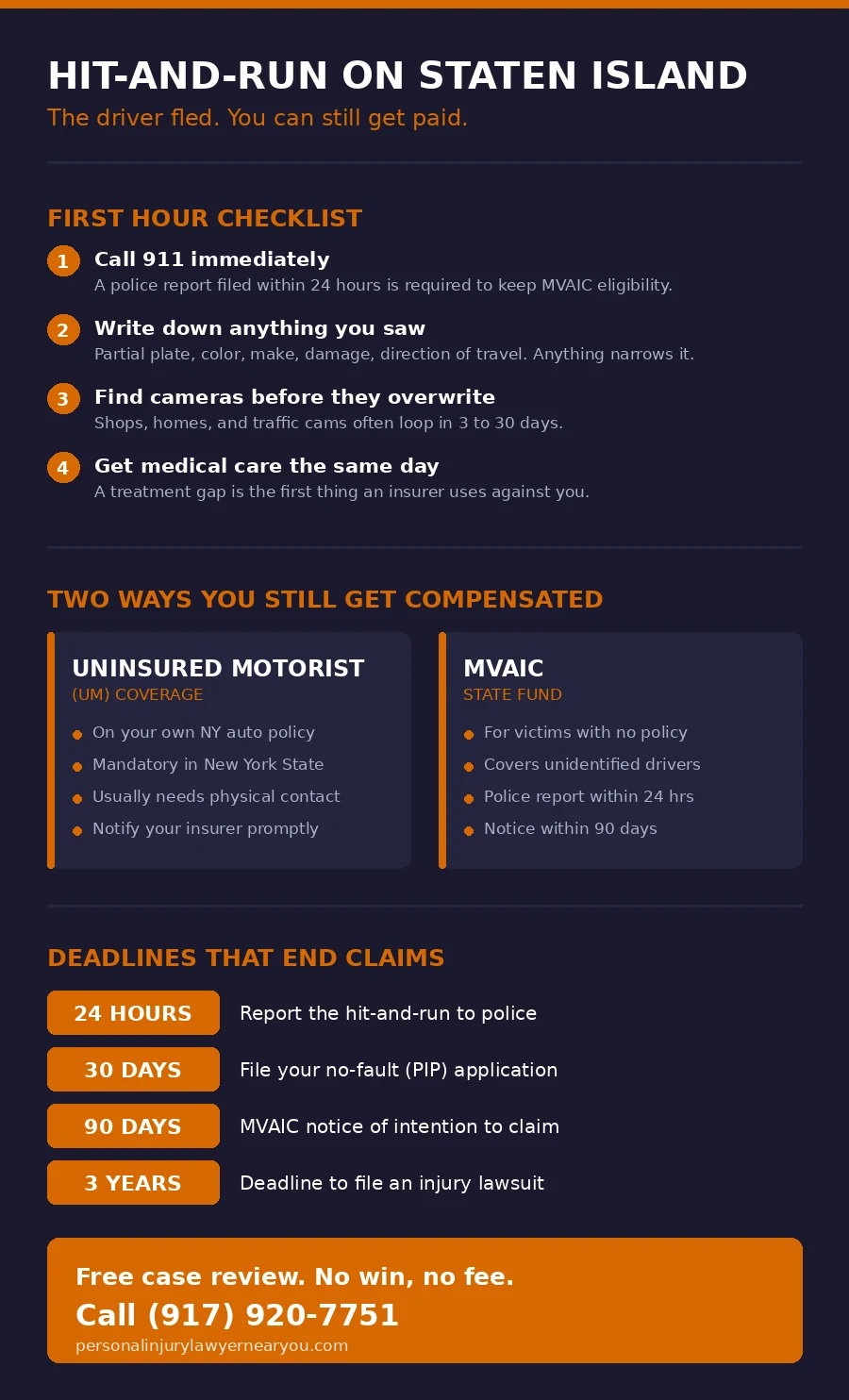
- Call 911 right away. This is not optional in a hit-and-run. A police report filed within 24 hours — or as soon as you physically can — is a threshold requirement for MVAIC eligibility later. Skip it and you can lose an entire compensation route.
- Write down everything you remember before it fades. A partial plate, the color, the make, which side was damaged, the direction it fled. Investigators have identified vehicles from far less.
- Look up, not just around. Note every business, home doorbell camera, gas station, and traffic camera within sight of the crash. Much of this footage overwrites itself in as little as three days.
- Ask anyone who stopped for their contact information. In a hit-and-run, a single witness who caught a plate can decide the case.
- Get medical care the same day. Adrenaline hides concussions and soft-tissue injuries for 24 to 72 hours, and a gap in treatment is the first thing an insurer uses to argue you were not really hurt.
- Do not chase the other vehicle. It is dangerous, and it takes you away from the scene where the evidence is.
If you were too hurt to do any of this at the scene, that is normal and it is not fatal to your claim. Much of it can be reconstructed afterward — but faster is always better.
How You Still Get Paid When the Driver Is Never Found
This is the part almost nobody knows. New York does not leave hit-and-run victims with nothing. There are two distinct routes, and which one applies to you depends on whether there is an auto insurance policy available in your household. Both are covered in more depth in our overview of hit and run accident claims.
Route 1: Your Uninsured Motorist (UM) Coverage
Every auto insurance policy issued in New York State is required to carry uninsured motorist coverage. It exists for precisely this scenario: the at-fault driver cannot be identified, or turns out to have no insurance at all. You file the claim against your own policy, and it does not work like an at-fault claim — you are not being blamed for anything.
One important limitation: for an unidentified vehicle, New York generally requires physical contact between that vehicle and yours. If a driver ran you off the road without ever touching your car and then fled, a UM claim becomes considerably harder to establish. This is one of several places where the specific facts change the outcome, and where getting advice early matters.
You should also notify your own insurer promptly. UM policies contain notice requirements, and insurers do enforce them.
Route 2: MVAIC — New York’s Fund of Last Resort
If there is no auto policy available to you at all — you do not own a car, nobody in your household does, and you were struck as a pedestrian or cyclist — New York’s Motor Vehicle Accident Indemnification Corporation exists to fill that gap. MVAIC is a state-created fund that compensates qualifying victims of unidentified and uninsured drivers.
MVAIC has strict entry requirements, and the ones that trip people up most are the police report and the notice deadline. You generally must have reported the accident to police within 24 hours — or as soon as reasonably possible — and you must file a notice of intention to make a claim within 90 days of the crash. These are not soft guidelines. Courts have denied claims filed only days late.
One distinction worth knowing: the 90-day notice deadline applies when the vehicle was unidentified, as in a classic hit-and-run. If the driver is identified but turns out to be uninsured, the notice window is 180 days instead. Confusing the two costs people their claims.
MVAIC also requires you to qualify. You must show that no other auto insurance is available to you or anyone in your household — this is done through a household affidavit — and under New York Insurance Law § 5218 you must show you made all reasonable efforts to identify the driver. That second requirement is why keeping a written log of every step you took, every witness you contacted, and every camera you asked about genuinely matters. MVAIC provides the statutory minimum coverage, which is lower than most liability policies would have paid.
The Deadlines That Quietly End Hit-and-Run Claims
More Staten Island hit-and-run claims are lost to a calendar than to weak facts. The MVAIC notice requirements below come straight from New York Insurance Law § 5208. Know these:
- 24 hours — report the hit-and-run to police (or as soon as reasonably possible) to preserve MVAIC eligibility
- 30 days — file your no-fault (PIP) application with your own insurer
- 90 days — file an MVAIC notice of intention where the vehicle was never identified
- 180 days — file an MVAIC notice of intention where the driver is identified but uninsured
- 90 days — file a Notice of Claim if a City vehicle, an MTA bus, or the Staten Island Railway was involved
- 3 years — the general deadline to file a personal injury lawsuit in New York
Notice how many of these run in days rather than years. The three-year figure is the one everyone has heard of, and it is the one that lulls people into waiting until the shorter deadlines have already passed.
How Fleeing Drivers Actually Get Identified
Hit-and-run drivers are found more often than people expect — but usually because someone moved fast, not because the case solved itself.
Camera canvassing is the single most productive method. Businesses along Hylan Boulevard and Richmond Avenue, residential doorbell cameras on side streets, and DOT traffic cameras all capture vehicles that never stopped — but most of that footage loops and overwrites within days. Someone has to physically go door to door and ask before it is gone.
Physical evidence matters too. Paint transfer, broken trim, headlight fragments, and side-mirror debris left at the scene can identify a make and model, which then gets circulated to local body shops. And when a crash involves critical injury or death, the NYPD’s collision investigation resources come into play at a level that a routine fender-bender never triggers.
A lawyer’s role here is largely about speed: sending preservation letters demanding footage be saved, and getting an investigator canvassing while the evidence still exists.
If You Were a Pedestrian, Cyclist, or Motorcycle Rider
Hit-and-run victims outside a car are usually the most seriously hurt and the most likely to be told they have no options. Both assumptions deserve pushback.
If you were walking or cycling and a household member has an auto policy, that policy’s UM coverage may reach you even though you were not in a vehicle. If no policy exists anywhere in the household, MVAIC is specifically designed for you. Riders face an additional wrinkle worth understanding: New York’s no-fault system excludes motorcyclists entirely, which is why a Staten Island motorcycle accident lawyer approaches these claims very differently from a standard car crash.
What a Staten Island Hit-and-Run Claim Can Recover
A successful claim can cover much more than the emergency room bill:
- Emergency treatment, surgery, imaging, and ongoing medical care
- Physical therapy and long-term rehabilitation
- Lost wages, including freelance, gig, and self-employed income
- Pain and suffering, once your injuries clear New York’s serious-injury threshold
- Future medical costs for injuries with lasting effects
- Vehicle damage and out-of-pocket expenses
One honest caveat: UM and MVAIC recoveries are capped by policy limits and statutory maximums, which are often lower than what an at-fault driver’s liability policy would have provided. That makes accurate valuation more important, not less. Before you accept any figure, our free personal injury settlement calculator gives you a realistic range to work from.
And if the driver is later identified, the case converts into an ordinary liability claim against them — which is another reason the investigation is worth pursuing rather than settling for the fallback route immediately. Whatever the path, a Staten Island personal injury claim follows the same core framework.
Frequently Asked Questions
Can I get compensation if the hit-and-run driver is never found on Staten Island?
Yes. Two routes exist. If you or a household member has a New York auto policy, its mandatory uninsured motorist (UM) coverage applies. If no policy is available to you at all, MVAIC — New York’s state fund for victims of unidentified and uninsured drivers — may cover you. Both have strict deadlines, so acting quickly matters.
How long do I have to file a hit-and-run claim in New York?
Several clocks run at once. Report the crash to police within 24 hours (or as soon as reasonably possible) to preserve MVAIC eligibility, file your no-fault application within 30 days, and file an MVAIC notice of intention within 90 days where the vehicle was never identified — or 180 days if the driver is identified but uninsured. The general deadline to file a personal injury lawsuit is three years, but the shorter deadlines usually decide the case first.
Does my insurance go up if I use uninsured motorist coverage?
A UM claim is not an at-fault claim against you — you did not cause the crash, and that is the entire purpose of the coverage you already pay for. Rating practices vary between insurers, so if this is a concern it is worth raising during a free case review before you file.
What if I only got a partial plate number?
A partial plate is genuinely useful. Combined with a vehicle make, color, or damage description, it can narrow the field enough for police or an investigator to identify the vehicle. Write down whatever you remember immediately, even if it feels incomplete — details fade quickly after a crash.
Do I need a lawyer for a Staten Island hit-and-run claim?
You are not required to have one. But hit-and-run claims involve short deadlines, evidence that disappears within days, and a choice between two compensation systems with different eligibility rules. Because Staten Island hit and run accident lawyers work on contingency — no fee unless they win — there is no financial risk in finding out where you stand.
Key Takeaways
✅ A fleeing driver does not end your claim — UM coverage and MVAIC are both built for this
✅ Report to police within 24 hours, or as soon as you physically can, to protect MVAIC eligibility
✅ The MVAIC notice of intention is due within 90 days, not three years
✅ Nearby camera footage often overwrites within days — canvassing has to start immediately
✅ Pedestrians, cyclists, and riders have routes too, even without their own vehicle
Hit by a Driver Who Fled on Staten Island?
The evidence that identifies a fleeing driver has a short shelf life, and the deadlines that protect your compensation are measured in days. A Staten Island hit and run accident attorney can start the camera canvass, send preservation letters, and file the right notices before those windows close. The case review is free, and there is no fee unless you win.
Get Connected With a Staten Island Hit and Run Accident Lawyer Today
Free case review. No win, no fee. No upfront cost.
