
TL;DR — Quick Summary
From a personal injury lawyer you should expect: a written fee agreement, an honest case assessment, help handling insurers and records, regular updates and prompt replies, and every settlement offer brought to you. New York clients have a right to be kept reasonably informed. A fair communication rhythm is a check-in every few weeks in busy stages and at least every month or two in quiet ones, plus immediate notice of offers and deadlines.
What to expect from a personal injury lawyer is rarely explained clearly at the start, which is why so many clients end up frustrated. You sign the agreement, the lawyer says they’ll take care of it, and then weeks go by without a word. Was that normal, or a warning sign?
This guide sets out what a good injury lawyer should do at each stage, how often you should hear from them, why they might call, and what to do if communication breaks down. It also covers what your lawyer will expect from you, because a case works best when both sides know their role.
What to Expect From a Personal Injury Lawyer, Stage by Stage
| Stage | What your lawyer should be doing | What you should hear |
|---|---|---|
| Sign-up | Explain the fee agreement, assess the case, send letters to insurers | Written fee terms and next steps |
| Treatment | Collect records and bills, handle insurer contact, protect deadlines | Check-ins every few weeks to monthly |
| Demand | Prepare and send a demand package once treatment stabilizes | The demand amount and the reasoning |
| Negotiation | Respond to offers and counteroffers | Every offer, promptly, with advice |
| Lawsuit | File suit, handle discovery, prepare you for deposition | Key dates and what’s needed from you |
| Settlement | Resolve liens, prepare closing statement, release funds | A written breakdown of every dollar |
Your Rights as a Client in New York
New York has a formal Statement of Client’s Rights. Among other things, it says clients are entitled to be kept reasonably informed about the status of their matter, to prompt replies to letters, calls and emails, and to make the final decision on whether to settle. The New York State Bar Association’s summary of client rights lists them in full.
Those rights don’t mean your lawyer must call every day. They do mean you shouldn’t be left guessing for months, and you should never learn about a settlement offer after it has expired.
How Often Should I Hear From My Personal Injury Attorney?
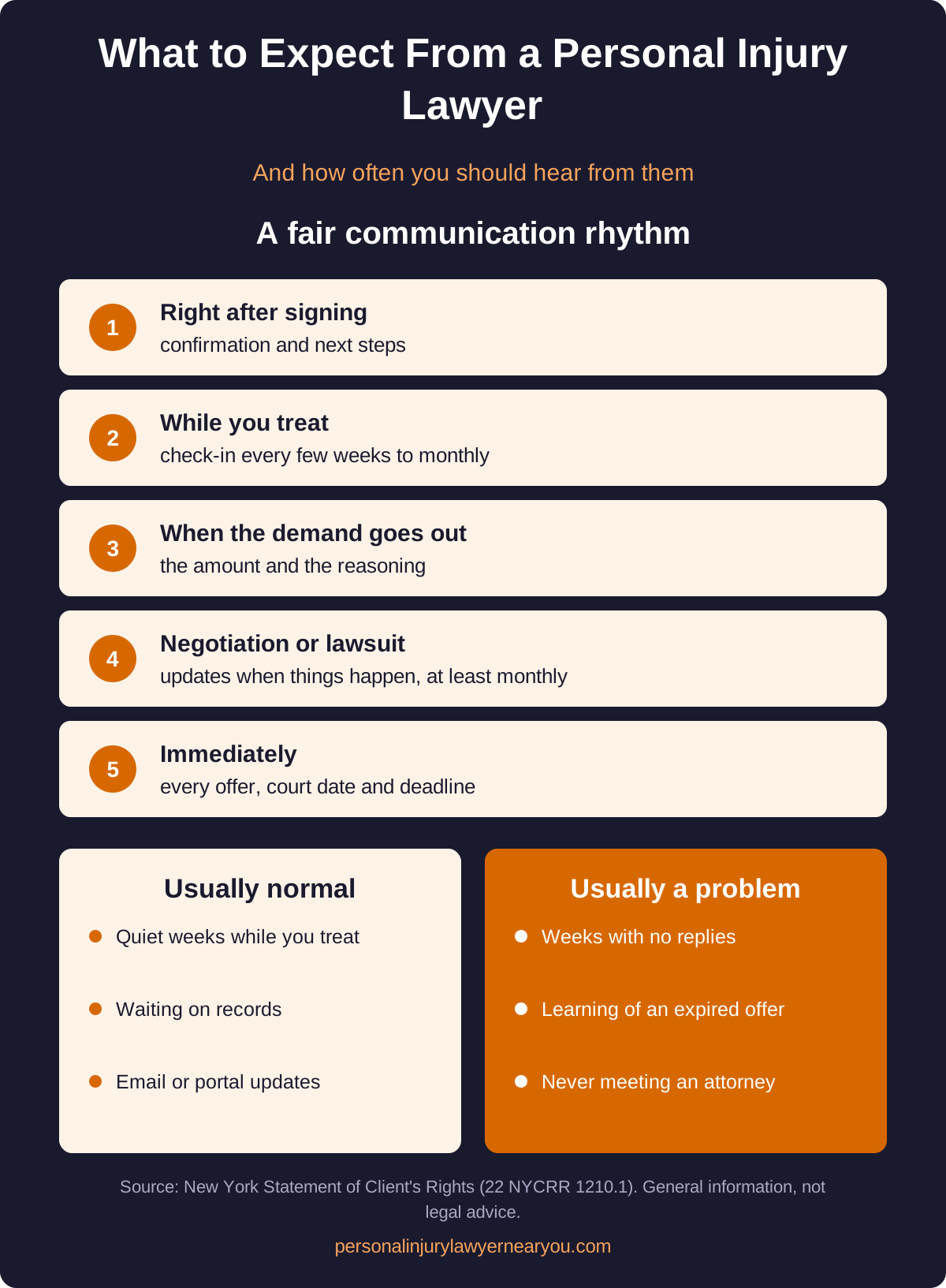
There is no single rule, but these are reasonable expectations for most injury cases:
- Right after signing: confirmation that letters of representation went to the insurers and what you should do next.
- While you are treating: a short check-in every few weeks to monthly. Not much happens in this phase, and that’s normal.
- When the demand goes out: a call or email explaining the amount and what to expect.
- During negotiation or litigation: updates whenever something happens, and at least monthly.
- Immediately: any settlement offer, court date, deposition, medical exam or deadline.
If your lawyer agrees a different rhythm with you, that’s fine. The point is that the expectation is set, so silence doesn’t feel like neglect.
Why Would a Personal Injury Lawyer Call Me?
- To update you on the case or an insurer’s response.
- To ask for new medical records, bills, pay stubs or receipts.
- To prepare you for a deposition, independent medical exam or examination under oath.
- To discuss a settlement offer and get your decision.
- To confirm details before a filing or court deadline.
A call from a lawyer you didn’t contact is different. If someone calls you out of the blue about your accident, be cautious and verify who they are before sharing anything. Our guide to settlement mills explains why high-volume firms sometimes chase cases this way.
Why Personal Injury Cases Have Quiet Periods
Most frustration comes from long stretches where nothing seems to happen. Usually there’s a good reason. A case can’t be valued properly until treatment is finished or your doctors know what the long-term effects will be. Records requests to hospitals can take weeks. Insurers take time to review a demand. And once a lawsuit is filed, courts set the pace, which is why only a small share of cases ever reach a verdict, as our article on how many personal injury cases go to trial shows.
A good lawyer explains these quiet periods in advance and checks in anyway. Even a two-line email saying records are still being collected and nothing is needed from you is enough to keep most clients comfortable, and it shows the case hasn’t been forgotten.
Normal Silence vs a Real Problem
| Usually normal | Usually a problem |
|---|---|
| No news for a few weeks while you’re still treating | No reply to calls or emails for several weeks |
| Waiting on hospital records or an insurer’s review | Learning about an offer after it expired |
| Months between court conferences in a lawsuit | Never speaking to an actual attorney |
| Updates by email or a client portal rather than calls | Missed deadlines or a case dismissed for inactivity |
Communication in Car Accident Cases
New York car crash cases have an extra early step. Your own insurer pays medical bills and lost wages under no-fault, and the no-fault application must be filed within 30 days. Your lawyer should confirm that has been done and tell you if any no-fault benefits are denied, because those denials can need a quick response. Our guide to New York no-fault insurance explains the forms and deadlines involved. After that, communication in car cases follows the same pattern as other injury claims.
What a Good Lawyer Should Never Do
- Settle your case or accept an offer without your approval.
- Keep a settlement offer from you, even one they think is too low.
- Pressure you to take an early offer without explaining why.
- Leave you without a named contact at the firm.
- Refuse to explain the fee, expenses or liens on your closing statement.
What Your Lawyer Will Expect From You
| Your responsibility | Why it matters |
|---|---|
| Keep all medical appointments | Gaps in treatment lower case value |
| Reply quickly to requests | Delays can stall a demand or miss a deadline |
| Share bills, pay stubs and receipts | Your losses have to be proven |
| Tell them about new injuries or changes | Surprises at a deposition hurt credibility |
| Don’t talk to insurers or post about the case | Statements and posts can be used against you |
| Be honest, including about earlier injuries | Your lawyer can only protect what they know |
What to Expect From a Personal Injury Lawyer When Communication Breaks Down
Even good relationships hit rough patches. If you aren’t getting the communication you expected, these steps usually fix it.
1. Put your request in writing
Send a short, polite email asking for a status update and the next expected step. Written requests are easier to track and usually get a faster response. Keep it factual: what you’ve asked before, what you need to know, and by when.
2. Ask who is handling your file
At many firms a paralegal or case manager handles day-to-day contact. Knowing the right person, and the responsible attorney, can solve most communication problems. Save their direct phone number and email so you aren’t routed through a general line every time.
3. Ask for a scheduled call
Request a set call with the attorney to go over where the case stands, what’s next and how often you’ll hear from the firm going forward.
4. Agree on a rhythm
Settle on a schedule that works for both of you, such as a monthly email, and stick to it. Ask the firm to note it on your file so whoever answers knows what you were promised.
5. Keep your own notes
Write down the date of each call or email, who you spoke with and what was agreed. Simple notes help if there is ever a dispute and make every conversation more productive.
6. Use the firm’s tools
Many firms have a client portal or a dedicated case manager. If yours does, use it. Updates there are often faster than waiting for a call back.
7. Know you can change lawyers
If problems continue, you can switch to another lawyer. The first lawyer’s fee is usually handled from the eventual settlement, so changing doesn’t normally mean paying twice. Before you do, read the fee agreement and ask your new lawyer to handle the transfer.
Knowing what to expect from a personal injury lawyer, and saying so at the start, prevents most of these problems. The best time to agree on communication is at the first meeting, before anything goes wrong.
Choosing a Lawyer Who Communicates Well
The way a firm treats you before you sign is usually how it will treat you after. Notice how quickly they return your first call, whether you meet an attorney, and whether they answer questions in plain language.
Communication is easier to check before you hire than after. At a free consultation, ask how often you’ll hear from the firm and who your contact will be. Our guides to what to expect at a personal injury consultation and the questions to ask a personal injury lawyer include the questions that reveal the most, and our breakdown of personal injury lawyer fees in New York explains the fee terms to check.
Frequently Asked Questions
What should I expect from a personal injury lawyer?
Expect a clear written fee agreement, an honest assessment of your case, help with insurers and medical records, regular updates, prompt replies to reasonable questions, and every settlement offer brought to you. The decision to settle is always yours.
How often should I hear from my personal injury attorney?
There is no fixed rule, but a reasonable expectation is a short update every few weeks during active stages, and at least every month or two during quiet periods while you treat. You should also hear right away about any settlement offer, deadline or court date.
Why would a personal injury lawyer call me?
Usually to update you on the case, ask for medical or wage information, prepare you for a deposition or exam, discuss a settlement offer, or confirm details for a filing. If a lawyer you didn’t contact calls about an accident, be cautious and verify who they are.
Is it normal not to hear from my lawyer for months?
Long quiet stretches are common while you are still treating and records are being collected, but you shouldn’t be left completely in the dark. If calls and emails go unanswered for weeks, ask for a status update in writing.
What should I do if my personal injury lawyer is not communicating?
Send a short written request for an update, ask who at the firm is handling your file, and request a call with the responsible attorney. If nothing improves, you have the right to change lawyers.
What does a personal injury lawyer expect from me?
Honest information, consistent medical treatment, prompt replies, copies of bills and records, notice of any new injury or change, and no recorded statements or social media posts about the case without checking first.
Key Takeaways
✅ Expect a written fee agreement, honest advice, regular updates and every offer
✅ New York clients have a right to be kept reasonably informed
✅ A check-in every few weeks to monthly is a fair expectation for most cases
✅ Quiet periods during treatment are normal, but silence for months isn’t
✅ If communication fails, ask in writing, schedule a call, or change lawyers
Want a Lawyer Who Keeps You Informed?
A free case review is a chance to ask how a firm communicates before you commit, and to get a clear picture of your case and what happens next.
Get a Free Case Review and Clear Next Steps
Free case review. No win, no fee. No upfront cost.
Want more NYC injury guides and legal news from PILNY in your Google results?
