
TL;DR — Quick Summary
New York no-fault insurance (also called PIP) pays up to $50,000 for your medical bills and lost wages after a crash — regardless of who caused it. You file with your own insurer, not the other driver’s. But there’s a catch most people miss: you must file within 30 days, and no-fault never covers pain and suffering. To claim that, your injury has to cross New York’s serious injury threshold. Here’s exactly how it works.
If you’ve been in a car accident in New York, the first checks that cover your bills won’t come from the driver who hit you — they’ll come from your own policy. That’s because New York is a no-fault state. Understanding New York no-fault insurance is the difference between getting your bills paid fast and watching a valid claim collapse over a missed deadline.
This guide explains what no-fault covers, what it doesn’t, the deadlines that quietly kill claims, and when you’re allowed to step outside the system to sue for everything you’re owed.
What Is No-Fault Insurance in New York?
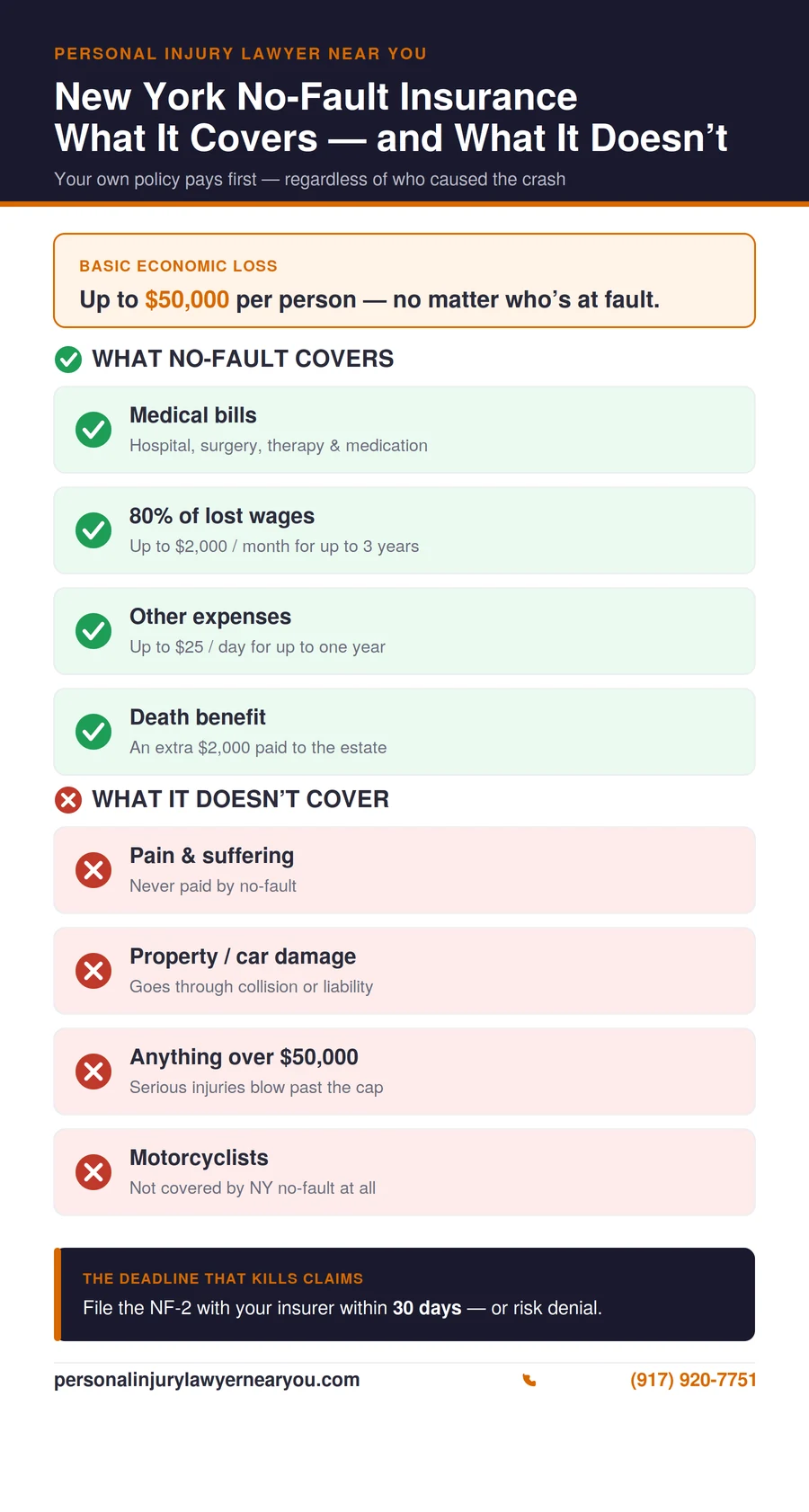
Every registered vehicle in New York must carry no-fault coverage, formally called Personal Injury Protection (PIP). After a crash, your own insurer pays your “basic economic loss” — up to $50,000 per person — no matter who was at fault. The purpose of New York no-fault insurance is simple: get injury victims treated and paid quickly, without waiting years for a liability fight to settle.
No-fault covers the driver, passengers, and even pedestrians struck by the vehicle. One important exception: motorcyclists are not covered by New York’s no-fault system. If you were hurt in a standard car crash, though, PIP is where your recovery starts — and a Manhattan car accident lawyer can make sure your insurer actually pays what the law requires.
What No-Fault (PIP) Actually Covers
Within that $50,000 limit, New York no-fault insurance pays for the real, out-of-pocket costs of your injury:
- Medical expenses — reasonable and necessary hospital, doctor, surgery, X-ray, physical therapy, and medication costs.
- Lost earnings — 80% of your gross wages, up to $2,000 per month, for up to three years.
- Other necessary expenses — up to $25 per day for up to a year, covering things like transportation to treatment or household help.
- Death benefit — an additional $2,000 paid to the estate in a fatal crash.
All of these share the same $50,000 pool of basic economic loss. If you expect higher medical bills or lost income, New York lets you buy extra coverage (OBEL or additional PIP) before an accident ever happens.
What No-Fault Does NOT Cover
This is where most people get blindsided. No-fault is deliberately narrow, and it leaves out the biggest parts of a serious claim:
- Pain and suffering — no-fault never pays for this.
- Property damage — your car repairs go through collision or liability coverage, not PIP.
- Anything above $50,000 — serious injuries blow past that cap quickly.
- Non-economic damages — unless your injury meets New York’s serious injury threshold.
That gap is exactly why serious injuries need a separate liability claim against the at-fault driver. Before you accept any number, it helps to know what your case is really worth — a free personal injury settlement calculator gives you a realistic starting estimate.
The 30-Day Deadline That Wrecks Most Claims
Here is the single most expensive mistake people make with New York no-fault insurance: they wait. You must notify your own insurer in writing within 30 days of the accident, using the no-fault application (form NF-2). On top of that, medical providers generally must submit their bills within 45 days of treatment.
Miss the 30-day window and the insurer can deny an otherwise valid claim outright — no matter how badly you were hurt. That’s why acting fast matters, and why a Queens car accident lawyer will file your paperwork immediately rather than let the clock run.
📄 Free PDF: Every New York Injury Deadline
The 30-day no-fault rule is one of several early deadlines. Our free New York injury deadlines cheat sheet lists them all, including the 90-day notice of claim, and shows where to send each one.
When You Can Step Outside No-Fault and Sue
No-fault keeps most minor claims out of court. But when your injuries are serious, New York lets you step outside the system and sue the at-fault driver for full damages, including pain and suffering. To qualify, your injury must meet the “serious injury” threshold under Insurance Law § 5102(d) — such as a fracture, significant disfigurement, or a permanent or significant limitation of a body part or function. The 2026 reform removed the old category for injuries that kept you from your usual activities for 90 of the first 180 days, for lawsuits started on or after May 26, 2026.
Once you cross that threshold, fault becomes everything — and so does proving it. If you were rear-ended, for example, the law already leans in your favor; our guide on who is at fault in a rear-end collision breaks down how liability is decided. A Bronx car accident lawyer can tell you quickly whether your injury clears the threshold.
How to File a No-Fault Claim in NYC
Filing correctly protects both your health and your money. Follow these steps in order:
- Report the crash and get the police report — it anchors the facts and timeline.
- Notify your own insurer within 30 days — submit the NF-2 no-fault application in writing.
- Get medical treatment immediately — and tell every provider it’s a no-fault claim so they bill correctly.
- Keep every record — bills, wage statements, mileage, and out-of-pocket receipts.
- Make sure bills are submitted within 45 days — follow up with providers so nothing slips past the deadline.
If the process feels overwhelming while you’re trying to heal, a Staten Island car accident lawyer can handle the filings and deadlines for you.
Common Reasons No-Fault Claims Get Denied
Insurers look for any technical reason to cut off benefits. The most common denials come from:
- Missing the 30-day filing deadline.
- A gap or delay in medical treatment after the crash.
- Missing a scheduled independent medical exam (IME).
- An IME doctor declaring you “no longer injured.”
- An incomplete or inconsistent NF-2 application.
- The insurer claiming your injury wasn’t caused by the accident.
Most of these are avoidable — and many wrongful denials can be challenged. Don’t assume “denied” means the end of your claim. If your crash happened in Brooklyn, a Brooklyn car accident lawyer can challenge a wrongful denial and get your benefits reinstated.
Key Takeaways
✅ New York no-fault insurance (PIP) pays up to $50,000 for medical bills and lost wages — regardless of fault
✅ You file with your own insurer, and you must notify them in writing within 30 days
✅ No-fault never covers pain and suffering, property damage, or amounts above $50,000
✅ Motorcyclists are not covered by New York’s no-fault system
✅ You can sue for full damages only if your injury meets the serious injury threshold under § 5102(d)
Frequently Asked Questions
How much does no-fault insurance pay in New York?
New York no-fault insurance pays up to $50,000 in basic economic loss per person. This covers reasonable medical expenses, 80% of lost wages up to $2,000 per month, and other necessary expenses up to $25 per day. Higher limits are available if you purchase optional additional coverage before an accident.
Does no-fault cover pain and suffering?
No. No-fault insurance never covers pain and suffering. You can only recover pain and suffering by filing a liability claim against the at-fault driver, and only if your injury meets New York’s serious injury threshold under Insurance Law § 5102(d).
How long do I have to file a no-fault claim in New York?
You must notify your own insurer in writing within 30 days of the accident using the NF-2 application, and medical bills must generally be submitted within 45 days of treatment. Missing these deadlines can cause an otherwise valid claim to be denied.
Does no-fault insurance cover motorcycle accidents in New York?
No. New York’s no-fault (PIP) system does not cover motorcycle riders. Injured motorcyclists must seek compensation through the at-fault driver’s liability coverage or their own optional insurance, which makes these claims more complex than standard car accident claims.
Can I still sue if New York is a no-fault state?
Yes, but only if your injuries meet the serious injury threshold under Insurance Law § 5102(d), such as fractures, permanent limitations, or a disability lasting at least 90 days. If you qualify, you can sue the at-fault driver for pain and suffering and damages beyond the $50,000 no-fault limit.
Get a Free Case Review
Confused about what your no-fault policy actually owes you — or already been denied? You don’t have to fight the insurance company alone. Get a free, no-obligation case review today and find out exactly what you’re entitled to and whether you can claim beyond the $50,000 limit.
Find Out What Your No-Fault Claim Is Really Worth
Free case review. No win, no fee. No upfront cost.
