
TL;DR — Quick Summary
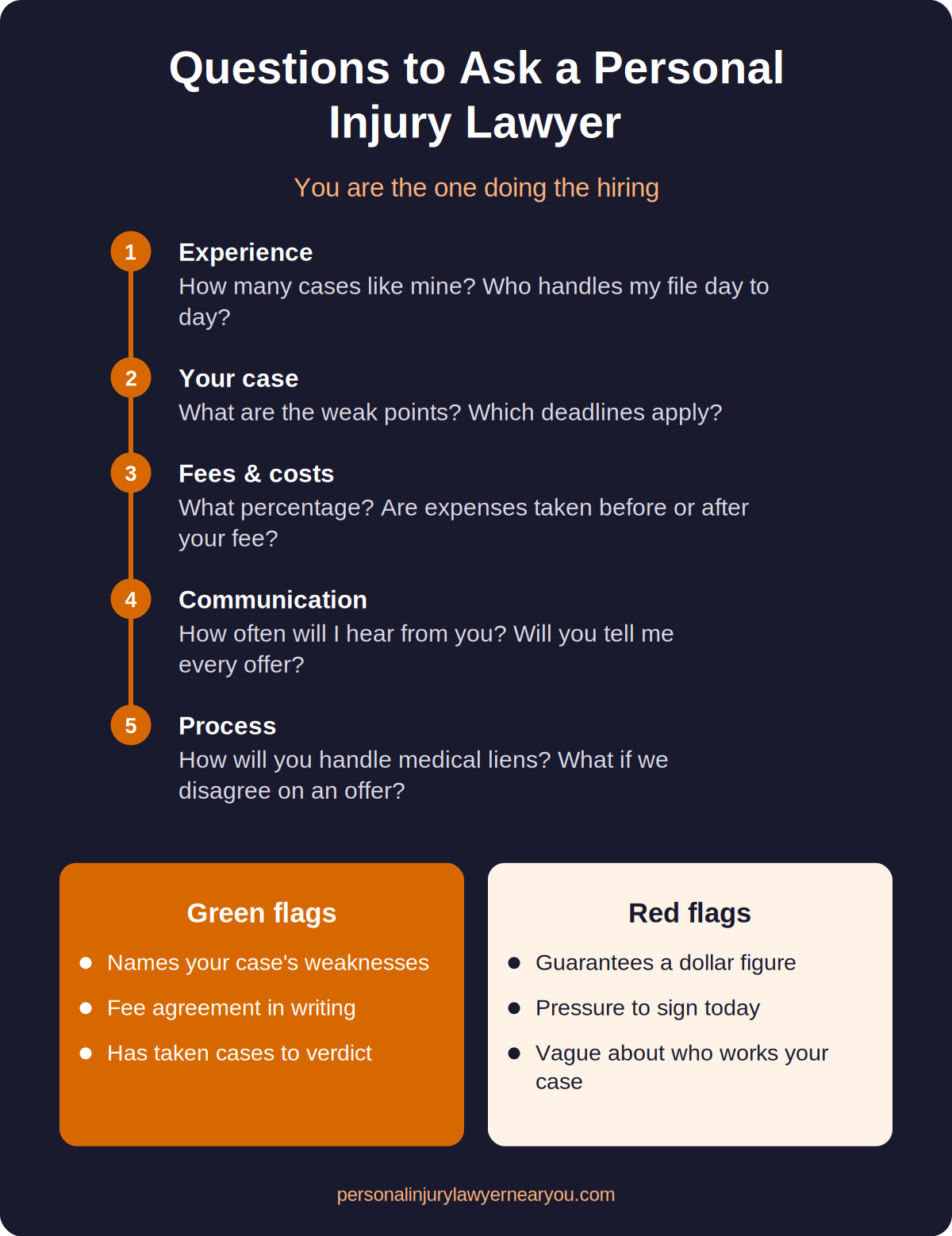
The first meeting with a personal injury lawyer is a job interview — and you are the one hiring. Below are 20 questions grouped into five areas: experience, your case, fees and costs, communication, and process. The most important ones: who will actually handle your file, whether case expenses come out before or after the lawyer’s percentage, and how often you will hear from them. Be wary of any lawyer who guarantees a number or pushes you to sign on the spot.
Most people walk into a consultation and let the lawyer do all the talking. That is a missed chance. Knowing the right questions to ask a personal injury lawyer helps you compare firms, avoid surprises over fees, and pick someone who will actually fight for your claim.
This is a question checklist. If you want to know how the meeting itself runs — how long it takes and what the lawyer will ask you — see our guide to what happens at a personal injury consultation.
Before You Ask: Print This List
Take the questions with you and write the answers down. If you are meeting more than one firm — and you should, since the first meeting is usually free — written notes are the only fair way to compare. If you have not shortlisted anyone yet, start with our guide on how to find a personal injury lawyer after an accident.
Questions About Experience (1–4)
| Question | Why it matters / red flag |
|---|---|
| 1. How many cases like mine have you handled? | A truck crash, a fall on a city sidewalk and a construction injury each have their own rules. Red flag: vague answers like “we handle everything.” |
| 2. Who will work on my case day to day? | The lawyer you meet may hand the file to a junior associate or case manager. Ask to meet them. |
| 3. How many cases have you taken to trial? | Insurers pay more when they believe a lawyer will go to court. Red flag: none, ever. |
| 4. Are you in good standing with the state bar? | You can usually verify this yourself on the state court or bar website. Any public discipline is worth asking about. |
Questions About Your Case (5–8)
| Question | Why it matters / red flag |
|---|---|
| 5. What are the weak points in my case? | An honest lawyer names them. Red flag: a lawyer who says there are none. |
| 6. Which deadlines apply to me? | The statute of limitations is only one of them — claims against a city or public agency can need a notice within weeks. |
| 7. How will you work out what my case is worth? | Listen for a method — medical records, lost income, insurance limits. Red flag: a big number promised on day one. |
| 8. How long do you expect this to take? | Nobody can promise a date, but they should explain the stages and what could slow things down. |
Questions About Fees and Costs (9–13)
Most injury lawyers work on a contingency fee, but the details differ from firm to firm — and the details are where the money is.
| Question | Why it matters / red flag |
|---|---|
| 9. What percentage do you take — and does it change if we file suit or go to trial? | Many agreements step up at each stage. Know every tier. |
| 10. Are expenses taken out before or after your fee? | On a large case, this one detail can be worth thousands to you. |
| 11. Do I owe expenses if we lose? | Some firms absorb them; others can bill you. Get the answer in the contract. |
| 12. Will I get the fee agreement in writing? | It should be in writing and signed. Red flag: a lawyer who wants to “sort out the paperwork later.” |
| 13. Will I get a written breakdown when the case ends? | You should see exactly where every dollar went — fee, expenses, liens, and your share. |
Questions 12 and 13 are not just good practice. Under ABA Model Rule 1.5, which most states follow, a contingency fee agreement must be in writing and signed by the client, and the lawyer must give a written statement of the outcome and how the money was divided. For typical rates, see our breakdown of personal injury lawyer fees in New York.
Questions About Communication (14–17)
| Question | Why it matters / red flag |
|---|---|
| 14. How often will I hear from you? | Agree a rhythm now — monthly, or after each major step. |
| 15. Who do I call with a question, and how fast will they reply? | Unreturned calls are the most common complaint clients have about their lawyers. |
| 16. Will you tell me about every settlement offer? | The decision to settle is yours, not the lawyer’s. The answer should be an immediate yes. |
| 17. Will you keep my case, or refer it to another firm? | Some firms sign cases and pass them on. You deserve to know who your lawyer really is. |
Good communication is also an ethical duty. ABA Model Rule 1.4 requires lawyers to keep clients reasonably informed about the status of their matter and to respond promptly to reasonable requests for information.
Questions About the Process (18–20)
- 18. What should I do — and not do — right now? Expect advice on talking to adjusters, posting on social media, and keeping up with medical treatment.
- 19. How will you handle my medical bills and liens? Health insurers and hospitals often have a right to be repaid from the settlement. A good lawyer negotiates those liens down.
- 20. What happens if we disagree about an offer? You want a lawyer who gives a clear recommendation but respects that the final call is yours.
Red Flags to Walk Away From
- A guaranteed result or a specific dollar figure at the first meeting
- Pressure to sign the retainer before you leave the room
- Someone who contacted you uninvited after the accident
- No clear answer on who will handle your file
- A firm that seems to run on volume, with quick settlements and little contact — the hallmarks of a settlement mill
How to Compare Answers to These Questions to Ask a Personal Injury Lawyer
A list of questions to ask a personal injury lawyer only helps if you can compare the answers. After two or three consultations, the details blur together. A simple scoring sheet fixes that.
Score each lawyer on five things
- Relevant experience (1–5). Did they give specific numbers and examples for cases like yours, or general reassurance?
- Honesty about weaknesses (1–5). The lawyer who names the problems in your case is the one most likely to solve them.
- Fee clarity (1–5). Could they explain the percentage, the expenses and the order they come out in, without hesitation?
- Communication plan (1–5). Did they commit to a specific update schedule and a named contact?
- Trial readiness (1–5). Have they taken cases to verdict, and did they talk about preparing yours that way?
Add the scores, but do not let the total decide alone. A lawyer who scores 4 everywhere and gives you a clear, written fee agreement is usually a safer choice than one with a dazzling trial record who cannot say who will actually handle your file.
What to bring so the answers are specific
Lawyers can only give real answers to real facts. Bring the accident report, photos, your insurance details and the other party’s, a list of your doctors and treatment dates, proof of missed work, and any letters or offers from an insurer. With those in hand, the questions to ask a personal injury lawyer stop being theoretical — you will hear how each one would actually run your case.
Finally, notice how the meeting felt. Did they listen, or talk over you? Did they pressure you to sign? You may be working with this person for a year or more, and trust matters as much as any score.
Frequently Asked Questions
What should I ask a personal injury lawyer at the first consultation?
Focus on four things: their experience with cases like yours, who will handle your file day to day, exactly how the fee and expenses work, and how often they will update you. Also ask what weaknesses they see in your case and which deadlines apply.
What should I bring to a personal injury consultation?
Bring the police or incident report, photos, insurance details for both sides, medical records and bills, proof of lost wages, and any letters or offers from an insurance company. A written timeline of what happened and your treatment also helps.
Is the first consultation with a personal injury lawyer free?
Almost always. Most personal injury lawyers offer a free case review and work on contingency, so you pay nothing unless they recover money for you. Ask them to confirm this in writing.
What are red flags when interviewing a personal injury lawyer?
Be cautious if a lawyer guarantees a specific amount, pressures you to sign on the spot, cannot say who will handle your case, avoids explaining fees and expenses, or has never taken a case to trial.
How often should my personal injury lawyer update me?
There is no fixed rule, but lawyers must keep clients reasonably informed and respond promptly to reasonable requests for information. Agree at the start how often you will hear from them, such as monthly or after every major step.
Can I interview more than one personal injury lawyer?
Yes, and it is a good idea. Free consultations let you compare experience, fees and how each lawyer communicates before you sign anything. You are not committed until you sign a retainer agreement.
Key Takeaways
✅ Treat the consultation as an interview — you are the one hiring
✅ Find out who will actually handle your case day to day
✅ Ask whether expenses come out before or after the lawyer’s percentage
✅ Get the fee agreement in writing and a written breakdown at the end
✅ Walk away from guarantees, pressure to sign, or vague answers
Ask Us Anything
Bring this list to your case review. We will answer every question on it — fees, expenses, timelines and who handles your file — before you are asked to sign anything.
Got Questions About Your Injury Claim? Get Straight Answers
Free case review. No win, no fee. No upfront cost.
