
TL;DR — Quick Summary
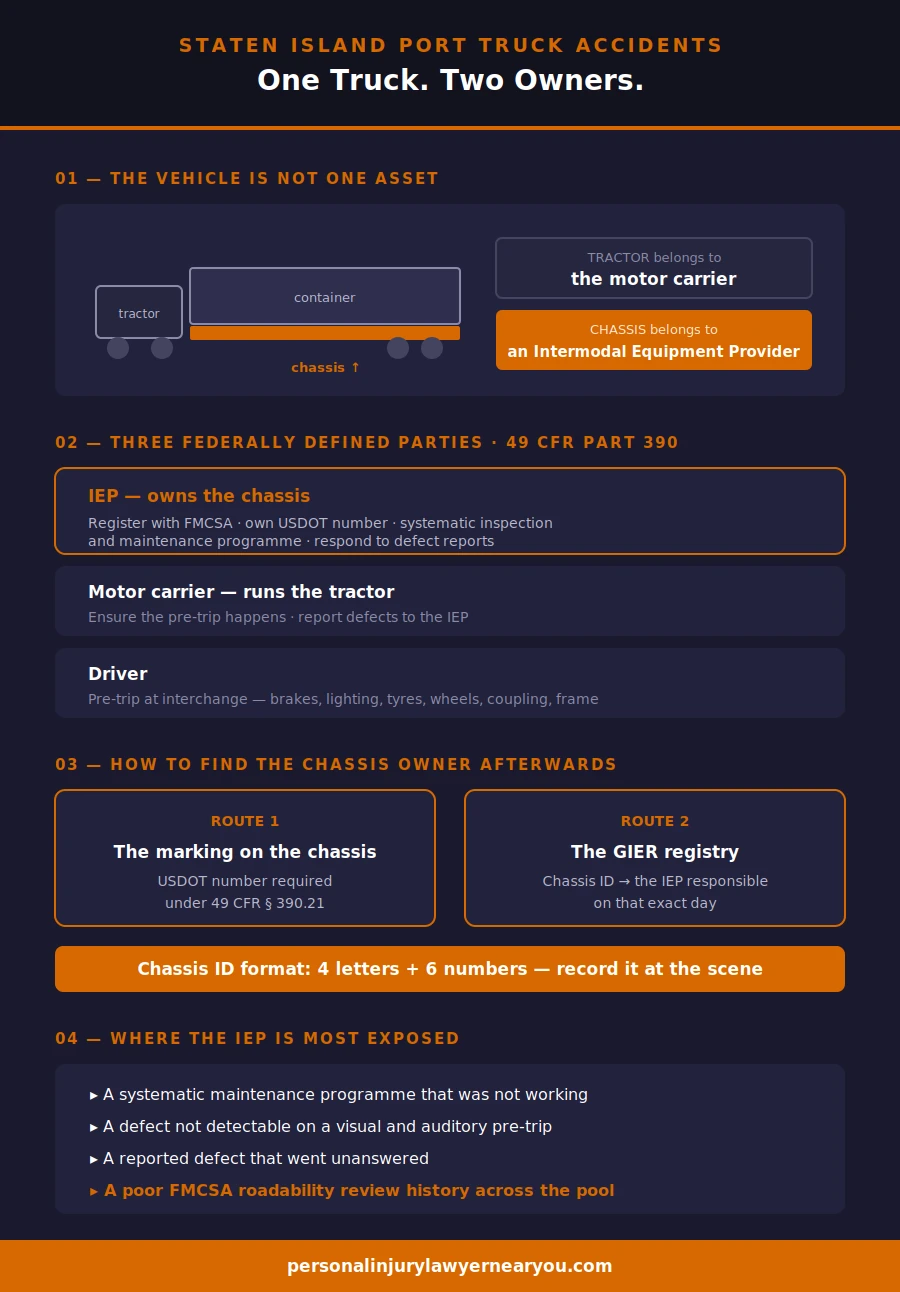
A container truck is not one vehicle. The tractor belongs to the carrier — but the chassis underneath the container usually belongs to somebody else entirely: an Intermodal Equipment Provider. Since 2008, federal rules require every IEP to register with FMCSA, hold its own USDOT number, mark it on each chassis, and run a systematic inspection and maintenance programme. If a brake, tyre or light on that chassis failed, the IEP is a separate defendant with separate insurance — and a federal database records which IEP was responsible for that exact chassis on that exact day. Almost no claim ever names them.
A Staten Island port truck accident gets treated like any other truck crash. One truck, one driver, one company to claim against.
Look at the vehicle again. The tractor at the front is one asset. The steel frame under the container is a completely different one, owned by a different company, maintained under a different programme, carrying a different USDOT number — and frequently the thing that actually failed.
Why Staten Island Has This Problem at All
Staten Island’s western shore holds the city’s container terminal at Howland Hook. Boxes come off ships there and leave by road, which means drayage — the short-haul movement of containers between the port and warehouses, rail yards and distribution centres.
Those trucks feed straight onto the West Shore Expressway and the Staten Island Expressway, and from there across the bridges. So a borough of half a million people absorbs a steady flow of container traffic that has nothing to do with anyone living there.
Drayage also runs on thin margins with tight terminal appointment windows, and a very high proportion of drivers are engaged as owner-operators rather than employees. Both facts matter when you start looking for who is actually responsible.
Three Federally Defined Parties, One Truck
Intermodal is the only category of trucking where federal regulation splits responsibility across three separate parties by name. The framework comes from the FMCSA’s 2008 final rule on intermodal equipment providers, implementing section 4118 of SAFETEA-LU.
| Party | What the rules require of them | What it means for your claim |
|---|---|---|
| Intermodal Equipment Provider owns the chassis |
Register with FMCSA on Form MCS-150C, hold a USDOT number, mark it on each chassis, run a systematic inspection, repair and maintenance programme, keep the records, and respond to defect reports | A separate defendant with separate insurance — and the one almost never named |
| Motor carrier runs the tractor |
Ensure the driver pre-trip inspection happens before accepting the chassis, and report defects to the IEP | The usual defendant — vicarious liability plus its own supervision failures |
| Driver | Conduct the pre-trip inspection at the interchange, covering brakes, lighting, tyres, wheels, coupling and frame, and report deficiencies | Where classified as an owner-operator, this raises its own employment question |
The top row is the one that changes cases. An IEP that let a chassis into service with worn brakes or a failing tyre is not a bystander — it is a regulated entity that breached a federal duty it was specifically assigned.
How to Identify the Chassis Owner After the Fact
This is the part that makes the claim practical rather than theoretical, and it is unusually well documented.
Every chassis offered for interstate transportation must be marked with the IEP’s USDOT number under 49 CFR § 390.21. That marking alone is often enough.
Beyond that, the industry maintains the Global Intermodal Equipment Registry — a centralised database identifying each chassis by its unique alphanumeric identifier, four letters followed by six numbers, together with the USDOT number of the IEP responsible for that equipment on a given day and at any given time. It was built so enforcement officers could record the responsible IEP accurately on a roadside inspection.
So the chassis number in the police report can lead to the company that owned the safety duty on the date of your crash. That is a far cleaner evidentiary path than most trucking claims ever offer.
Where the Line of Responsibility Falls
It is worth being straight about the limits here, because the IEP is not liable for everything that happens to a chassis.
The driver performs a pre-trip inspection at the interchange point — and the IEP must provide adequate space for it to happen. Once the driver accepts the equipment and takes it onto the road, the driver is generally treated as having confirmed that the inspected components were in working order. A failure in one of those components afterwards tends to fall toward the motor carrier rather than the IEP.
Where the IEP’s exposure is strongest is different: a systematic maintenance failure, a defect not detectable on a visual and auditory pre-trip, a documented defect report that went unanswered, or a pattern across a chassis pool. FMCSA conducts roadability reviews of IEPs precisely to assess compliance with Parts 390, 393 and 396, can cite them and impose civil penalties, and where equipment presents an imminent hazard can prohibit the IEP from offering it at all.
That regulatory history is discoverable, and a poor one reframes a single crash as the predictable result of a programme that was not working.
The Owner-Operator Question
Port drayage is dominated by drivers engaged as independent contractors rather than employees, and carriers rely on that classification when a claim arrives.
It is not the shield it is presented as. Vicarious liability is only one route to a carrier — a claim built on the company’s own conduct in scheduling, routing, equipment selection and supervision survives an argument about employment status, because it does not depend on it. The same reasoning runs through our post on truck route violations.
Coverage matters here too. A small drayage operator’s policy can be far thinner than people assume, which is set out in our breakdown of when the $750,000 federal minimum does not apply. An IEP is often a substantially larger entity than the carrier hauling its chassis.
What to Capture at the Scene
| What to record | Why it matters |
|---|---|
| The chassis ID — four letters, six numbers | Leads through GIER to the IEP responsible that day |
| The USDOT number on the chassis | Required marking under § 390.21 — identifies the IEP directly |
| The USDOT number on the tractor | A different company — identifies the motor carrier |
| Photographs of brakes, tyres, lights and coupling | The components the pre-trip covers — condition evidence disappears on repair |
| The container number and steamship line | Establishes the move, the terminal and the appointment window |
| Any interchange or inspection paperwork | Shows what was recorded at the gate, and by whom |
The first two rows are the entire point, and they take thirty seconds. Everyone photographs the tractor. Almost nobody photographs the plate on the chassis. The general sequence is covered in our guide on what to do after a truck accident in New York.
Where It Happened Still Matters
A container truck crash on Staten Island carries all the location questions covered elsewhere in this series. On the West Shore or Staten Island Expressway, a road-condition claim runs against the State through the Court of Claims on a ninety-day clock — see our post on Staten Island Expressway truck crashes. On the Goethals or Outerbridge, the Port Authority’s one-year limit applies instead, covered in our post on Staten Island bridge truck accidents.
The usual New York rules apply throughout: 30 days for your no-fault application, the serious injury threshold under Insurance Law § 5102(d) for pain and suffering, and comparative negligence reducing recovery by your share of fault — with a plaintiff found mostly at fault unable to recover non-economic damages under the 2026 reform.
Frequently Asked Questions
What is an intermodal equipment provider?
An IEP is any entity that interchanges intermodal equipment with a motor carrier under a written agreement, or that has contractual responsibility for maintaining that equipment. In practice it is the company that owns the container chassis. Since 2008 IEPs must register with FMCSA, hold a USDOT number, and operate a systematic inspection, repair and maintenance programme for every chassis they offer.
Can I sue the chassis owner as well as the trucking company?
Where a chassis defect contributed to the crash, yes. The IEP carries federally defined duties of its own and typically has separate insurance. It is a distinct defendant from the motor carrier operating the tractor, and it is frequently a larger organisation.
How do I find out who owned the chassis?
Two routes. Each chassis offered in interstate transportation must be marked with the IEP’s USDOT number under 49 CFR § 390.21. There is also the Global Intermodal Equipment Registry, which links a chassis to the USDOT number of the IEP responsible for it on a given day — so the chassis identifier recorded at the scene can be traced back even after the equipment has moved on.
Is the IEP responsible for every chassis defect?
No. The driver conducts a pre-trip inspection at interchange, and once the equipment is accepted the inspected components are generally treated as having been confirmed in working order, which shifts later failures toward the motor carrier. The IEP’s exposure is strongest where the maintenance programme itself failed, where a defect was not detectable on a pre-trip, or where a reported defect went unaddressed.
Does it matter that the driver was an owner-operator?
It affects one route to the carrier but not all of them. Vicarious liability depends on the employment relationship, so classification is contested there. A claim built on the company’s own conduct — scheduling, routing, equipment selection, supervision — does not depend on employment status and survives that argument.
What is a roadability review?
It is an on-site FMCSA examination of an intermodal equipment provider’s compliance with Parts 390, 393 and 396. FMCSA can cite an IEP for non-compliance and impose civil penalties, and where equipment presents an imminent hazard it can prohibit the IEP from offering that equipment. A poor review history is relevant evidence in a chassis defect claim.
Key Takeaways
✅ The chassis is usually owned by a different company than the tractor
✅ That company must hold a USDOT number and mark it on the chassis
✅ A federal registry records which IEP was responsible on which day
✅ IEP exposure is strongest on systematic maintenance failures
✅ Photograph the chassis plate — everyone photographs the tractor instead
Find Out Who Really Owned the Truck That Hit You
Container traffic is the one area of trucking where federal law hands you a second defendant and a database to find them with. It is also the one most consistently left out of claims, because the chassis looks like part of the truck. Speak to a Staten Island truck accident lawyer before the equipment goes back into the pool. The framework is the same as any Staten Island personal injury claim, with an extra regulated party sitting behind it. The case review is free, and there is no fee unless you win.
Talk to a Staten Island Truck Accident Lawyer Today
Free case review. No win, no fee. No upfront cost.
Want more NYC injury guides and legal news from PILNY in your Google results?
