
TL;DR — Quick Summary
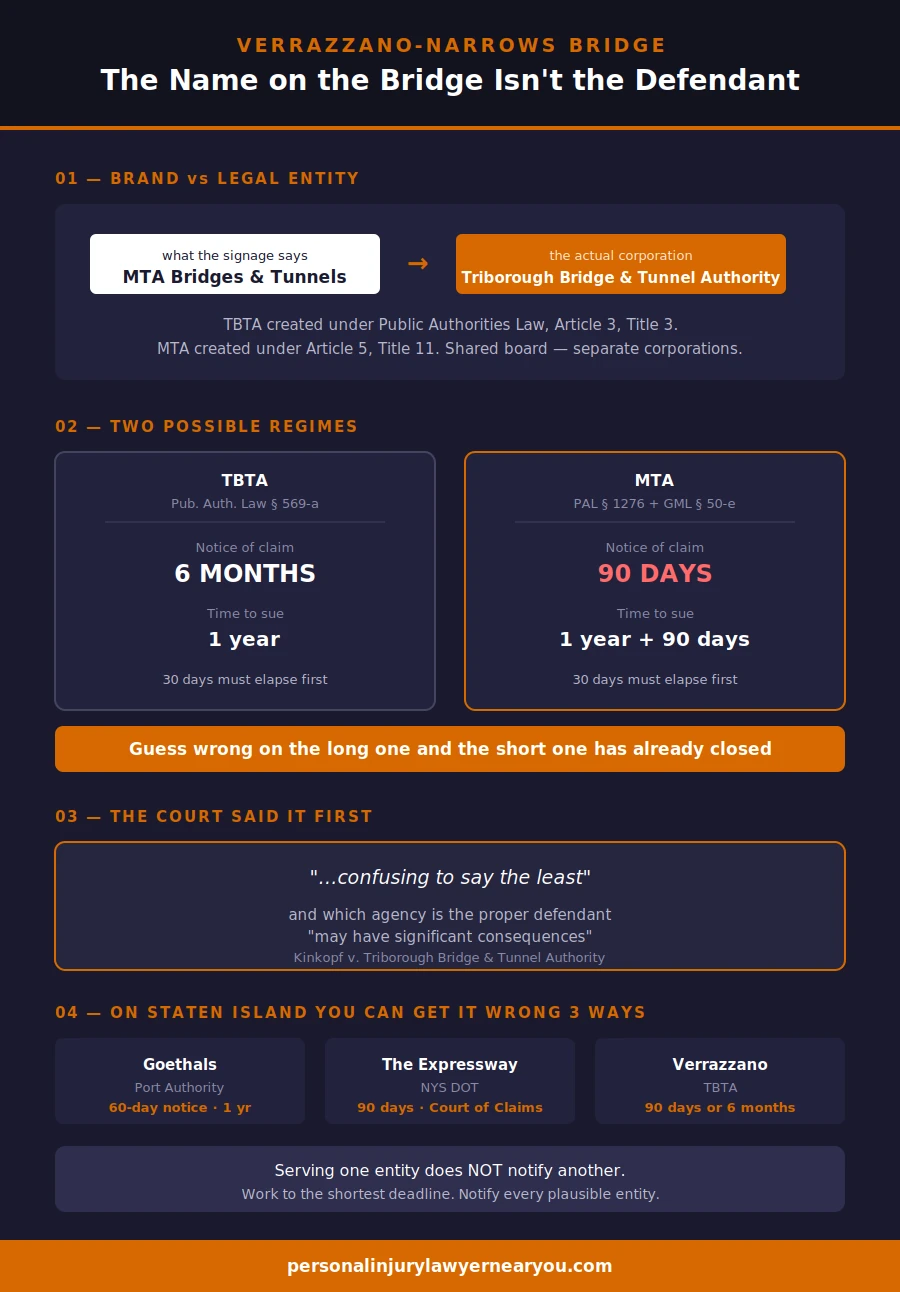
The Verrazzano-Narrows is signed as MTA Bridges and Tunnels — but that is a brand, not a legal entity. The corporation behind it is the Triborough Bridge and Tunnel Authority, created under a different article of the Public Authorities Law than the MTA. Which one is the proper defendant can change your notice period from 90 days to six months and your limitation period from one year and 90 days to one year. A New York court has called the labelling “confusing to say the least” and noted the choice “may have significant consequences.” Serving the wrong entity does not protect you.
A Verrazzano Bridge truck accident produces one of the strangest questions in New York injury law: who exactly did you just have a crash with?
Not the driver — that part is straightforward. The bridge. Because the name on the signage is not the name of the thing that owns it, and the difference is measured in months of deadline.
The Name on the Bridge Is Not a Legal Entity
The Triborough Bridge Authority was created in 1933. In 1946 it was reorganised as the Triborough Bridge and Tunnel Authority, and in 1994 it began operating under the trading name MTA Bridges and Tunnels. That is the name you see on the toll gantries and the patch on the officer’s shoulder.
Underneath it, the TBTA remains a separate public benefit corporation. It was created under Article 3, Title 3 of the Public Authorities Law. The Metropolitan Transportation Authority was created under Article 5, Title 11. They share a governing board under section 552 — but sharing a board does not make them the same defendant.
In Kinkopf v. Triborough Bridge & Tunnel Authority, the court addressed this directly. It observed that the TBTA “exists separate and apart from” the MTA, said the labelling as “MTA Bridges and Tunnels” was confusing to say the least, and warned that which agency is the proper defendant “may have significant consequences.”
When a court says the branding of a public authority is confusing, that is not a technicality. That is a warning.
Two Possible Regimes, and They Are Not Close
Depending on which entity is properly named, a tort claim arising on the Verrazzano can fall under two quite different sets of rules.
| TBTA as its own authority Public Authorities Law § 569-a |
MTA as the proper defendant PAL § 1276 with GML § 50-e |
|
|---|---|---|
| Notice of claim | Within six months of accrual | Within 90 days of the event |
| Waiting period | 30 days must elapse before suit | 30 days must elapse before suit |
| Time to sue | One year after accrual | One year and 90 days |
| Wrinkle | If TBTA is treated as an MTA subsidiary corporation, no notice of claim may be required at all | Naming the parent does not automatically reach an affiliate or subsidiary |
Look at the shortest number in that table. If you assume the six-month notice period applies and it turns out to be ninety days, you have already lost by the time you find out.
Serving One Entity Does Not Notify Another
This is the practical trap, and it is not unique to the Verrazzano — it runs through the whole MTA family.
The MTA, New York City Transit Authority, MTA Bus Company, the Triborough Bridge and Tunnel Authority and the City of New York are separate legal entities. Serving one does not automatically provide legal notice to another, and New York courts have continued to emphasise that knowledge held by one of these bodies is not simply imputed to the others.
The practical consequence is unforgiving: a notice of claim sent to the wrong entity comes back, and if the shorter window has closed by the time the error surfaces, the claim is barred. That is the same failure mode covered in our post on Port Authority bridge claims — where naming the MTA does nothing to preserve a claim that belongs to the Port Authority.
Staten Island is the one place in New York City where you can get this wrong in three different directions on the same journey. The Goethals belongs to the Port Authority. The Verrazzano belongs to the TBTA. The expressway between them belongs to the State, with its own Court of Claims procedure covered in our post on Staten Island Expressway crashes.
The Safe Approach
Where the correct defendant is genuinely arguable — and here it is — the working answer is to proceed on the shortest applicable deadline and to notify every plausible entity rather than choosing between them.
A notice served on an entity that turns out not to be liable costs nothing. A notice not served on the entity that is liable ends the case. Those two outcomes are not symmetrical, and the strategy follows from that.
There is also a limited safety valve. General Municipal Law § 50-e permits a court to grant permission to serve a late notice of claim in certain circumstances — but it is discretionary, it must be applied for within the limitation period, and it is not something to plan around.
Why the Verrazzano Concentrates Truck Traffic
The Verrazzano-Narrows is the only road link between Staten Island and the rest of New York City. Everything moving by truck between New Jersey and Brooklyn or Queens crosses it, having already crossed the Goethals or the Outerbridge and traversed the expressway.
That produces a specific set of conditions: sustained grades on both approaches, high crosswinds over the Narrows, a double-deck structure, and toll infrastructure that changes traffic patterns at the approaches. Heavy vehicles behave differently in all four.
And because most of those trucks have neither an origin nor a destination on Staten Island, the through-route obligations discussed in our post on truck route violations apply to the journey as a whole.
What to Establish Immediately
- Which deck and which direction — upper or lower, Brooklyn-bound or Staten Island-bound
- Whether you were on the span, the approach, or past the toll plaza — the boundary between authorities sits somewhere in that stretch
- Which police agency responded — Bridge and Tunnel Officers, NYPD and State Police generate different reports
- Toll and gantry timestamps, which fix the crossing precisely
- The carrier’s USDOT number, which opens the private claim on its ordinary three-year track
- Weather and wind conditions, which matter more here than almost anywhere else in the city
The second item is the one that decides everything else, and it is the one nobody records. The general sequence is covered in our guide on what to do after a truck accident in New York.
The New York Rules That Still Apply
Whoever the defendant turns out to be, you still have 30 days to file your no-fault application. The serious injury threshold under Insurance Law § 5102(d) governs pain and suffering. Comparative negligence reduces recovery by your share of fault, and under the 2026 reform a plaintiff found mostly at fault cannot recover non-economic damages at all. Our free settlement calculator gives you a working range before any figure is discussed.
Frequently Asked Questions
Who owns the Verrazzano-Narrows Bridge?
It is operated by the Triborough Bridge and Tunnel Authority, a public benefit corporation created under Article 3, Title 3 of the Public Authorities Law. Since 1994 the TBTA has traded under the name MTA Bridges and Tunnels, which is a brand rather than a separate legal entity. The MTA itself was created under a different article of the same law.
How long do I have to file a claim after a Verrazzano Bridge accident?
It depends on which entity is the proper defendant, and that is genuinely arguable. A tort claim against the TBTA under Public Authorities Law § 569-a involves a notice of claim within six months, a 30-day waiting period, and suit within one year. Where the MTA is the proper defendant, Public Authorities Law § 1276 applies General Municipal Law § 50-e, which requires a notice of claim within 90 days. Because the shorter period governs if you guess wrong, these claims are worked to 90 days.
Why is it unclear which entity to sue?
Because the TBTA and the MTA share a governing board while remaining separate corporations created under different provisions, and because the TBTA trades under a name that includes “MTA”. A New York court addressing this described the labelling as confusing to say the least and noted that which agency is the proper defendant may have significant consequences.
If I serve the MTA, does that cover Bridges and Tunnels?
Not reliably. The MTA, the Triborough Bridge and Tunnel Authority, New York City Transit Authority, MTA Bus Company and the City of New York are separate entities, and serving one does not automatically provide legal notice to another. Courts have emphasised that knowledge held by one is not simply imputed to the others.
What if the crash was purely the truck driver’s fault?
Then your claim is against the carrier and runs on the ordinary three-year period with no notice of claim required. The authority only becomes a defendant where the structure, its maintenance, its signage or its traffic management contributed. The difficulty is that this is rarely clear within the first ninety days, which is why the shorter clock is treated as running from the outset.
Can I still act if I have missed the notice deadline?
Possibly. General Municipal Law § 50-e allows a court to grant permission to serve a late notice of claim in certain circumstances, but permission is discretionary and the application must be made within the applicable limitation period. It is a remedy for a missed deadline, not a substitute for meeting one.
Key Takeaways
✅ “MTA Bridges and Tunnels” is a trading name — the entity is the TBTA
✅ Notice may be 90 days or six months depending on the proper defendant
✅ A court has called the labelling “confusing to say the least”
✅ Serving one MTA-family entity does not give notice to another
✅ Work to 90 days and notify every plausible entity — the errors are not symmetrical
Do Not Guess Which Authority You Are Suing
This is one of the few areas of New York injury law where a court has openly said the naming is confusing — and the consequence of getting it wrong is not a delay but a dismissal. It is also entirely avoidable if it is addressed in the first weeks rather than the last. Speak to a Staten Island truck accident lawyer before any of these windows close. The framework is the same as any Staten Island personal injury claim, with an identification question sitting in front of everything else. The case review is free, and there is no fee unless you win.
Talk to a Staten Island Truck Accident Lawyer Today
Free case review. No win, no fee. No upfront cost.
Want more NYC injury guides and legal news from PILNY in your Google results?
