
TL;DR — Quick Summary
PIP pays you. Bodily injury pays the other person. Personal injury protection covers your own medical bills and lost wages after a crash, regardless of fault. Bodily injury liability covers people you injure, and it’s the policy you claim against when someone else hits you. MedPay is a smaller, medical-only version of PIP used in some states. In New York you must carry $50,000 of PIP and at least $25,000/$50,000 of bodily injury liability. After a crash, PIP pays first; a bodily injury claim for pain and suffering comes later, if the injury is serious enough.
Personal injury protection vs bodily injury is one of the most confusing parts of an auto policy, partly because both have “injury” in the name. They pay different people, at different times, for different things. Getting them mixed up after a crash can mean missing a deadline or leaving money on the table.
This guide compares PIP, bodily injury liability and MedPay side by side, then shows how they work together after a New York accident. If you want the full rundown on PIP alone, our guide to personal injury protection insurance covers it in detail; here the focus is the comparison.
Personal Injury Protection vs Bodily Injury vs MedPay at a Glance
| Personal injury protection (PIP) | Bodily injury liability (BI) | Medical payments (MedPay) | |
|---|---|---|---|
| Who it pays | You and your passengers | People you injure | You and your passengers |
| Fault needed? | No | Yes, you must be at fault | No |
| Medical bills | Yes | Yes (the injured person’s) | Yes |
| Lost wages | Yes, partly | Yes, as damages | No |
| Pain and suffering | No | Yes | No |
| Required in NY? | Yes, $50,000 | Yes, $25k/$50k minimum | Not a standard NY coverage |
| Who files the claim | You, with your own insurer | The injured person, against your insurer | You, with your own insurer |
The simplest way to remember it: PIP and MedPay are first-party coverage, meaning you claim on your own policy. Bodily injury is third-party coverage, meaning someone else claims on it.
What Personal Injury Protection Pays
PIP is the core of no-fault insurance. In New York it pays up to $50,000 per person for reasonable medical treatment, a share of lost earnings, and some other expenses such as travel to medical appointments, whoever caused the crash. You must file a no-fault application with your insurer within 30 days. Our guide to New York no-fault insurance walks through the forms and deadlines.
What PIP doesn’t pay is just as important: nothing for pain and suffering, nothing for vehicle damage, and nothing once the $50,000 is used up. That is where bodily injury coverage comes in.
What Bodily Injury Liability Pays
Bodily injury liability is the at-fault driver’s coverage for the harm they cause. If another driver hits you, their BI coverage is what pays your claim for pain and suffering, medical costs beyond PIP and lost income above what PIP covered. If you cause a crash, your BI protects your own assets when the other person claims against you.
New York’s minimum is low. According to the New York Department of Financial Services, drivers must carry at least $25,000 for injury to one person and $50,000 per accident, plus $50,000 of no-fault coverage. A serious injury can easily exceed $25,000, which is why the other driver’s limit matters so much to your recovery.
The serious injury threshold
In New York you can’t bring a bodily injury claim for pain and suffering after a car crash unless your injury meets the “serious injury” threshold, such as a fracture, significant disfigurement or a permanent limitation. The 2026 reforms narrowed those categories; our article on the serious injury threshold after the 2026 changes explains what qualifies now.
Where MedPay Fits
MedPay is a simpler, medical-only coverage. It pays medical bills for you and your passengers regardless of fault, usually in smaller amounts, such as $1,000 to $10,000, and it doesn’t pay lost wages. It is common in states that don’t use no-fault. In New York, PIP already does this job and more, so MedPay is not a standard coverage here. New York drivers who want more first-party protection usually look at additional PIP or optional basic economic loss coverage instead.
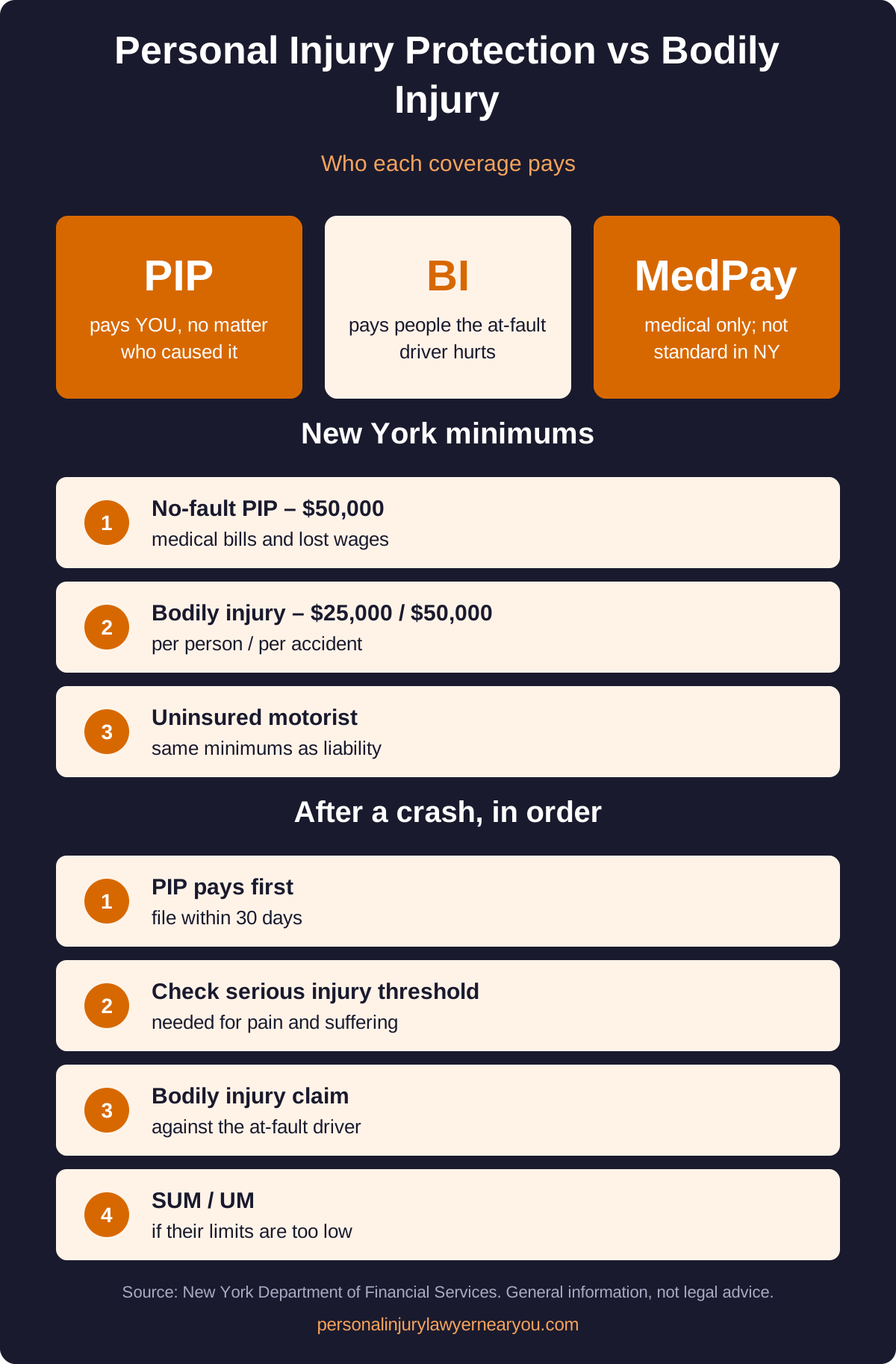
How PIP and Bodily Injury Work Together After a Crash
After a New York car accident, the two coverages work in sequence:
- Step 1: PIP pays first. Your own insurer pays medical bills and part of your lost wages up to $50,000, regardless of fault.
- Step 2: Check the threshold. If your injury qualifies as a serious injury, you can pursue the at-fault driver.
- Step 3: Bodily injury claim. You claim against the other driver’s BI policy for pain and suffering and for economic losses above PIP.
- Step 4: Uninsured or underinsured coverage. If the other driver has no insurance or too little, your own UM or SUM coverage may make up the difference.
That last step catches many people out. If the at-fault driver only carries $25,000 and your case is worth far more, your own supplementary coverage becomes the key source. Our guide to being hit by an uninsured driver in NYC covers UM, SUM and MVAIC.
Example: One Crash, Three Coverages
An illustrative example with made-up numbers. You are rear-ended in Queens and break your wrist, needing surgery.
| Loss | Who pays | Amount |
|---|---|---|
| Hospital, surgery, physical therapy | Your PIP | $38,000 |
| Lost wages (first months) | Your PIP | $12,000 |
| Remaining medical and lost wages above PIP | Other driver’s BI | $9,000 |
| Pain and suffering (serious injury met) | Other driver’s BI | Negotiated, up to their limit |
| Losses above the other driver’s limit | Your SUM coverage | If you bought it |
For a rough sense of what the pain and suffering part might be worth, our step-by-step guide to calculating a car accident settlement in New York shows how adjusters approach it.
Special Cases: Motorcyclists, Pedestrians and Passengers
The usual order of claims changes for some people:
- Motorcyclists. New York’s no-fault system does not cover motorcycle riders, so a rider usually has no PIP to fall back on and goes straight to the at-fault driver’s bodily injury coverage, with no serious injury threshold. Our guide on what to do after a motorcycle accident in Brooklyn explains why that matters.
- Pedestrians and cyclists. If you are hit while walking or biking, the PIP coverage on the vehicle that struck you usually pays your no-fault benefits, even if you don’t own a car.
- Passengers. A passenger generally claims PIP from the policy on the vehicle they were riding in, then a bodily injury claim against whichever driver was at fault, which can be their own driver.
Common Mistakes When People Mix Up PIP and Bodily Injury
- Waiting on the other driver’s insurer for medical bills. In New York your own PIP pays first. Missing the 30-day no-fault application can cost you those benefits.
- Settling the bodily injury claim too early. Once you sign a release with the at-fault driver’s insurer, you usually can’t reopen it, even if your injury turns out worse.
- Assuming PIP covers pain and suffering. It never does. That only comes through a bodily injury claim.
- Forgetting your own SUM coverage. If the other driver’s limit is too low, your SUM claim has its own notice rules, so tell your insurer early.
Personal Injury Protection vs Bodily Injury: Which Matters More When You Buy a Policy?
When you shop for car insurance, the comparison flips. Instead of asking who pays you after a crash, you are deciding how much protection to buy for yourself and for others.
Bodily injury protects your savings
If you cause a serious crash, the injured person can claim more than your bodily injury limit, and anything above it may come from your own assets. The $25,000 minimum is rarely enough for a serious injury. Many advisers suggest much higher limits, particularly if you own a home or have savings.
PIP protects your own recovery
Basic PIP of $50,000 can run out quickly after surgery or a long time off work. Additional PIP raises that ceiling and can pay lost wages longer, which matters if you are the main earner in your household.
Is personal injury protection redundant with good health insurance?
Not in New York. PIP is mandatory, pays before health insurance for accident injuries, and covers lost wages and some household expenses that health plans never touch. It also avoids deductibles and network limits for accident-related care.
Don’t skip SUM
Supplementary uninsured/underinsured motorist coverage lets you recover from your own policy when the at-fault driver’s bodily injury limit is too low. It is one of the most valuable and least understood coverages on a New York policy, and it usually costs relatively little. Many drivers choose SUM limits that match their own bodily injury limits, so they get back the same protection they give others.
A quick test when you review your policy: ask what would happen if you caused a crash that put someone in the hospital for a week, and what would happen if someone did that to you with only minimum coverage. If either answer worries you, raise your bodily injury limit, add PIP or buy SUM.
In short, when comparing personal injury protection vs bodily injury, think of PIP as protecting you and bodily injury as protecting everyone else from you. A well-built policy has enough of both, plus SUM to cover drivers who don’t.
Frequently Asked Questions
What is the difference between personal injury protection and bodily injury coverage?
Personal injury protection (PIP) pays your own medical bills and lost wages after a crash, no matter who caused it. Bodily injury liability pays other people you injure when the crash is your fault, and it is the coverage you claim against when another driver hurts you.
Is bodily injury liability the same as personal injury protection?
No. Bodily injury liability protects you if you injure someone else, and that person claims against your policy. Personal injury protection protects you and your passengers, paying your own medical costs and part of your lost income regardless of fault.
What is the difference between MedPay and personal injury protection?
MedPay pays medical expenses for you and your passengers regardless of fault, usually with lower limits and no lost wage benefits. PIP is broader, covering medical bills plus lost income and some other expenses. In no-fault states like New York, PIP is the required coverage.
Is personal injury protection redundant if I have good health insurance?
Not in New York. PIP is mandatory here, and after a car crash it pays before your health insurance. It also covers lost wages and some household costs that health insurance never pays, and it has no deductible or network rules for accident care.
How much PIP and bodily injury coverage does New York require?
New York requires $50,000 of no-fault personal injury protection and bodily injury liability of at least $25,000 per person and $50,000 per accident, plus uninsured motorist coverage at the same minimums. Many drivers buy higher limits.
Can I claim both PIP and bodily injury after a car accident?
Yes. In New York you first claim PIP from your own policy for medical bills and lost wages. If your injury meets the serious injury threshold, you can also bring a bodily injury claim against the at-fault driver for pain and suffering and losses above PIP.
Key Takeaways
✅ PIP pays your own medical bills and lost wages, regardless of fault
✅ Bodily injury liability pays people injured by the at-fault driver
✅ MedPay is a smaller, medical-only coverage not standard in New York
✅ New York requires $50,000 PIP and $25,000/$50,000 bodily injury minimums
✅ After a crash PIP pays first; a BI claim follows if the injury is serious
Not Sure Which Coverage Pays for Your Injuries?
After a crash, the order of claims and the deadlines matter. A free case review can sort out which policies apply, whether your injury meets the threshold and how much each source may pay.
Hurt in a Car Accident? Find Out Which Coverage Pays
Free case review. No win, no fee. No upfront cost.
Want more NYC injury guides and legal news from PILNY in your Google results?
