
TL;DR — Quick Summary
Everyone is writing about the new 50% fault bar. The change that will quietly end more Staten Island claims is different: Part EE deleted the 90/180 category from the definition of serious injury in Insurance Law § 5102(d). That was the route for injuries that were real, disabling for months, and then resolved. Eight categories remain, and all of them are objective or permanent. Two more changes ride alongside it — juries must now decide fault before serious injury, and a new $100,000 cap applies to certain at-fault claimants.
The Staten Island serious injury threshold is where most motor vehicle claims are actually won or lost, and on 26 May 2026 it got materially harder to clear.
The coverage of New York’s 2026 reform has been almost entirely about comparative negligence. That is the dramatic change. This is the one that will close more files.
What the Threshold Is, and Why It Decides Cases
Under Article 51, medical bills and lost earnings flow through no-fault regardless of who caused the crash. Pain and suffering does not. To recover non-economic loss you must first clear the “serious injury” threshold in Insurance Law § 5102(d).
That threshold is a list of categories. Meet one, and the claim proceeds. Meet none, and the pain and suffering component of a Staten Island personal injury claim disappears no matter how clearly the other driver was at fault. It is the gate, and the gate just got narrower.
The Category That Is Gone
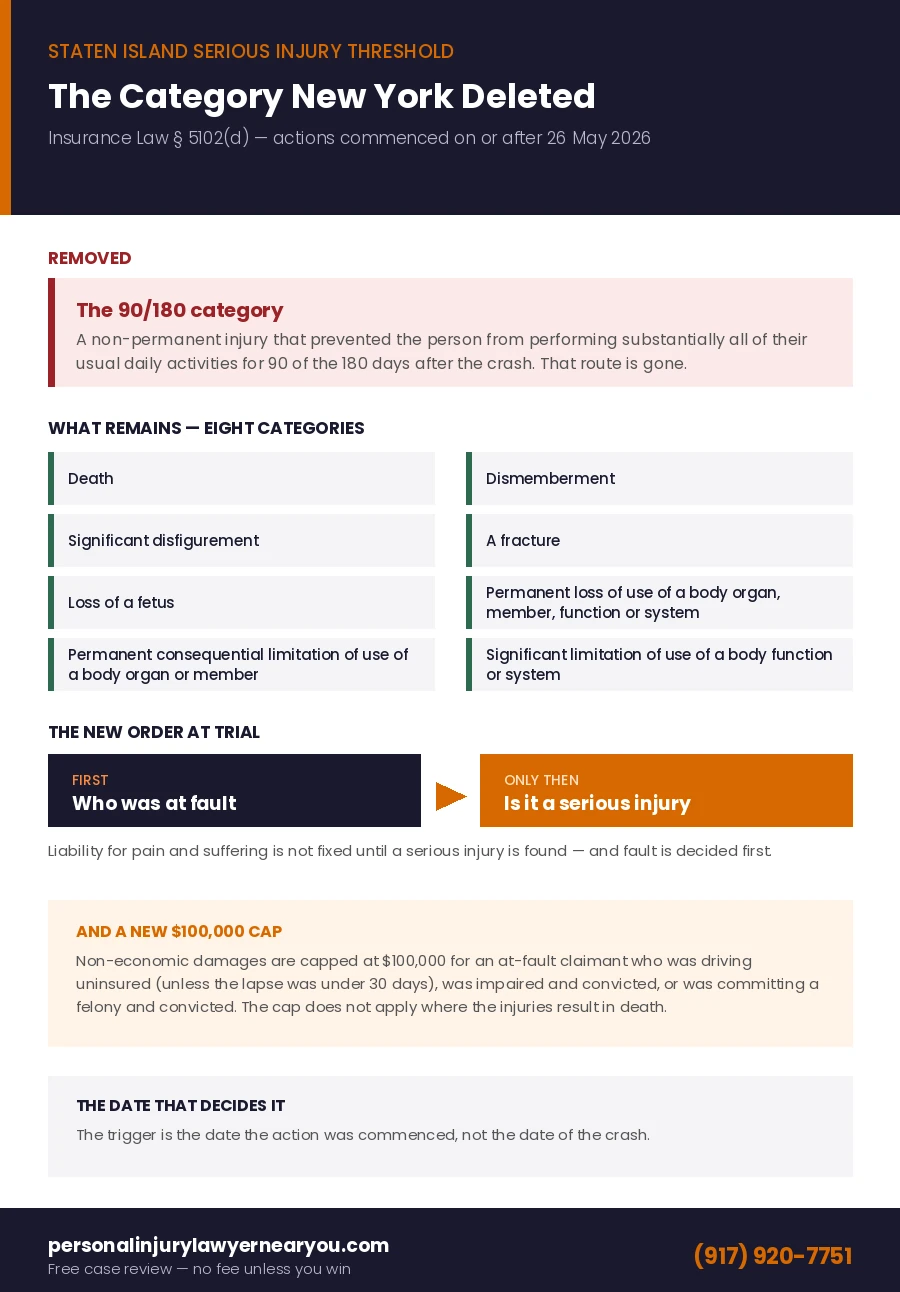
Part EE of Chapter 58 removed the ninth category — the one lawyers call 90/180.
It covered a medically determined injury or impairment of a non-permanent nature that prevented the injured person from performing substantially all of the material acts making up their usual and customary daily activities for at least 90 of the 180 days immediately following the crash. The Department of Financial Services circular letter implementing the reform confirms that deletion.
Understand what that category did. It was the only route that did not require permanence. A back injury that kept someone out of work for four months and then largely resolved could clear the threshold under 90/180 and under nothing else. Those cases are not small — four months is a serious disruption to a household — and as of May they have no statutory door.
| Injury picture | Before 26 May 2026 | Now |
|---|---|---|
| Any fracture | Its own standalone category | Unchanged — still qualifies |
| Scarring from the crash or from surgery | Significant disfigurement | Unchanged — still qualifies |
| Disc injury with documented, lasting restriction | Typically argued as permanent consequential or significant limitation | Same route, but now it is the only route |
| Soft tissue injury, months out of work, then resolved | Cleared the threshold under 90/180 | No category left to meet |
The last row is the change. Everything in it was true and provable before; none of it is a door now.
Why This Lands Differently on Staten Island
Here is a consequence that has not been written about, and it runs in an unexpected direction.
The eight surviving categories reward objective, visible, lasting harm: fracture, dismemberment, disfigurement, permanent loss of use. Those are the injury patterns produced by mass and speed. A loaded tractor-trailer striking a car or a person on foot produces them far more often than a rear-end collision in stop-start traffic does.
So the deletion does not hit all Staten Island claims equally. It falls hardest on ordinary car-occupant claims — the moderate-speed arterial and parking-lot collisions that fill the borough’s caseload — while truck-crash claims are comparatively insulated, because they more often produce an injury that fits a surviving category on its own terms. The borough that carries the city’s through freight ends up with a caseload split down the middle by a single deleted paragraph.
That is not a reason to be relaxed about a truck case. It is a reason to be far more careful about the moderate one, because the moderate one is where the threshold now does its work. Our post on why a City street is the hardest defendant on Staten Island covers the other half of the problem.
Fault Is Now Decided First
The second change is procedural and it is easy to skim past.
Insurance Law § 5104(a) now provides that liability for non-economic loss cannot be fixed unless and until the trier of fact has determined that a serious injury exists — and that the trier of fact must determine the party or parties at fault before deciding whether the injury is a serious injury.
Put that next to CPLR § 1411 and the sequence becomes stark. Fault is decided first. If the claimant’s share is greater than the defendants’ combined share, the case ends there — the jury never reaches the medical evidence at all. Two separate gates, and the fault gate now comes first.
The New $100,000 Cap
Part EE also added Insurance Law § 5104(d), a cap on non-economic damages that applies to an at-fault injured person who is not already barred from recovery.
| The cap applies where the at-fault claimant was | Detail that matters |
|---|---|
| Driving uninsured | A vehicle they were responsible for insuring — but a lapse of under 30 days is excepted |
| Impaired at the time | Requires an actual conviction — an accusation is not enough |
| Committing a felony, or in flight from one | Also requires conviction of that felony |
| Where the injuries result in death | The cap does not apply at all |
That final row is worth holding onto, because it is the second place in this reform where fatal cases are carved out of a restriction. The first is the fault bar itself, which we set out in our post on the claim the 2026 bar does not name. A pattern is forming in how the legislature drafted around death, and it is worth arguing.
What This Changes About the First Six Months
The practical consequence is evidentiary, and it starts on day one rather than at trial.
The deleted category was forgiving in a specific way: it asked what the person could not do, which is something a treating doctor and an employer can describe. The surviving categories ask what is objectively wrong and whether it lasts. That shifts the weight onto imaging, measured range-of-motion findings, and a continuous treatment record.
- Gaps in treatment now cost more. A three-month break in care has always been used to argue that an injury resolved. Under a permanence-based category it does more damage than it used to.
- Measurements beat adjectives. “Still in pain” is not a category. Quantified restriction, recorded over time by the treating provider, is what the surviving categories are built around.
- Early imaging matters for causation. The longer the gap between crash and first study, the easier it is to attribute a finding to something else.
- Scarring is a category in its own right. Significant disfigurement survives untouched and is routinely overlooked, including scarring from the surgery rather than the crash.
None of that is medical advice about what treatment to have — it is a description of what the statute now asks a file to prove. Our free settlement calculator gives a working range once the threshold question is settled, and pedestrians face this alongside the fault bar described in our post on pedestrians struck by trucks on Staten Island.
Frequently Asked Questions
What is the 90/180 rule and why does it no longer apply?
It was a category of serious injury covering a medically determined injury or impairment of a non-permanent nature that prevented the injured person from performing substantially all of the material acts constituting their usual and customary daily activities for at least 90 of the 180 days immediately following the crash. Part EE of Chapter 58 of the Laws of 2026 deleted it from Insurance Law § 5102(d) for actions and proceedings commenced on or after 26 May 2026.
Which serious injury categories still exist in New York?
Eight remain: death; dismemberment; significant disfigurement; a fracture; loss of a fetus; permanent loss of use of a body organ, member, function or system; permanent consequential limitation of use of a body organ or member; and significant limitation of use of a body function or system. A claimant seeking damages for pain and suffering must now fit one of those.
My injuries were serious but I recovered after a few months. Do I still have a claim?
You may still recover medical expenses and lost earnings through no-fault, because those are not affected by the threshold. Pain and suffering is a different question, and it now depends on whether the injury fits one of the eight remaining categories rather than on how long you were unable to carry on normally. Whether it does is a medical and evidentiary question that should be looked at properly rather than assumed either way.
Does the jury decide fault or serious injury first?
Fault first. Insurance Law § 5104(a) now requires the trier of fact to determine the party or parties at fault before determining whether an injury is a serious injury, and liability for non-economic loss is not fixed until a serious injury has been found.
What is the new $100,000 cap on pain and suffering?
Insurance Law § 5104(d) caps non-economic damages at $100,000 for an at-fault injured person who was driving a vehicle they were responsible for insuring while uninsured, subject to an exception for lapses under 30 days; or who was impaired at the time and convicted of that offence; or who was committing a felony or in immediate flight from one and convicted of that felony. The cap does not apply where the injuries result in death.
Does this apply to my crash if it happened before May 2026?
The amendments apply to actions and proceedings commenced on or after 26 May 2026, not to accidents occurring on or after that date. A claim arising from an earlier crash that is filed now is governed by the new rules, which makes the timing of commencement a real strategic question.
Key Takeaways
✅ The 90/180 category is deleted — the only route that did not require permanence
✅ Eight categories remain, and all of them are objective or lasting
✅ Juries now decide fault before they reach the question of serious injury
✅ A $100,000 cap applies to certain at-fault claimants — but never in death cases
✅ Treatment gaps and vague findings cost far more than they used to
The Gate Moved, and Nobody Told the People Walking Through It
Most people injured on Staten Island this year still believe the rule is what it was in April. The insurer on the other side knows it is not, and the evidence that decides which category an injury falls into is built in the first weeks after a crash, not the month before trial. Speak to a Staten Island truck accident lawyer while that record is still being made. The case review is free, and there is no fee unless you win.
Find Out Whether Your Injury Still Clears the Threshold
Free case review. No win, no fee. No upfront cost.
