
TL;DR — Quick Summary
Personal injury protection insurance (PIP) is car insurance that pays your own medical bills and part of your lost wages after a crash, no matter who caused it. It is mandatory in the 12 no-fault states plus Delaware and Oregon, and optional in most others. It does not pay for your car, for pain and suffering, or for anyone you hurt. Limits range from $2,500 in Texas to $50,000 in New York — and once PIP runs out, the at-fault driver’s insurance is usually the next place to look.
Personal injury protection insurance — PIP for short — is the part of a car insurance policy that pays for your injuries before anyone has decided who caused the crash. You claim against your own insurer, not the other driver’s, and the money starts flowing in weeks rather than after a lawsuit.
That speed is the whole point. It is also why PIP is misunderstood: people assume it covers everything, then discover the limit was $10,000 and the hospital bill was three times that.
What Is Personal Injury Protection Insurance?
PIP is first-party coverage. “First-party” means it protects the person who bought it, rather than paying out to strangers you injure, which is what liability coverage does.
It is often called “no-fault” coverage because it pays regardless of fault. According to the Insurance Information Institute, twelve states and Puerto Rico have no-fault laws, and every driver in those states must carry PIP as part of their policy. If you live in New York, our guide to New York no-fault insurance covers the state’s own rules and its 30-day filing deadline.
How Does Personal Injury Insurance Work After a Crash?
The process is simpler than a liability claim because nobody has to prove fault first.
- You notify your own insurer. Most states set a short deadline for this — sometimes 30 days or less — and missing it can cost you the benefits entirely.
- You file a PIP application. This lists your injuries, your treating providers and your employer.
- Your providers bill the insurer directly. In many states, doctors and hospitals send bills straight to the PIP carrier.
- Wage benefits are paid to you. You submit proof of income and time off work, and the insurer pays a percentage of what you lost.
- PIP runs until the limit is used up. After that, your health insurance or a claim against the at-fault driver takes over.
PIP usually covers you, members of your household, passengers in your car and, in several states, pedestrians hit by your vehicle.
What PIP Covers — and What It Doesn’t
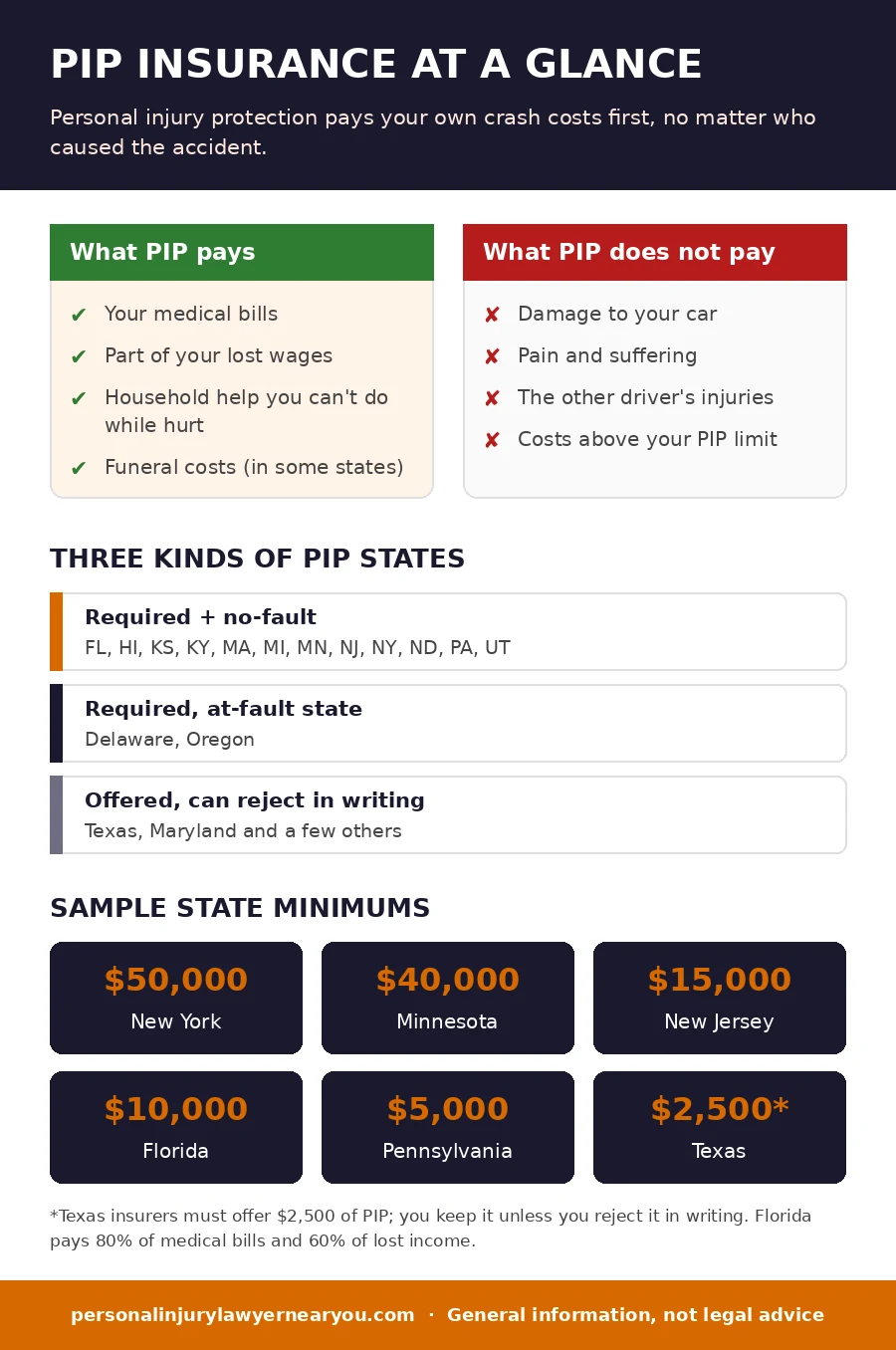
| PIP usually pays | PIP does not pay |
|---|---|
| Medical bills — ER, hospital, doctor, therapy | Damage to your car — that is collision coverage |
| Part of your lost wages — often 60–80% | Pain and suffering |
| Replacement services — help with chores you can’t do while injured | Injuries you cause to others — that is bodily injury liability |
| Funeral expenses — in some states | Anything above your PIP limit |
The right-hand column is where most claims go wrong. Pain and suffering is often the largest part of an injury claim, and PIP never touches it. That money only comes from the at-fault driver’s insurer — which is why a car accident injury claim often continues long after PIP has paid out.
Which States Require PIP?
States fall into three groups, and the group decides whether PIP is optional and whether you can still sue the other driver.
- No-fault states (PIP required): Florida, Hawaii, Kansas, Kentucky, Massachusetts, Michigan, Minnesota, New Jersey, New York, North Dakota, Pennsylvania and Utah. Kentucky, New Jersey and Pennsylvania are “choice” states, where drivers can opt for a traditional tort policy instead.
- At-fault states that still require PIP: Delaware and Oregon. You must carry it, but you can sue the at-fault driver without meeting a no-fault threshold.
- States where PIP is offered but optional: Texas and Maryland require insurers to include it unless you reject it in writing. Arkansas, South Dakota and Washington also make it available.
Florida deserves a note of its own. Repeal bills keep being filed, and plenty of websites claimed PIP ended on 1 July 2026. It did not — the 2026 repeal bills died in committee, and the $10,000 requirement still applies. Our Florida personal injury claims guide covers how PIP fits with the state’s fault rules.
How Much PIP Coverage Is Required?
| State | Minimum PIP | What to know |
|---|---|---|
| New York | $50,000 | Highest standard minimum among no-fault states |
| Michigan | Driver chooses | Levels range from limited options up to unlimited medical coverage |
| Minnesota | $40,000 | Split between medical and non-medical losses |
| New Jersey | $15,000 | Choice state; much higher limits can be bought |
| Florida | $10,000 | Pays 80% of medical bills and 60% of lost income; treatment must start within 14 days |
| Pennsylvania | $5,000 | Medical benefits only at the minimum |
| Texas | $2,500 (offered) | Included unless you reject it in writing |
Minimums are floors, not recommendations. A single ambulance ride and ER visit can use up a Florida or Pennsylvania minimum before any follow-up care begins. Texas drivers can read how PIP interacts with the state’s at-fault system in our Texas personal injury claims guide.
PIP vs Health Insurance: Do You Need Both?
Health insurance pays medical bills. It does not replace lost wages or pay someone to do the housework you can’t, and it may carry a deductible PIP does not. In many no-fault states, PIP is also the primary payer for crash injuries, so your health plan only steps in once PIP is exhausted.
There is one more reason to keep it. Your health insurer may claim reimbursement out of a later injury settlement. PIP benefits generally don’t come with that kind of payback demand in no-fault states, which can leave more of a settlement in your pocket.
When PIP Runs Out: Suing the At-Fault Driver
In an at-fault state, you can claim against the other driver’s bodily injury coverage from the start. In a no-fault state, you usually have to cross a threshold first — either a “serious injury” as defined by statute, or a dollar amount of medical bills — before you can sue for pain and suffering.
Once you cross it, the claim against the at-fault driver covers what PIP left behind: medical costs above the limit, the rest of your lost income, and non-economic damages. If the driver had no insurance or fled the scene, uninsured motorist coverage is the next layer — see our guide to uninsured and hit-and-run driver claims. To get a rough idea of what that wider claim might be worth, try our personal injury settlement calculator.
Frequently Asked Questions
What is PIP car insurance in simple terms?
PIP, or personal injury protection, is car insurance that pays your own medical bills and part of your lost wages after a crash, regardless of who caused it. You claim it from your own insurer rather than the other driver’s.
Does PIP cover the other driver?
No. PIP covers you, your household members and passengers in your car, and in some states pedestrians your vehicle hits. Injuries you cause to another driver are paid by your bodily injury liability coverage, not your PIP.
Does PIP pay for pain and suffering?
No. PIP pays economic losses such as medical bills, lost wages and replacement services. Pain and suffering can only be recovered from the at-fault driver, and in no-fault states only after your injury meets the state’s threshold.
Is PIP insurance required in every state?
No. It is required in the 12 no-fault states and in Delaware and Oregon. Texas and Maryland include it unless you reject it in writing, and in most other states it is optional or not offered at all.
Is PIP worth having if I already have good health insurance?
Usually yes. Health insurance does not replace lost wages or pay for help at home, it may carry a deductible PIP does not, and it may seek repayment from a later settlement. Where PIP is mandatory you cannot drop it anyway.
Did Florida get rid of PIP in 2026?
No. Florida’s 2026 repeal bills died in committee, and the $10,000 PIP requirement still applies to most registered vehicles. Claims that PIP ended on 1 July 2026 came from an earlier bill that never became law.
Key Takeaways
✅ PIP pays your own medical bills and lost wages, whoever caused the crash
✅ It never pays for your car, pain and suffering, or other people’s injuries
✅ Required in 12 no-fault states plus Delaware and Oregon
✅ Limits range from $2,500 in Texas to $50,000 in New York
✅ Once PIP runs out, the at-fault driver’s insurance covers the rest
PIP Is the First Check, Not the Last One
PIP was built to pay quickly, and it does. What it was never built to do is pay fully. If your injuries are serious enough that the limit is gone within weeks, the larger claim is against the driver who caused the crash — and the deadlines for that claim are already running. A personal injury lawyer can look at both at once. The case review is free, and there is no fee unless you win.
PIP Ran Out? Find Out What Else You Can Claim
Free case review. No win, no fee. No upfront cost.
Want more NYC injury guides and legal news from PILNY in your Google results?
