
TL;DR — Quick Summary
A life care plan is a detailed report, prepared by a qualified planner, listing every medical and care need an injured person will have for the rest of their life and what each will cost. In a life care plan personal injury case, it is the main evidence for future damages, and it is usually reserved for serious injuries such as brain, spinal cord, amputation and severe burn cases. An economist then converts the plan to a present-day value, and the defense usually hires its own planner to challenge it.
In most injury claims, the medical bills are already in a folder. In catastrophic cases, most of the cost is still ahead: decades of care, equipment, therapy and help at home. A life care plan personal injury report is how that future is turned into evidence a jury or insurer can value.
This guide explains what a life care plan is, who prepares it, what goes into it, and how it is challenged.
What a Life Care Plan Is
A life care plan is a written, itemized projection of an injured person’s future needs: what care they will need, how often, for how long, and at what cost. It is based on medical records, interviews with treating doctors, an assessment of the injured person and their home, and current prices for services and equipment.
It is usually prepared by a certified life care planner, often a nurse, rehabilitation specialist or physician, and it relies on the opinions of the treating doctors for the medical needs it lists.
Which Cases Need a Life Care Plan?
- Traumatic brain injuries
- Spinal cord injuries and paralysis
- Amputations
- Severe burns and disfigurement
- Serious orthopedic injuries with future surgeries, such as joint replacements
These injuries often come from truck crashes, construction accidents and serious falls. Our guide to truck accident injuries covers several of them.
What a Life Care Plan Includes
| Category | Examples |
|---|---|
| Future medical care | Doctor visits, specialist follow-ups, future surgeries |
| Therapy | Physical, occupational, speech and psychological therapy |
| Medication and supplies | Prescriptions, catheters, wound care |
| Equipment | Wheelchairs, prosthetics, hospital beds, and their replacement over time |
| Home and vehicle changes | Ramps, accessible bathrooms, adapted vehicles |
| Attendant and home care | Aides, nursing care, help with daily tasks |
| Transportation | Travel to appointments |
From Plan to Dollar Figure
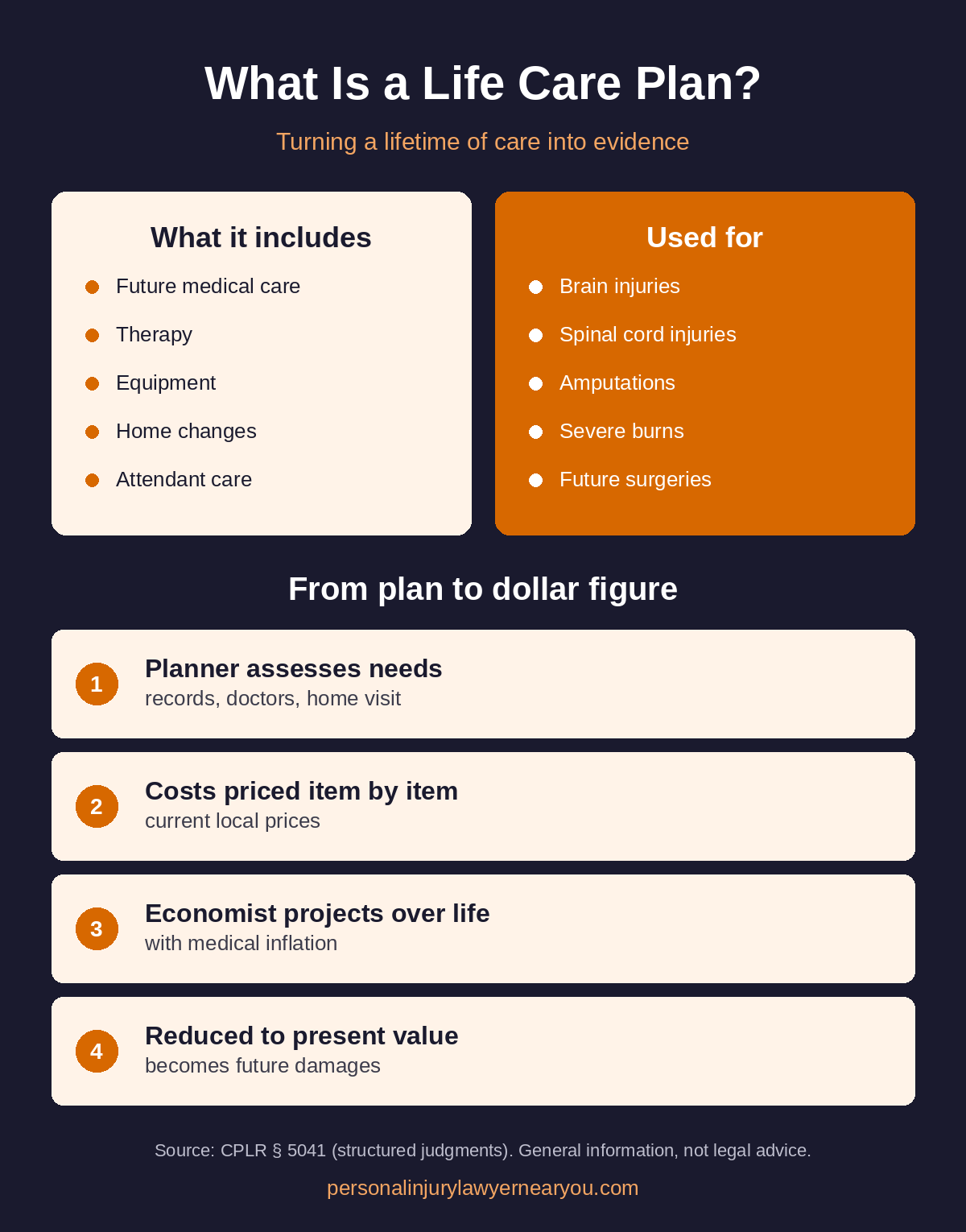
A life care plan lists needs and annual costs. An economist then projects those costs over the person’s life expectancy, adjusts for medical inflation, and reduces the total to present value, the lump sum needed today to pay for it all. That present-value figure drives settlement talks. If the case goes to a New York jury, future costs are awarded in full dollars and the court handles discounting when it sets up payments. See the full range of damages you can recover in New York.
In New York, if a personal injury case goes to verdict and the jury awards more than $250,000 in future damages, the excess is generally paid through an annuity over time rather than all at once, under CPLR § 5041. Settlements are negotiated separately and can be structured the same way.
How Insurers Challenge a Life Care Plan
| Defense argument | Typical response |
|---|---|
| Some items are not medically necessary | Each item backed by a treating doctor’s recommendation |
| Costs are inflated | Prices sourced from local providers and documented |
| Life expectancy is too long | Medical evidence specific to the injured person |
| Care could be cheaper | Explain why the cheaper option does not meet the need |
| The planner is biased | Credentials, methodology and reliance on treating doctors |
The best protection is a plan tied closely to the treating doctors’ written opinions. A plan built only on the planner’s own judgment is much easier to attack.
Life Care Plans and Settlement Value
Because future care can dwarf past bills, the life care plan often has more influence on the final number than anything else in a catastrophic case. It is a large part of why the settlements in our guide to million-dollar personal injury settlement examples reach those figures. It also shapes the timeline: these cases usually cannot settle until doctors can predict future needs. Our guide on how long a personal injury case takes explains why.
A life care plan is expensive to prepare, so it is used where the injury justifies it. If a family member suffered a serious injury in a Staten Island truck crash, a Staten Island truck accident lawyer can explain whether one is needed.
Frequently Asked Questions
What is a life care plan in a personal injury case?
A life care plan is an itemized report projecting every future medical and care need an injured person will have and its cost. It is the main evidence for future damages in serious injury cases.
Who prepares a life care plan?
Usually a certified life care planner, often a nurse, rehabilitation specialist or physician. The plan relies on the treating doctors’ opinions for the medical needs it lists.
When is a life care plan needed?
Mainly in catastrophic cases with lifelong needs, such as traumatic brain injuries, spinal cord injuries, amputations, severe burns and serious orthopedic injuries that will need future surgery.
How is a life care plan turned into a dollar amount?
An economist projects the costs over the injured person’s life expectancy, adjusts for medical inflation and reduces the total to present value for settlement talks. If the case reaches a New York jury, future costs are awarded in full dollars and the court handles discounting when it sets up payments.
Can the defense challenge a life care plan?
Yes. The defense often hires its own planner to argue that items are unnecessary, costs are inflated or life expectancy is shorter. A plan backed by treating doctors’ recommendations is the hardest to challenge.
Are future damages paid all at once in New York?
Not always. If a jury awards more than $250,000 in future damages in a personal injury case, the excess is generally paid over time through an annuity under CPLR § 5041. Settlements can be structured by agreement.
Key Takeaways
✅ A life care plan itemizes lifelong care needs and their costs
✅ It is mainly used in catastrophic injury cases
✅ Plans backed by treating doctors are the hardest to challenge
✅ An economist converts the plan to present value
✅ Large future damages verdicts in New York are often paid over time
Facing a Lifetime of Care After an Injury?
When future care costs more than everything spent so far, the claim needs to be built around it. A free case review explains whether a life care plan is needed and what it could mean for the claim.
Serious Injury in the Family? Talk to Someone Today
Free case review. No win, no fee. No upfront cost.
Want more NYC injury guides and legal news from PILNY in your Google results?
