
TL;DR — Quick Summary
A simple injury claim that settles without a lawsuit often takes a few months to a year. Once a lawsuit is filed, one to three years is common, and a case that goes all the way to trial can take longer. The biggest driver is not the lawyer or the court — it is your medical treatment, because a claim cannot be valued properly until your doctors know how far you will recover. Disputed fault, low policy limits, several defendants and court backlogs add time on top.
How long does a personal injury lawsuit take? Every lawyer gives the same frustrating first answer — “it depends” — because it genuinely does. But what it depends on is predictable, and once you know the stages, you can usually tell roughly where your own case sits and why it has slowed down.
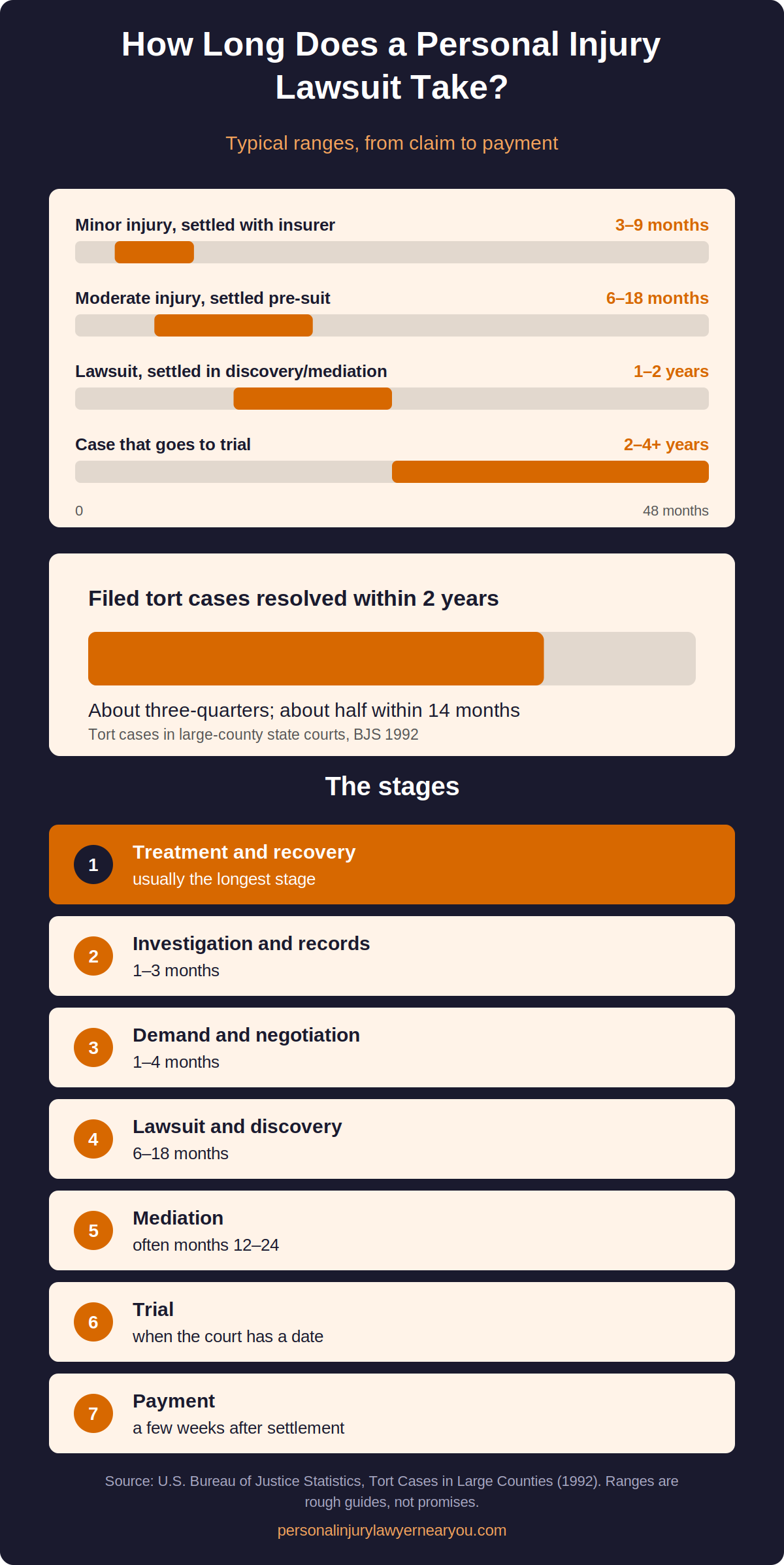
For a sense of scale: a Bureau of Justice Statistics study of tort cases in large-county state courts found that about half were resolved within 14 months of filing and roughly three-quarters within two years, while cases decided by trial had a median of nearly two years. That data is old (1992), but the pattern — most cases settle, trials take longest — still holds.
How Long Do Personal Injury Cases Take to Settle? Typical Timelines
| Type of case | Typical range | What drives it |
|---|---|---|
| Minor injury, clear fault, settled with the insurer | 3–9 months | Mostly the length of treatment |
| Moderate injury, settled before a lawsuit | 6–18 months | Treatment plus a longer negotiation |
| Lawsuit filed, settled during discovery or mediation | 1–2 years | Depositions, expert reports, court schedule |
| Case that goes to trial | 2–4+ years | Court backlog, then possible appeal |
These are rough ranges, not promises. A case in a busy urban court can run well past them, and a clear-liability case with a cooperative insurer can beat them.
The Stages of a Personal Injury Claim, Step by Step
- 1. Treatment and recovery (weeks to many months). You get treated until you reach “maximum medical improvement” — the point where your doctors can say how much you will recover. This is usually the longest stage, and it is out of everyone’s hands.
- 2. Investigation and records (1–3 months). The lawyer gathers medical records and bills, wage proof, police reports and witness statements. Hospitals and providers are often slow to send records.
- 3. Demand and negotiation (1–4 months). A demand package goes to the insurer, which reviews it and responds with an offer. Several rounds are normal.
- 4. Lawsuit and discovery (6–18 months). If talks stall, a complaint is filed. Both sides exchange documents, answer written questions and take depositions. Most cases that settle after filing settle somewhere in here.
- 5. Mediation (often months 12–24). Many courts require a mediation session before trial, and it closes a large share of the remaining cases.
- 6. Trial (when the court has a date). The trial itself may last only days; the wait for a trial date is what takes time.
- 7. Payment (usually a few weeks after settlement). You sign a release, the insurer sends the funds, and medical liens are resolved before your share is paid out.
For a worked example of these stages with real local deadlines, our step-by-step guide to filing a personal injury claim in Staten Island walks through each one.
Why Is My Personal Injury Case Taking So Long?
If your claim feels stuck, it is almost always one of these:
| Reason | Why it slows things down |
|---|---|
| You are still treating | Settling early risks leaving future surgery or therapy unpaid — a release cannot be reopened |
| Fault is disputed | More evidence, experts and often a lawsuit are needed to prove liability |
| Serious or permanent injuries | Bigger claims get more scrutiny, more expert reports and higher-level insurer approval |
| Several defendants or insurers | Each one blames the others before anyone agrees to pay a share |
| Medical liens | Health insurers, Medicare or Medicaid must be repaid or negotiated before money is released |
| Court backlog | Busy courts push hearings and trial dates months apart |
| Insurer delay tactics | Some insurers slow-walk claims hoping you will accept less out of frustration |
That last one is real. Delay is a negotiating tool — a person behind on rent will take a lower number. It is also why what you say on those calls matters; our list of what never to say to an insurance adjuster covers the common traps.
Can You Speed Up a Personal Injury Claim?
Somewhat — but faster is not always better. Things that genuinely help:
- Get treated early and consistently. Gaps in care give the insurer an argument and stretch the timeline.
- Keep every record yourself. Bills, receipts, pay stubs and appointment dates save weeks of chasing.
- Answer your lawyer quickly when they need signatures, documents or decisions.
- Be realistic about value. A demand far above what the case is worth invites a long stand-off. The settlement calculator and our guide to average personal injury settlement amounts help set expectations.
- Be willing to file suit. A filed lawsuit with a court schedule often moves a stalled insurer faster than more letters.
What you should not do is settle before your treatment is finished just to end the wait. A release is final, even if your injury turns out worse than expected.
Don’t Let the Clock Run Out While You Wait
Negotiations do not pause the legal deadline. Every state sets a statute of limitations for filing a lawsuit — and claims against a city, state or public agency often require a formal notice within weeks or months. If talks drag on past the deadline, the insurer has no reason left to pay. New York’s rules are covered in our guide to how long you have to file a personal injury claim.
How Long Does a Personal Injury Lawsuit Take in New York?
New York cases follow the same stages described above, but a few local features affect the timeline.
No-fault comes first for car crashes
In a car accident, your own no-fault coverage pays medical bills and part of your lost wages early, regardless of fault. That takes some pressure off while the injury claim develops — but the application has a short deadline, and missing it can cause long disputes later.
The serious injury threshold
To claim pain and suffering after a car crash, your injury must meet New York’s legal definition of a serious injury. Proving that often requires detailed medical reports, and defense teams frequently challenge it — which can add months to a case.
Claims against the city or public agencies
Claims against a city, county or public authority start with a notice of claim, usually within 90 days, and the claimant may be examined under oath before a lawsuit can proceed. That front-loaded process adds time before the case is even in court.
Court calendars
Busy courts in New York City can mean months between conferences and a long wait for a trial date once discovery ends. Many cases settle while waiting, often at a court-ordered or private mediation.
Put together, how long does a personal injury lawsuit take in New York? For most filed cases, one to three years is a realistic expectation, with serious-injury and multi-defendant cases toward the longer end. Remember that the general deadline to start most injury lawsuits here is three years, and much shorter for claims against public bodies.
Frequently Asked Questions
How long does a personal injury lawsuit take?
Once a lawsuit is filed, one to three years is common. Most lawsuits settle during discovery or mediation rather than at trial. Cases that go all the way to trial usually take the longest, mainly because of the wait for a trial date.
How long do personal injury cases take to settle without a lawsuit?
A claim that settles directly with the insurer often takes a few months to a year. The length of your medical treatment is usually the biggest factor, because the claim cannot be valued properly until your doctors know how far you will recover.
Why is my personal injury case taking so long?
The usual reasons are ongoing medical treatment, disputed fault, serious injuries that need expert reports, several defendants, medical liens that must be resolved, court backlogs, or an insurer deliberately slowing the claim to pressure you into a lower settlement.
How long after a settlement do you get paid?
Usually a few weeks. You sign a release, the insurer sends the funds to your lawyer, and any medical liens are paid or negotiated before your share is released. Cases involving Medicare or a minor can take longer.
Is a long personal injury case a bad sign?
Not necessarily. Serious injury claims take longer because there is more at stake and more to prove. A long case is only a concern if nobody can explain what stage it is in or what is holding it up.
Key Takeaways
✅ Simple claims often settle in months; lawsuits commonly take one to three years
✅ Medical treatment is usually the longest stage — and the most important
✅ Disputed fault, liens and court backlogs add months
✅ Never settle before treatment ends just to finish faster
✅ Negotiation does not stop the filing deadline
Stuck Waiting? Get a Straight Answer
If your claim has stalled and nobody can tell you why, a second opinion costs nothing. A free case review can tell you what stage your claim is really at, whether the delay is normal, and how close your filing deadline is.
Claim Taking Too Long? Find Out Why
Free case review. No win, no fee. No upfront cost.
Want more NYC injury guides and legal news from PILNY in your Google results?
