
TL;DR — Quick Summary
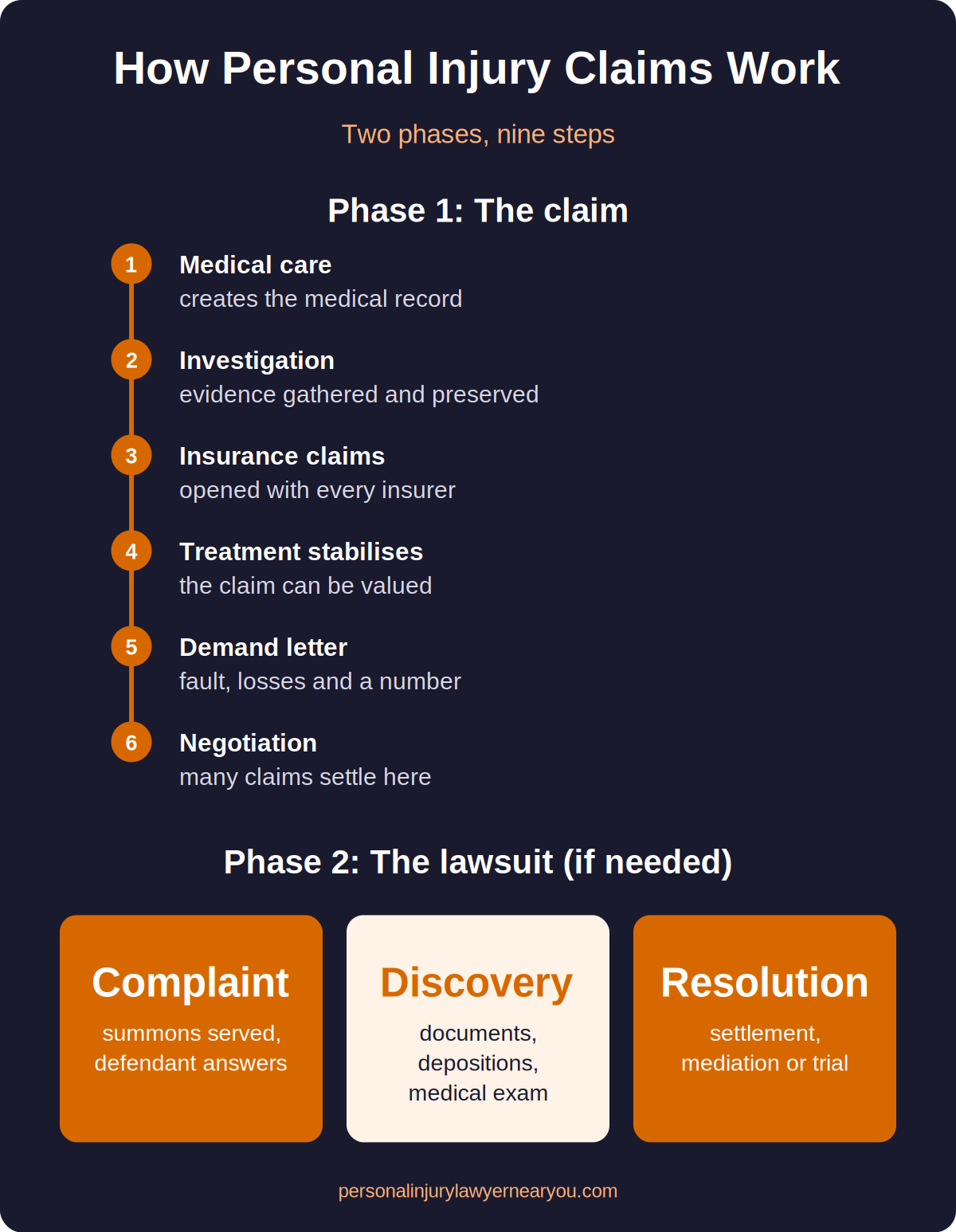
A personal injury claim moves through two phases. The claim phase: treatment, opening the insurance claims, documenting your losses, a written demand letter, and negotiation — where many cases settle. The lawsuit phase, only if needed: the complaint, the defendant’s answer, discovery (documents, depositions, a defense medical exam), mediation, and trial. Most cases end in a settlement somewhere along the way. In New York, the lawsuit generally has to be filed within three years.
Knowing how personal injury claims work takes much of the stress out of the process. It explains why nothing seems to happen for months, why your lawyer wants you to finish treatment before settling, and why a lawsuit is not the same thing as a trial.
Here are the nine steps of a personal injury claim and lawsuit, in the order they usually happen.
The 9 Steps at a Glance
| Step | What happens |
|---|---|
| 1. Medical care | Treatment begins and creates the medical record |
| 2. Investigation | Reports, photos, witnesses and video are gathered and preserved |
| 3. Insurance claims | Claims opened with the relevant insurers |
| 4. Treatment stabilises | Doctors can say how far you will recover and what future care you need |
| 5. Demand letter | A written demand sets out fault, losses and a number |
| 6. Negotiation | Offers and counter-offers — many claims settle here |
| 7. Lawsuit filed | Summons and complaint served; the defendant answers |
| 8. Discovery | Documents exchanged, depositions taken, defense medical exam |
| 9. Resolution | Settlement, mediation or trial — then liens paid and funds distributed |
Phase One: The Claim
Steps 1–4: Treatment, evidence and insurance
Everything rests on the medical record, so treatment comes first and should be consistent. Meanwhile, evidence is collected before it disappears, and the insurance claims are opened. In New York, that starts with your own no-fault insurance for medical bills and lost wages, regardless of fault.
Step 4 is the one people find frustrating. A claim cannot be valued properly until doctors know whether you will fully recover. Settling before then risks leaving future costs uncovered.
Step 5: The demand letter
Demand letters for personal injury cases are the formal start of negotiation. A strong one includes:
- How the accident happened, and why the other party is legally at fault
- Your injuries, diagnosis and treatment, with records attached
- Medical bills, lost income and out-of-pocket costs
- How the injury has affected your work, sleep, family and daily life
- A specific amount, and a deadline to respond
That amount is built from the categories of personal injury damages the law allows — not just the bills.
Step 6: Negotiation
The insurer responds with a lower offer, and the two sides go back and forth. Many claims settle at this stage without a lawsuit. If the offer stays too low — or a filing deadline is approaching — the case moves to phase two.
Phase Two: The Lawsuit
Step 7: The complaint
A lawsuit starts with a summons and complaint, filed in court and served on the defendant. If you have been looking for a sample complaint for a personal injury lawsuit, this is what one typically contains:
| Section | What it says |
|---|---|
| Caption and parties | The court, the plaintiff and every defendant |
| Facts | When, where and how the accident happened |
| Causes of action | The legal claims, usually negligence — duty, breach, causation |
| Damages | That you were injured and are seeking compensation |
Timing is critical here. Under CPLR § 214, a New York personal injury action must generally be commenced within three years — and claims against public bodies need a notice of claim far sooner. Our guide to the personal injury statute of limitations lists the exceptions.
Step 8: Discovery
Both sides exchange evidence: medical records, photos, written questions, and in New York a bill of particulars setting out your injuries in detail. Then come depositions — sworn testimony from you, the defendant and key witnesses — and usually an examination by a doctor chosen by the defense. Discovery is often the longest stage, and also where many cases settle, because both sides finally see the full picture.
Step 9: Mediation, settlement or trial
Most remaining cases settle at mediation or as trial approaches. If not, a jury decides fault and damages. Once there is a settlement or verdict, medical liens are paid, the fee and expenses are deducted, and you receive the balance with a written breakdown.
What This Looks Like in Practice
The steps are the same everywhere, but local rules change the deadlines and courts. For a borough-specific walk-through, see how to file a personal injury claim in Staten Island. And for how the facts of your case translate into a number at the end, read what an accident case is worth.
If you have not chosen a lawyer yet, our guide on how to find a personal injury lawyer covers what to look for before step 2.
How Personal Injury Claims Work Inside the Insurance Company
The nine steps describe your side of the process. Understanding how personal injury claims work on the insurer’s side explains a lot of what feels like silence or delay.
The adjuster and the reserve
When a claim is opened, an adjuster is assigned and the insurer sets a “reserve” — an internal estimate of what the claim will cost. The reserve is updated as records arrive. A claim that comes in well documented tends to get a realistic reserve early; a claim with gaps tends to be reserved low, and low reserves make for low offers.
Settlement authority
Adjusters can only offer up to a certain limit on their own. Larger claims need approval from a supervisor or a claims committee. This is one reason serious-injury claims take longer: every significant increase may need sign-off above the person you are talking to.
How the number is built
Insurers look at medical bills and the type and length of treatment, lost income, the strength of liability, and how a jury in your area might react. Some use claims-evaluation software to suggest a range. Diagnoses, treatment gaps and how consistently your records describe the injury all feed into it — which is why accurate, complete medical documentation matters so much.
What moves the file forward
- A complete demand package, rather than records sent piecemeal
- A clear, supported number in the demand
- A filed lawsuit with a court schedule, which puts the file in front of defense counsel
- A mediation date, which forces both sides to commit to a position
Seen from both sides, how personal injury claims work becomes clearer: the injured person builds the evidence, and the insurer prices the risk that evidence creates. The stronger the file, the higher the price.
Frequently Asked Questions
How do personal injury claims work?
You get treated, the claim is reported to the insurers, and once your injuries are documented your side sends a demand for compensation. Most claims settle through negotiation. If not, a lawsuit is filed, evidence is exchanged, and the case is resolved by settlement, mediation or trial.
What are the steps of a personal injury lawsuit?
Filing and serving the summons and complaint, the defendant’s answer, discovery including document exchange and depositions, often a defense medical examination, then mediation or settlement talks, and finally trial if the case does not settle.
What goes in a personal injury demand letter?
How the accident happened and why the other party is at fault, your injuries and treatment, your medical bills and lost income, the effect on your daily life, supporting documents, and a specific amount you are asking for.
What is in a personal injury complaint?
The complaint names the parties, describes the facts of the accident, sets out the legal claims such as negligence, and states that you were injured and are seeking damages. It is the document that starts the lawsuit.
Do all personal injury claims become lawsuits?
No. Many settle with the insurer before a lawsuit is ever filed. A lawsuit is usually needed only when the insurer will not make a fair offer or a filing deadline is approaching.
How long do I have to file a personal injury lawsuit in New York?
Generally three years from the date of the injury under CPLR 214. Claims against public bodies have much shorter notice requirements, and some other claims have different deadlines, so check early.
Key Takeaways
✅ A claim has two phases: the insurance claim, then a lawsuit if needed
✅ Treatment needs to stabilise before a claim can be valued properly
✅ The demand letter sets out fault, losses and a specific number
✅ Discovery is usually the longest stage of a lawsuit
✅ New York generally allows three years to file — shorter for public bodies
Not Sure Which Step You’re On?
If your claim feels stuck, it usually means one step has stalled — treatment, a missing record, or an insurer that will not move. A free case review tells you exactly where your claim stands and what should happen next.
Injured and Unsure What Comes Next? Ask Us
Free case review. No win, no fee. No upfront cost.
Want more NYC injury guides and legal news from PILNY in your Google results?
