
TL;DR — Quick Summary
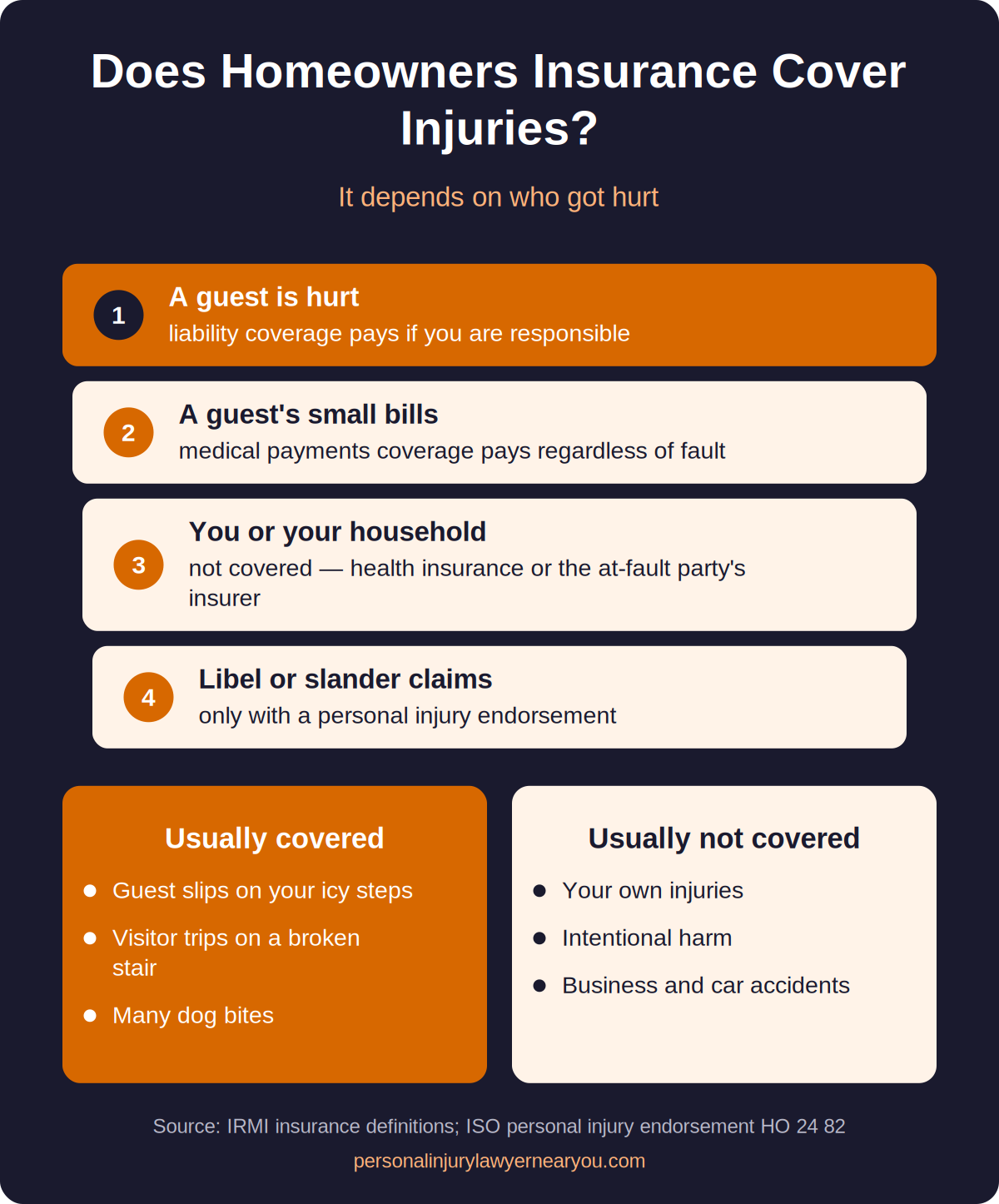
Homeowners insurance protects you against injuries to other people — not to yourself. If a guest is hurt and you are responsible, liability coverage pays, and medical payments coverage can cover small medical bills regardless of fault. If you or a household member are hurt at home, your own homeowners policy generally will not pay; health insurance or another party’s insurance does. And confusingly, “personal injury coverage” on a homeowners policy usually means libel, slander and similar claims — not physical injuries — and is added by endorsement.
Does homeowners insurance cover personal injury to the homeowner? It is one of the most common insurance misunderstandings. The short answer is no — and the reason makes sense once you see how a homeowners policy is built.
This guide explains what the injury-related parts of a homeowners policy actually pay for, who they protect, and what to do if you were the one who got hurt.
Two Very Different Meanings of “Personal Injury”
| Everyday / legal meaning | Insurance policy meaning | |
|---|---|---|
| What it covers | Physical or psychological harm caused by someone’s negligence | Libel, slander, defamation, false arrest, invasion of privacy, wrongful eviction |
| Policy term for physical harm | — | “Bodily injury” |
So when a homeowners policy talks about “personal injury,” it usually means something other than a fall down the stairs. The industry definition from IRMI notes that standard homeowners liability covers bodily injury and property damage to others, while personal injury losses such as libel and slander are not covered. That protection is typically added through a separate personal injury endorsement — the standard ISO form is known as HO 24 82.
It is different again from personal injury protection (PIP), which is car insurance, not home insurance.
What the Injury Coverages in a Homeowners Policy Pay
| Coverage | Who it protects | Does fault matter? |
|---|---|---|
| Personal liability | Other people you injure, plus your legal defense | Yes — you must be legally responsible |
| Medical payments to others | Guests’ medical bills, up to a small limit | No — pays regardless of fault |
| Personal injury endorsement | You, if sued for libel, slander and similar claims | Only if added to the policy |
Notice what is missing: a coverage that pays the homeowner’s own injuries. That is deliberate. Homeowners liability insurance exists to protect you from claims by others.
If You — the Homeowner — Are Injured
Your own homeowners policy generally will not pay for your injuries or those of people who live with you. Instead, look to:
- Your health insurance for medical treatment
- Disability insurance if you cannot work
- Someone else’s liability insurance if another person caused the accident — a contractor who left a hazard, for example, or the maker of a defective product
- Workers’ compensation if you were hurt while working from home for an employer, depending on the circumstances
If a Guest Is Injured on Your Property
This is what homeowners liability is designed for. If a visitor slips on an icy step you never salted, or trips over a broken stair you knew about, your policy typically pays their medical bills and other damages and pays a lawyer to defend you. Whether you are responsible depends on premises liability rules — the same principles behind any slip and fall or trip and fall claim.
For the injured guest, this matters: claiming against a friend’s or relative’s homeowners policy usually means the insurer pays, not your friend personally. In New York City, property owners are also responsible for the sidewalk in front of most buildings — see who is liable for a sidewalk slip and fall in NYC.
What Homeowners Liability Usually Does Not Cover
- Injuries to you or members of your household
- Intentional harm
- Business activities run from the home
- Car accidents (that is auto insurance)
- Libel, slander and similar claims — unless you add the personal injury endorsement
- Some dog breeds or dogs with a bite history, depending on the insurer
Renters and Landlords
Renters policies include similar liability and medical payments coverage for injuries inside the unit. Injuries in hallways, stairwells and other common areas are usually the landlord’s responsibility and the landlord’s insurance — our guide to slip and falls in apartment buildings explains who pays. If the fall was serious, a slip and fall attorney can identify every policy that applies.
Does Homeowners Insurance Cover Personal Injury to Contractors, Tenants and Neighbors?
The guest-versus-homeowner rule covers most situations, but a few common ones are less clear-cut.
Contractors and workers
A contractor’s employee hurt while working on your home usually claims through the contractor’s own workers’ compensation. If the contractor has no coverage, the injured worker may look to the homeowner, and your policy may or may not respond — which is why it pays to check a contractor’s insurance before work starts. Rules for household employees, such as a regular housekeeper or nanny, vary by state.
Tenants and landlords
If you rent out a property, a standard homeowners policy may not fit; landlords typically need a landlord or dwelling policy with liability coverage. A tenant hurt by a defect the landlord should have fixed would usually claim against that policy. Tenants’ own renters insurance covers injuries to their guests inside the unit.
Neighbors, children and dogs
A neighbor’s child hurt on your trampoline or pool, or a passer-by bitten by your dog, is generally a liability claim against your policy — subject to any exclusions for certain activities, equipment or dog breeds. Some insurers exclude trampolines or require safety measures, so check your policy wording.
So does homeowners insurance cover personal injury in these cases? Often, but not always, and the answer turns on who was hurt, why, and the exact exclusions in the policy. If you were injured on someone else’s property, the practical first step is to find out which policy applies — the owner’s, the landlord’s, or a contractor’s.
Frequently Asked Questions
Does homeowners insurance cover personal injury to the homeowner?
Generally no. The liability part of a homeowners policy pays for injuries to other people, not to you or members of your household. Your own injuries are usually covered by your health insurance, or by someone else’s insurance if they caused the accident.
What is personal injury coverage on a homeowners policy?
In insurance terms, personal injury coverage usually means protection against claims like libel, slander, defamation, false arrest and invasion of privacy. It is not included in a standard policy and is typically added by endorsement.
Does homeowners insurance cover a guest who gets hurt?
Usually, yes. Liability coverage pays if you are legally responsible for a guest’s injury, including their medical bills and damages. Medical payments coverage can also pay a guest’s smaller medical bills regardless of who was at fault.
What is medical payments coverage on a homeowners policy?
It pays reasonable medical bills for guests injured on your property, or by you or your pets elsewhere, without anyone having to prove fault. Limits are usually small, often a few thousand dollars.
Does homeowners insurance cover dog bites?
Often, yes, under the liability coverage, but some insurers exclude certain breeds or dogs with a bite history. Check your policy or ask your insurer, especially before a claim arises.
What does homeowners liability insurance not cover?
Common exclusions include injuries to you and your household members, intentional harm, business activities, car accidents, and, unless you add an endorsement, libel and slander claims.
Key Takeaways
✅ Homeowners liability covers injuries to others, not to the homeowner
✅ Medical payments coverage pays guests’ small bills regardless of fault
✅ “Personal injury coverage” in a policy usually means libel and slander
✅ Your own injuries go to health insurance or the at-fault party’s insurer
✅ A guest’s claim is usually paid by the insurer, not the homeowner personally
Hurt on Someone Else’s Property?
If you were injured at someone’s home, building or business, there is very likely an insurance policy built for exactly that situation. A free case review identifies which policy applies and whether you have a claim.
Injured on Someone’s Property? Find Out Who Pays
Free case review. No win, no fee. No upfront cost.
Want more NYC injury guides and legal news from PILNY in your Google results?
