
TL;DR — Quick Summary
If you were hurt in an apartment slip and fall in NYC, the party responsible is usually the landlord or property management company — especially when the fall happened in a common area like a lobby, hallway, or stairwell. To win, you generally have to show the landlord knew or should have known about the hazard and failed to fix it. If you live in NYCHA (public housing), special rules and a tight 90-day deadline apply. Here’s exactly who’s liable and how to protect your claim.
You slipped on a wet lobby floor, missed a step on a dark staircase, or tripped on torn hallway carpet in your own building — and now you’re injured and wondering whether you can do anything about it. An apartment slip and fall in New York City is one of the most common premises liability claims there is, and in many cases someone else is legally on the hook for what happened to you.
This guide explains exactly who can be held responsible — landlord, management company, or the City — where the fall happened matters, the “notice” rule that decides most cases, and the deadlines you can’t afford to miss.
Who’s Liable — Landlord, Management, or the City?
Under New York law, whoever owns or controls the building has a legal duty to keep it reasonably safe for tenants and visitors. When they fail that duty and you get hurt, they can be held liable. The most common responsible parties in an apartment slip and fall are:
- The landlord or building owner — responsible for maintaining the property and fixing known hazards.
- The property management company — often contractually responsible for day-to-day upkeep and repairs.
- NYCHA or a housing authority — if you live in public housing, a City agency may be the liable party.
- A maintenance contractor — if their work (or failure to work) created the hazard.
More than one party is often responsible at the same time. Identifying every liable party is critical because it directly affects how much compensation you can recover — something an experienced Brooklyn slip and fall lawyer will investigate right away.
Common Areas vs Inside Your Unit — Where It Happened Matters
One of the biggest factors in an apartment fall claim is where in the building you fell.
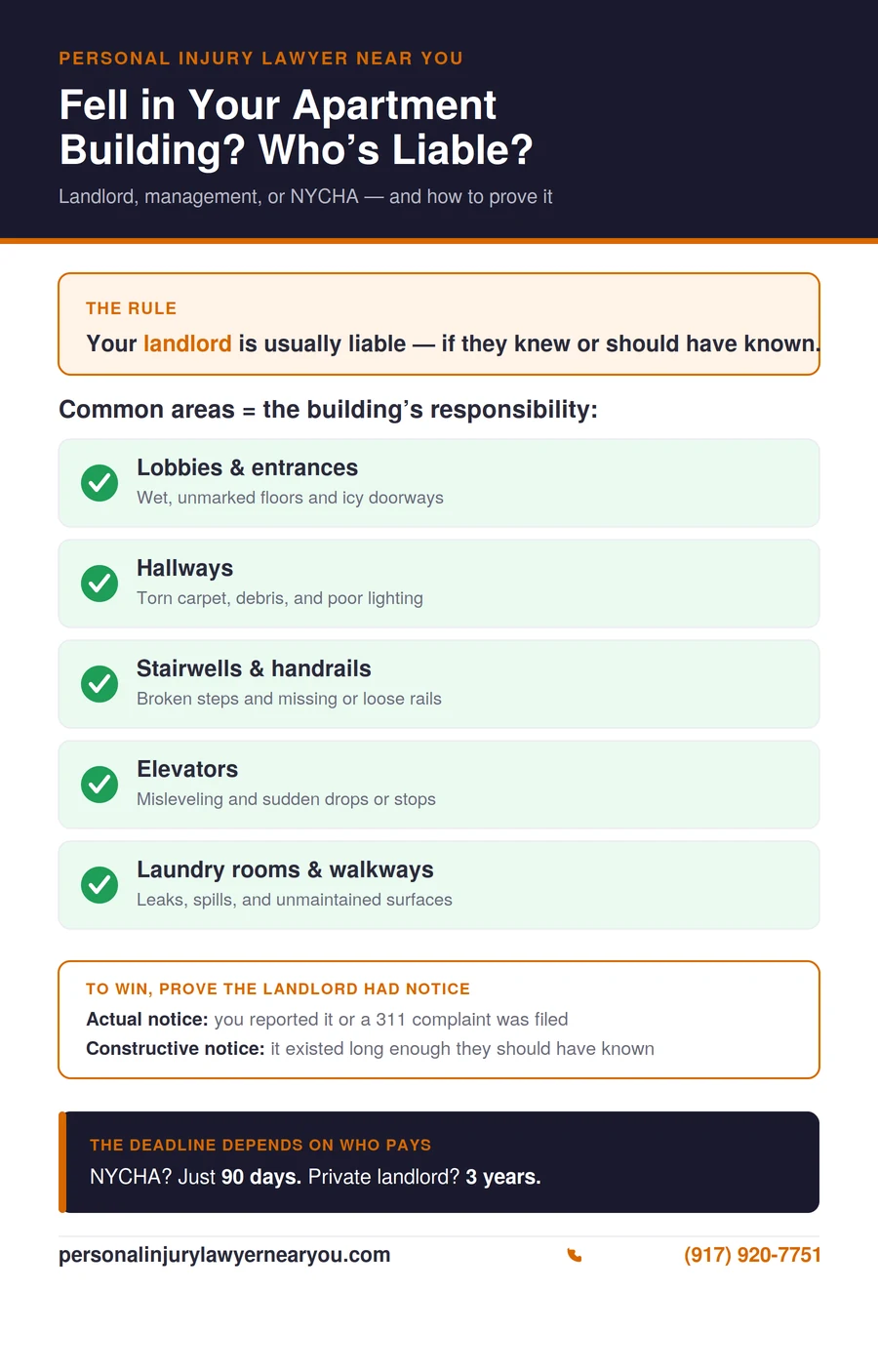
Common areas — lobbies, hallways, stairwells, elevators, laundry rooms, entrances, and exterior walkways — are almost always the landlord’s or management company’s responsibility. These are the spaces the building controls and is expected to maintain, so a fall there usually points straight at the property owner.
Inside your own unit, liability is more nuanced. The landlord is generally responsible for structural problems and repairs they’re legally required to make — a broken floor tile, a leaking pipe, a defect they were told about — while conditions a tenant created themselves may reduce or shift responsibility. A Manhattan slip and fall lawyer can sort out who controlled the exact spot where you fell.
The “Notice” Rule — Did the Landlord Know?
This is where most apartment slip and fall cases are won or lost. It usually isn’t enough that a hazard existed — you generally have to prove the landlord had notice of it and failed to fix it within a reasonable time. There are two kinds:
- Actual notice — the landlord knew directly. You reported the broken step, or another tenant filed a complaint or 311 report about it.
- Constructive notice — the landlord should have known. The hazard existed long enough that a reasonable inspection would have caught it, like a stairwell light that had been out for weeks.
This is why your prior complaints matter so much. Every repair request, text to the super, or 311 filing is powerful evidence that the landlord was on notice. If your fall happened in the Bronx, a Bronx slip and fall lawyer can pull building violation and complaint records to prove it.
Living in NYCHA or Public Housing? Special Rules Apply
If you were injured in a NYCHA building or other public housing, your claim works very differently from a case against a private landlord. Because NYCHA is a City agency, you generally must file a formal notice of claim within 90 days of your fall — not the usual three-year window — and there are strict procedural rules about how and when you can sue.
Miss that 90-day deadline and an otherwise strong case can be lost before it starts. Public housing tenants still have real rights and real claims — but the clock is far shorter, so acting immediately is essential.
Common Apartment Slip and Fall Hazards
Most apartment slip and fall injuries trace back to conditions the building should have fixed. The most common include:
- Wet or freshly mopped lobby floors with no warning signs
- Broken, worn, or poorly lit stairwells
- Missing or loose handrails on interior stairs
- Torn carpeting or damaged flooring in hallways
- Defective or malfunctioning elevators
- Ice and snow left untreated at building entrances and walkways
- Water leaks creating slick surfaces
These hazards cause serious injuries — hip fractures, torn ligaments, spinal injuries, and head trauma — that can mean months of treatment and lost income. Before accepting any settlement, it helps to understand the full value of your claim with a free personal injury settlement calculator.
Deadlines: 3 Years vs 90 Days
As with any premises case, the deadline depends on who is liable:
- Private landlord or management company — you generally have three years from the date of the fall to file a lawsuit.
- NYCHA or public housing — you must file a notice of claim within 90 days, then sue within one year and 90 days.
If your fall happened outside the building on the public sidewalk rather than inside, different rules apply — our guide on sidewalk slip and fall liability in NYC breaks that down. When you’re unsure who’s liable, treating the 90-day clock as if it applies is always the safer move.
What to Do After a Fall in Your Building
The steps you take right away can make or break your claim:
- Report the fall to the super or management immediately and ask for a written incident report.
- Photograph the hazard — the wet floor, broken step, missing handrail, or dark stairwell — before it gets fixed.
- Get medical attention the same day, even if you feel okay; symptoms often worsen later.
- Save your paper trail — prior repair requests, texts to the super, and any 311 complaints that prove notice.
- Get witness information from neighbors who saw the fall or knew about the hazard.
- Don’t give a recorded statement to the landlord’s insurer before getting advice.
For a fuller look at how these cases work across the five boroughs, see our complete guide to slip and fall claims in New York. The faster the hazard is documented and the liable party identified, the stronger your case.
Key Takeaways
✅ The landlord or property management company is usually liable for an apartment slip and fall, especially in common areas
✅ You generally must prove the landlord had actual or constructive notice of the hazard
✅ Common areas (lobbies, stairwells, hallways) are almost always the building’s responsibility
✅ NYCHA and public housing claims require a notice of claim within just 90 days
✅ Prior complaints, 311 reports, and repair requests are powerful evidence of notice
Frequently Asked Questions
Who is responsible for a slip and fall in an apartment building?
Usually the landlord or property management company, especially when the fall happened in a common area like a lobby, hallway, or stairwell. If you live in public housing, NYCHA or another housing authority may be responsible. More than one party can share liability at the same time.
Can I sue my landlord for a slip and fall?
Yes, if the landlord failed to keep the property reasonably safe and you can show they had notice of the hazard. You generally must prove the landlord knew or should have known about the dangerous condition and did not fix it within a reasonable time. Prior complaints and repair requests are strong evidence.
What if I fell in a NYCHA or public housing building?
Claims against NYCHA follow different rules because it is a City agency. You generally must file a notice of claim within 90 days of the accident and then sue within one year and 90 days. These deadlines are much shorter than a case against a private landlord, so it is important to act immediately.
How long do I have to file an apartment slip and fall claim?
Against a private landlord or management company, you generally have three years from the date of the fall to file a lawsuit. Against NYCHA or public housing, you must file a notice of claim within 90 days. Missing these deadlines can permanently end your claim.
What should I do right after falling in my building?
Report the fall to the super or management and request a written incident report, photograph the hazard before it is fixed, get medical care the same day, save any prior repair requests or 311 complaints that prove notice, collect witness information, and avoid giving recorded statements before getting legal advice.
Get a Free Case Review
Hurt in a fall in your own building and not sure who’s responsible? Figuring out whether your landlord, the management company, or NYCHA owes you — before the deadline runs — is exactly what makes these cases succeed. Get a free, no-obligation case review today and find out who is liable and what your claim is worth.
Injured in a Fall in Your Apartment Building? Find Out Who Owes You
Free case review. No win, no fee. No upfront cost.
