
TL;DR — Quick Summary
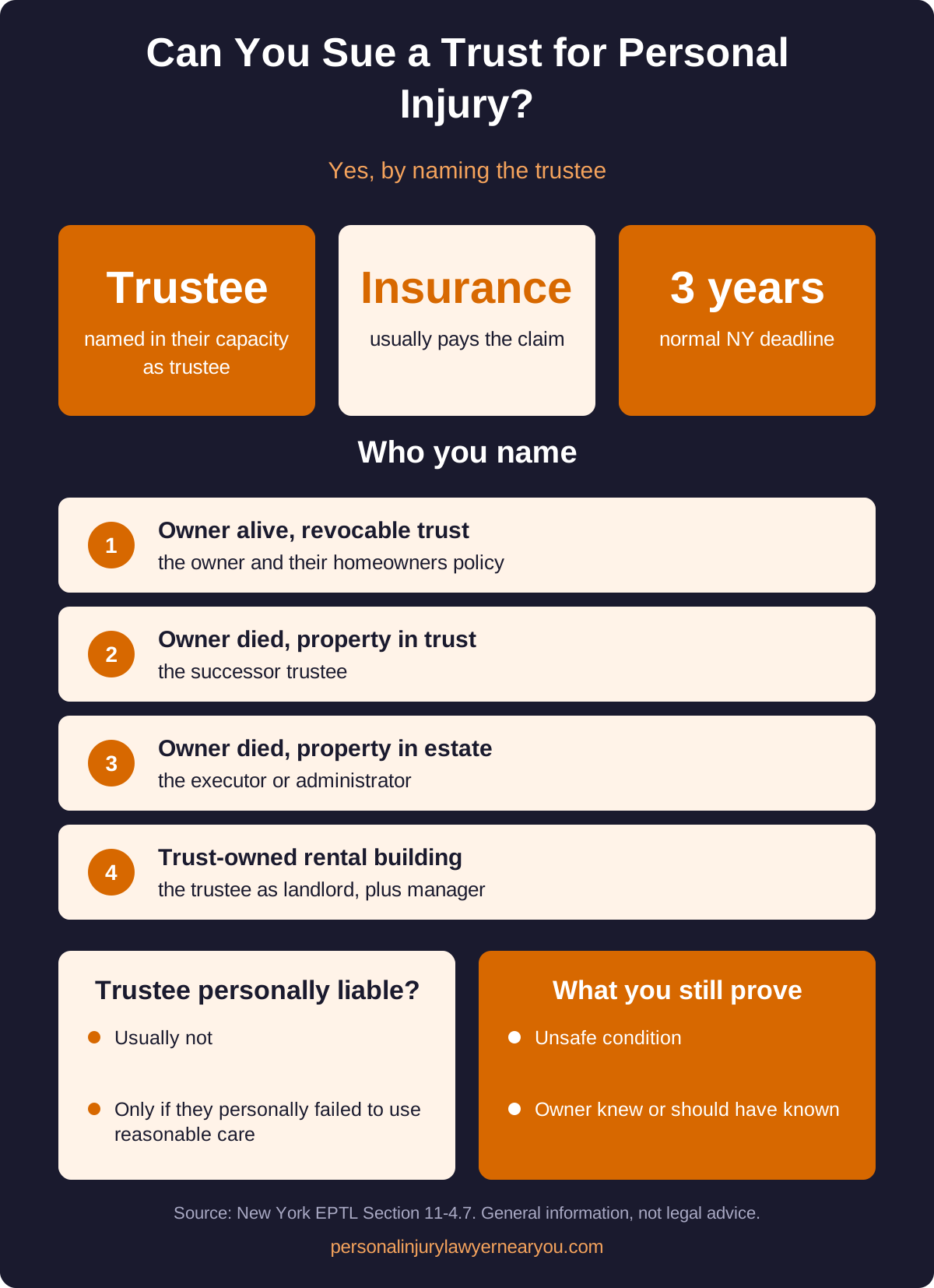
Yes, you can sue a trust for personal injury, but you sue the trustee. A trust isn’t a legal entity, so the case names the trustee in their capacity as trustee. Payment usually comes from the property’s liability insurance or from trust assets, not the trustee’s personal money. This comes up most often when you’re hurt on a home, rental building or land held in a trust, or when the owner has died. The normal three-year New York deadline generally applies.
Can you sue a trust for personal injury? The question usually comes up after someone falls on a property, gets bitten by a dog or is hurt in a building, and then learns the property isn’t owned by a person but by “The Smith Family Trust.” It sounds like a dead end. It isn’t.
Trusts are common estate planning tools, and plenty of homes and rental buildings in New York are held in one. This guide explains who you actually sue, where the money comes from, how revocable and irrevocable trusts differ, and what changes if the owner has died.
Can You Sue a Trust for Personal Injury? How It Works
A trust is a legal arrangement, not a legal person like a corporation. It can’t sign a contract or be served with a lawsuit by itself. Instead, the trustee, the person or company that holds and manages the trust property, acts for it. So a lawsuit is brought against “Jane Doe, as Trustee of the Smith Family Trust,” rather than against the trust’s name alone.
That wording matters. Suing the trustee as trustee means you are going after the trust’s assets and insurance. Suing them individually means going after their personal money, which is only possible in narrower situations.
When Trusts Come Up in Injury Cases
| Situation | Who you usually name | Who usually pays |
|---|---|---|
| Slip and fall at a home held in a living trust | The owner (if alive) or successor trustee | Homeowners insurance |
| Injury in a rental building owned by a trust | The trustee as landlord, plus any manager | Building liability insurance |
| Dog bite on trust-owned property | The dog owner, and possibly the trustee | Homeowners or renters insurance |
| Owner died and the property is in trust | The successor trustee | Insurance, then trust assets |
| Owner died and property is in their estate | The executor or administrator | Insurance, then estate assets |
| Business run through a trust | The trustee, or the business entity | Commercial liability insurance |
In most of these cases the real payer is an insurance company. The trust or trustee is simply the name that goes on the claim.
Revocable vs Irrevocable Trusts
Revocable living trust
A revocable trust is one the creator, called the grantor, can change or cancel at any time. While the grantor is alive, the property is generally treated as theirs, and their own creditors can usually reach it. In practice, an injury on a home in a revocable trust is handled much like any homeowner claim: through the homeowners policy, with the owner as the defendant.
Irrevocable trust
An irrevocable trust generally can’t be changed, and the property belongs to the trust rather than the grantor. Claims arising from that property go against the trustee. Irrevocable trusts are sometimes set up to protect assets, but they don’t make a property immune from injury claims based on how it is run.
Is the Trustee Personally Liable?
Usually not. The default is that the trust and its insurance answer for injuries arising from trust property. A trustee can face personal liability in narrower situations, for example where they personally failed to use reasonable care in managing the property. New York’s estates law sets out a similar rule for estate fiduciaries: under EPTL Section 11-4.7, a personal representative is personally liable for torts in administering an estate only if they failed to use reasonable care, and claims can be brought against the estate by suing the representative in their fiduciary capacity.
Professional trustees, such as banks and trust companies, are usually well insured and represented. Family members acting as trustee often aren’t lawyers and may not realize a claim needs to go to the insurer, so it helps to send notice early.
What You Still Have to Prove
Suing a trustee doesn’t change the core of the case. You still need to show the property was unsafe, that the owner knew or should have known about the hazard, and that it caused your injury. For building injuries, our guide to who is responsible for an apartment slip and fall in NYC explains how notice is proven. On NYC sidewalks, the abutting property owner is usually responsible, which can mean a trust-owned building, as our article on NYC Code 7-210 sidewalk liability explains.
Your compensation is the same as in any injury case: medical bills, lost earnings, future care and pain and suffering, covered in our guide to personal injury damages in New York.
Common Defenses in Trust Property Claims
- “The trustee didn’t know about the hazard.” As with any premises case, lack of notice is the main defense. Inspection records, prior complaints and repair requests help prove the owner knew.
- “The tenant was responsible.” In rentals, the trustee may argue a tenant controlled the area where you fell. Leases and who handled repairs decide this.
- “You sued the wrong party.” Naming the trust instead of the trustee, or the trustee individually, can cause delays. Getting the caption right avoids this.
- “The policy doesn’t cover it.” Insurers sometimes dispute coverage when a property was transferred into a trust without updating the policy.
Example: A Fall at a Trust-Owned Two-Family House
An illustrative example. You rent the upstairs unit of a two-family house in Staten Island. The owner put the house in a living trust before she died, and her son is now the successor trustee. You fall on a broken back step that you reported twice in writing. Your claim names the son as trustee, notice goes to the homeowners insurer, and your written complaints prove the trustee knew about the step. The insurer handles and pays the claim, and the son’s personal savings aren’t at risk. Our step-by-step guide to filing a personal injury claim in Staten Island covers the local process.
Finding Out Whether a Property Is Held in a Trust
- Property records. NYC property records (ACRIS) show the owner on the deed, which may read “Trustee of” a named trust.
- The insurance carrier. Ask the property owner or manager for insurance details; the policy often names the trust.
- Rent bills and leases. In rental buildings, the landlord named on the lease may be a trustee or an LLC owned by a trust.
- Your lawyer. Identifying the correct defendant is routine work at the start of a case.
Naming the right defendant matters, especially close to a deadline. Our guide to the personal injury statute of limitations in New York explains how much time you have.
Can You Sue a Trust for Personal Injury After the Owner Dies?
This is where most trust questions come from. A property owner dies, the house sits empty or is rented out, and someone is hurt there. Here is how it usually works.
If the property was in a trust
The trust document names a successor trustee who takes over when the grantor dies. That successor trustee manages the property and is the person to name in a claim, in their capacity as trustee. The homeowners policy should still apply if it was kept active.
If the property passed through the estate
If the house wasn’t in a trust, it becomes part of the owner’s estate. The claim goes against the executor or administrator appointed by the Surrogate’s Court. If no one has been appointed yet, a lawyer may need to ask the court to appoint someone before the case can move forward.
Watch the insurance
Insurers sometimes cancel or limit coverage on vacant homes. If a house sat empty after the owner died, check whether the policy was still in force on the date of the injury, and whether a vacancy exclusion applies.
The trust document itself isn’t public, but the successor trustee can usually be identified through the deed, the insurer or the family.
Act early
Trusts and estates can distribute assets over time. Sending notice of the claim early helps make sure insurance is notified and assets aren’t all paid out to beneficiaries before your claim is resolved.
Expect more parties
Estate and trust cases often involve family members, a property manager and an insurer all at once. Having one person, usually your lawyer, handle all communication keeps the claim on track and avoids mixed messages.
If you are a family member who has just become a trustee and receive a claim, notify the property’s insurer right away. Most homeowners policies require prompt notice, and the insurer will usually provide a defense lawyer at no cost to you.
So, can you sue a trust for personal injury after the owner has died? Yes, through the successor trustee or the estate’s representative, and in most cases the property’s insurance is still what pays the claim.
Do You Need a Lawyer?
Trust and estate claims add a layer of complexity: finding the right defendant, getting the insurer involved and dealing with family members who may not understand the process. Simple claims can sometimes be handled directly, as our guide to a personal injury claim without a lawyer explains, but disputed claims usually benefit from representation.
Frequently Asked Questions
Can you sue a trust for personal injury?
Yes, but not by naming the trust alone. A trust isn’t a legal person, so the claim is brought against the trustee in their capacity as trustee. Recovery then comes from the trust’s insurance or trust assets, not usually from the trustee’s own money.
Can a trust be sued for personal injury if the property owner has died?
Yes. If the property was held in a trust, the successor trustee can be sued in their trustee capacity. If it passed through the owner’s estate instead, the claim is usually brought against the executor or administrator on behalf of the estate.
Is the trustee personally liable for an injury on trust property?
Usually not. The trust and its insurance normally answer for the claim. A trustee can become personally liable in some situations, for example if they personally failed to use reasonable care in managing the property, so the specific facts matter.
Does homeowners insurance cover a house owned by a trust?
Often, yes, if the policy correctly lists the trust or trustee as an insured. Most injury claims on trust-owned homes are paid by that liability policy. Problems can arise if the policy wasn’t updated when the house was moved into the trust.
Can you sue a revocable living trust?
A revocable trust is usually treated as the grantor’s own property while they are alive, so claims are generally brought against the person and their insurance as owner. After the grantor dies and the trust becomes irrevocable, claims typically go against the successor trustee.
How long do I have to sue a trust for personal injury in New York?
The usual three-year deadline for personal injury lawsuits in New York generally applies, measured from the date of the injury. Extra rules can apply if the owner has died or a public body is involved, so it’s worth checking early.
Key Takeaways
✅ You can sue over an injury on trust property, but you name the trustee
✅ A trust isn’t a legal person; the trustee is sued in their capacity as trustee
✅ Insurance on the property usually pays, not the trustee’s own money
✅ Revocable trusts are usually treated as the grantor’s property while they’re alive
✅ After the owner dies, claims go to the successor trustee or the estate’s representative
Hurt on Property Owned by a Trust?
A free case review can identify the right defendant, find the insurance and check your deadline, so the claim starts on the right foot.
Injured on Someone Else’s Property? Get a Free Review
Free case review. No win, no fee. No upfront cost.
Want more NYC injury guides and legal news from PILNY in your Google results?
