
TL;DR — Quick Summary
If you fell on a Manhattan sidewalk, your claim is probably not against the City of New York. Since 2003, NYC Administrative Code § 7-210 has placed the duty to maintain the sidewalk — and liability for injuries — on the owner of the abutting property. That means a Manhattan sidewalk fall claim usually runs against a building owner, with a three-year deadline rather than the 90-day Notice of Claim everyone worries about. The City remains liable only in narrow situations, and getting this wrong at the start can end an otherwise valid case.
Search “who is liable for a Manhattan sidewalk fall” and you will find a great deal of confident advice telling you to file a Notice of Claim against the City within 90 days. For most Manhattan sidewalk falls, that advice is more than twenty years out of date — and following it can send you chasing the wrong defendant while the right one quietly runs out the clock on nothing.
Here is how sidewalk liability in Manhattan actually works now.
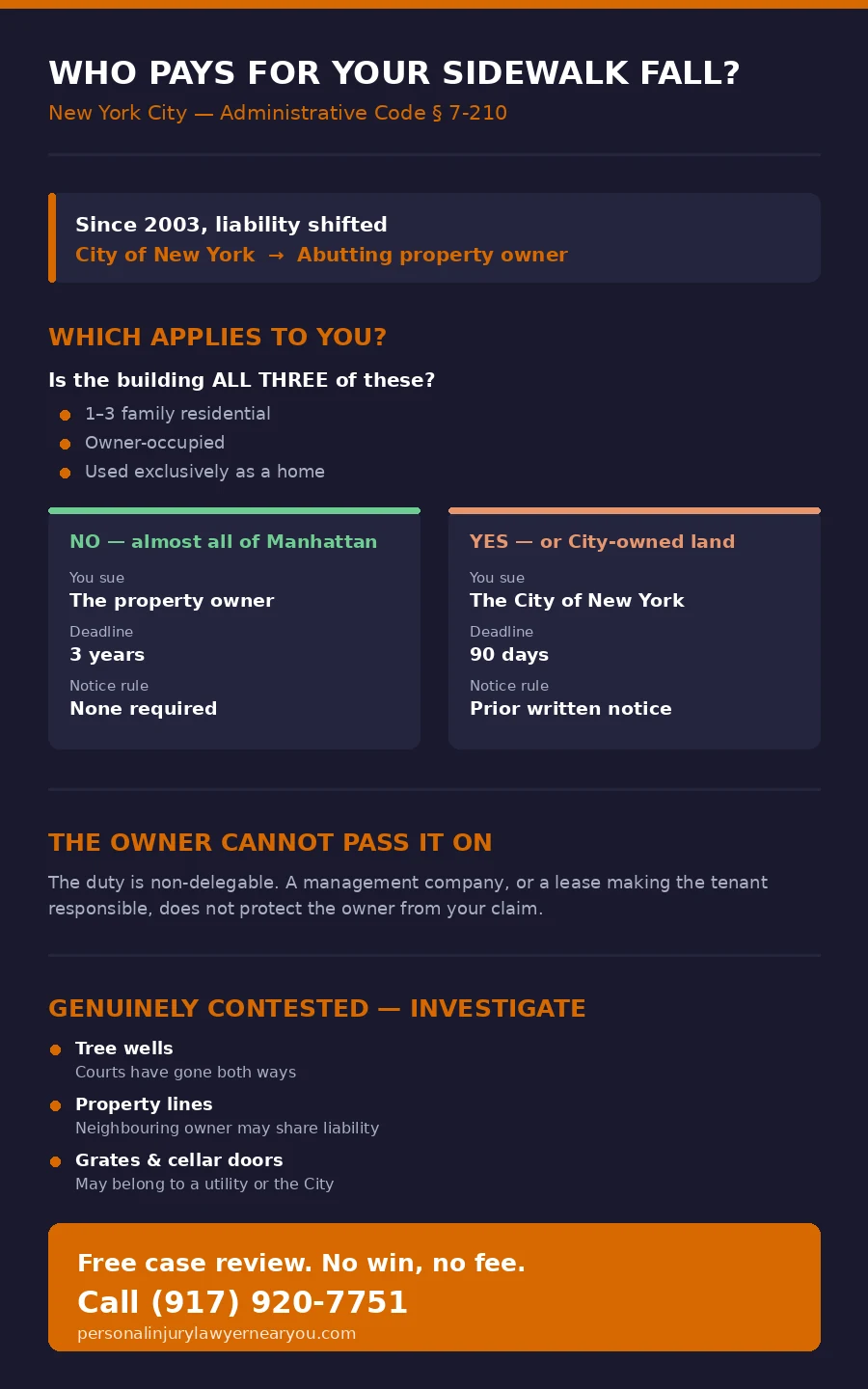
What Changed in 2003
Before September 2003, injured pedestrians generally sued the City for defective sidewalks. New York City had more than 12,000 miles of sidewalk to defend, the cases were expensive, and the City argued it was unfair to make taxpayers pay for walkways that sit in front of private buildings.
So the City Council passed Administrative Code § 7-210, sometimes called the shifting liability statute. It did two things at once: it imposed a duty on abutting property owners to keep their sidewalk in reasonably safe condition, and it made those owners liable for injuries caused by failing to do so.
The statute is specific about what “failure to maintain” includes — negligently failing to install, construct, repave, repair, or replace defective sidewalk flags, and negligently failing to remove snow, ice, dirt, or other material. It also covers the intersection quadrant for corner properties, which surprises a lot of corner-building owners.
The practical result in Manhattan: if you tripped on a raised flag outside an office building, an apartment tower, a restaurant, or a mixed-use property, your claim is against that building’s owner. Not the City.
Why This Changes Your Deadline — and Your Case
This is the part that matters most, and it cuts in your favor.
A claim against the City requires a Notice of Claim within 90 days, plus proof of prior written notice of the defect. Miss the 90 days and the claim is generally gone, no matter how badly you were hurt.
A claim against a private property owner is an ordinary premises liability case with a three-year statute of limitations, and no prior written notice requirement. That is a dramatically more forgiving position — and it is the position most Manhattan sidewalk victims are actually in.
People miss valid claims in both directions here. Some assume 90 days have passed and give up on a case they could still bring for years. Others spend those 90 days pursuing the City when the real defendant was the building they fell in front of. This is the same “identify the right defendant early” problem a Manhattan slip and fall injury lawyer works through at the very start of any premises case.
The Exception That Actually Matters
Section 7-210 does not apply to every property. There is one meaningful carve-out, and it has three conditions that must all be met:
- The property is a one-, two-, or three-family residential building
- It is owner-occupied, in whole or in part
- It is used exclusively for residential purposes
Fail any one of the three and the exception does not apply. A four-unit building fails. An absentee landlord’s brownstone fails. A townhouse with a dentist’s office on the ground floor fails the “exclusively residential” test — which is why mixed-use buildings almost never qualify.
In Manhattan specifically, this exception is close to theoretical. The borough is overwhelmingly commercial, institutional, and multi-family. If you fell on a Manhattan sidewalk, the odds strongly favor the abutting owner being liable.
The City also stays liable where it is the landowner itself — parks, plazas, public buildings, and land it controls directly. In those cases the 90-day Notice of Claim and prior written notice requirements come back into play.
The Duty Cannot Be Contracted Away
Property owners routinely try two arguments, and both fail.
The first is that a management company handles maintenance. The second is that the commercial lease makes the tenant responsible for the sidewalk. New York’s Court of Appeals has confirmed that § 7-210 imposes a non-delegable duty. Even an out-of-possession landlord remains liable to the injured pedestrian, regardless of what the lease says.
What those contracts do control is who ultimately absorbs the cost. The owner may have a claim over against the tenant or the contractor. That fight happens between them — it does not affect your right to recover from the owner.
Where It Gets Genuinely Complicated
Three situations produce real litigation rather than a clean answer.
Tree wells. A raised tree well edge or a gap around a street tree is not automatically the same thing as a “sidewalk” under the statute. Courts have gone both ways depending on the specific defect and its location, and some owners have won summary judgment on exactly this point. If you fell at a tree well, treat the outcome as genuinely uncertain rather than assumed.
Property lines. If the defect sits at the boundary between two buildings — an expansion joint, a shared flag — the answer is not automatically “whoever is closest.” New York’s Court of Appeals has held that a neighboring owner can bear liability where its own failure to maintain contributed to the defective condition. These cases often end with more than one defendant.
City-owned cellar doors, grates, and hardware. Vault covers, utility grates, and access hatches embedded in the sidewalk may belong to a utility or the City rather than the building. The right defendant depends on the specific piece of hardware you tripped on.
In all three, the answer comes from investigation — photographs, measurements, block-and-lot records, DOT violation history — not from a rule of thumb. Whatever the mechanism, the underlying framework of a Manhattan personal injury claim stays the same: duty, breach, notice, causation, damages.
What You Still Have to Prove
Section 7-210 tells you who owed the duty. It does not hand you the case. You still need to establish:
- A defect existed — with photographs showing the height differential, ideally with a coin or ruler for scale
- Notice — that the owner knew about it, or that it existed long enough that they should have. Weathering, accumulated dirt in the crack, and prior DOT violations all help
- Causation — that this defect caused your fall, not something else
- Damages — medical records that begin promptly and continue without unexplained gaps
The trivial defect defense is the one you will meet most often: the owner argues the height difference was too small to be actionable. There is no fixed threshold in inches — it turns on the specific circumstances, including lighting, foot traffic, and whether the edge was visible. Photographs taken the same day, before anyone repairs it, do more work here than anything else you can produce.
Once liability is established, valuation follows the ordinary path. Our free personal injury settlement calculator gives you a realistic range, and the average personal injury settlement amounts in New York show where sidewalk cases typically land.
If You Fell in Front of a Construction Site
Manhattan sidewalks spend years under scaffolding and sidewalk sheds. If your fall involved steel plating, a hose, debris, or a poorly lit shed, the analysis shifts. The contractor or permit holder may be liable alongside — or instead of — the building owner, and DOB permit filings identify exactly who controlled that stretch on the day you fell.
If you were working on that site rather than walking past it, a different statute applies entirely. Our guide to Manhattan construction site accidents and the Scaffold Law covers Labor Law § 240 and why workers’ compensation is rarely the whole story.
Frequently Asked Questions
Do I sue the City or the building owner for a Manhattan sidewalk fall?
Almost always the building owner. Since 2003, NYC Administrative Code § 7-210 has placed sidewalk liability on the abutting property owner. The City remains responsible only in narrow situations — owner-occupied one-to-three family homes used exclusively as residences, and land the City itself owns, such as parks and plazas.
How long do I have to file a sidewalk fall claim in Manhattan?
Three years from the date of the fall for a claim against a private property owner. If the City or a public entity is genuinely the responsible party, a Notice of Claim is generally due within 90 days and prior written notice of the defect may also be required. Because the defendant determines the deadline, identifying the right one early matters enormously.
The landlord says the tenant is responsible for the sidewalk. Is that true?
Not as far as you are concerned. Section 7-210 imposes a non-delegable duty on the property owner, and New York’s Court of Appeals has confirmed that a lease shifting maintenance to a tenant does not extinguish the owner’s liability to an injured pedestrian. Who ultimately pays between owner and tenant is a separate dispute.
How big does the sidewalk defect have to be?
There is no fixed measurement in New York. Owners frequently argue a defect was trivial and not actionable, but courts assess the specific circumstances — the size and shape of the edge, lighting, foot traffic, and whether it was reasonably visible. Same-day photographs with an object for scale are the most useful evidence you can gather.
What if I fell on ice or snow on a Manhattan sidewalk?
Snow and ice removal falls squarely within the owner’s § 7-210 duty. New York applies a storm-in-progress rule, meaning owners generally get a reasonable period after a storm ends before liability attaches, so the timing of the weather relative to your fall becomes central. Weather records for that specific day and location are usually the first thing an attorney pulls.
Key Takeaways
✅ Since 2003, the abutting property owner — not the City — is liable for most NYC sidewalk falls
✅ That usually means three years to file, not the 90-day Notice of Claim
✅ The exception needs all three: 1–3 family, owner-occupied, exclusively residential
✅ The duty is non-delegable — a lease shifting it to a tenant does not protect the owner
✅ Tree wells, property lines, and utility hardware are genuinely contested — investigate, don’t assume
Fell on a Manhattan Sidewalk?
The most common reason a valid sidewalk case fails is that nobody identified the right defendant while the defect was still there to photograph. A Manhattan slip and fall attorney can pull block-and-lot ownership records, check DOT violation history for that address, and preserve the evidence before the flag gets repaired. The case review is free, and there is no fee unless you win.
Get Connected With a Manhattan Slip and Fall Lawyer Today
Free case review. No win, no fee. No upfront cost.
