
TL;DR — Quick Summary
Personal injury litigation funding, also called pre-settlement funding or a lawsuit loan, is cash advanced against your expected settlement. It is usually non-recourse: if you lose, you owe nothing. The catch is the cost: charges often grow every month the case stays open, and the funder is repaid out of your settlement before you see a dollar. It can also make you feel pressure to settle quickly, or make a fair offer look too small. Use it only after cheaper options, such as no-fault benefits, payment plans and help from family, and only after your lawyer reviews the contract.
Injury claims take time, and bills do not wait. Personal injury litigation funding promises to bridge that gap with cash now, repaid only if you win. For some people it is a lifeline. For many, it quietly takes a large share of the settlement.
This guide explains how lawsuit funding works, what it really costs, and what to try first.
How Pre-Settlement Funding Works
- You apply to a funding company, usually through your lawyer.
- The funder reviews your case with your lawyer and decides how much to advance, typically a small fraction of the expected settlement.
- If approved, you sign a contract and receive the cash.
- When the case settles, your lawyer repays the funder from the settlement, including all fees, before paying you.
- If you lose the case, you usually owe nothing.
Because you only repay if you win, funders describe these advances as non-recourse rather than loans, and they are often not regulated like ordinary consumer loans. The rules differ from state to state.
Litigation Funding vs Other Options
| Option | Repay if you lose? | Typical cost |
|---|---|---|
| Pre-settlement funding | Usually no | High, often growing monthly |
| Credit card or personal loan | Yes | Interest at regular rates |
| No-fault benefits (car crash) | Not a loan | None |
| Medical treatment on a lien | Paid from the settlement | Provider’s full charges |
| Lawyer advancing case costs | Depends on the agreement | Repaid from the recovery |
What It Really Costs
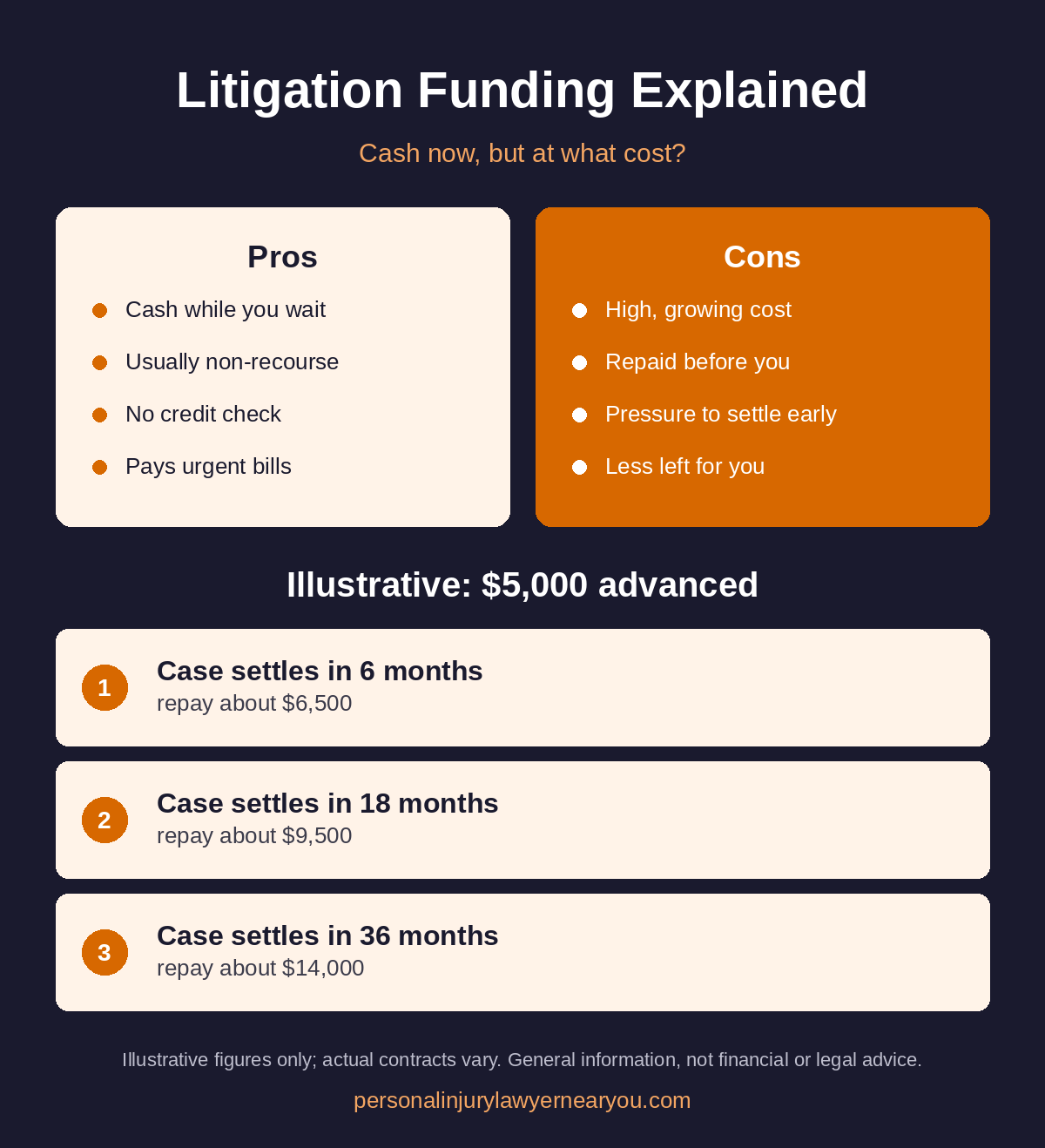
Funding charges are usually based on time. Many contracts add fees every month the case is open, and some compound. A case that drags on for two or three years can turn a modest advance into a repayment several times larger. Because injury cases rarely move as fast as people expect, see how long a personal injury case takes before you sign anything priced by time.
An Illustrative Example
The figures below are illustrative only, to show how timing changes the outcome:
| Case length | Amount advanced | Repayment owed (illustrative) | Left for you from a $60,000 net settlement |
|---|---|---|---|
| 6 months | $5,000 | $6,500 | $53,500 |
| 18 months | $5,000 | $9,500 | $50,500 |
| 36 months | $5,000 | $14,000 | $46,000 |
The settlement did not change, but the amount left for you shrank the longer the case ran. That is also why funding can create pressure to accept an early, lower offer.
Questions to Ask Before You Sign
- Is the charge a flat fee, or does it grow each month? Does it compound?
- What is the total repayment at 6, 12, 24 and 36 months?
- Is there a cap on the total repayment?
- What happens if the case settles for less than expected?
- Are there application, processing or broker fees?
Your lawyer should review the contract, because they will be the one repaying the funder from the settlement. Lawyers can usually advance court costs and case expenses, repaid from the recovery, but ethics rules generally stop them from lending you money for living expenses. Our guide to how a contingency fee works explains the difference.
Try These First
- No-fault benefits. After a car crash in New York, your own policy pays medical bills and part of lost wages, regardless of fault. See how New York no-fault insurance works.
- Payment plans with medical providers and creditors.
- Disability benefits through work or the state, if you cannot work.
- Help from family on clear, written terms.
Once the case settles, other parties may also have claims on the money. See whether creditors can take your personal injury settlement. The Federal Trade Commission’s consumer site has general advice on spotting costly or misleading financial offers. If you were hurt in Brooklyn and are struggling while your case is pending, a Brooklyn personal injury lawyer can talk through the options for free.
Frequently Asked Questions
What is personal injury litigation funding?
It is cash advanced to an injured person against their expected settlement, also called pre-settlement funding or a lawsuit loan. The funder is repaid from the settlement, and if the case is lost, you usually owe nothing.
Do I have to repay a lawsuit loan if I lose?
Usually not. Most pre-settlement funding is non-recourse, meaning repayment comes only from a recovery. Read the contract to confirm this before signing.
How much does pre-settlement funding cost?
It varies widely, but charges often grow every month the case stays open, and some compound. The longer the case lasts, the more of your settlement goes to the funder.
Can my lawyer lend me money while my case is pending?
Lawyers can usually advance court costs and case expenses, repaid from the recovery, but ethics rules generally prevent them from lending money for living expenses.
Does litigation funding affect my settlement?
Yes. The funder is repaid out of the settlement before you, which reduces what you take home, and the growing cost can create pressure to accept an early offer.
What are the alternatives to a lawsuit loan?
In New York car crashes, no-fault benefits pay medical bills and part of lost wages. Other options include payment plans, disability benefits and help from family. Funding is usually best kept as a last resort.
Key Takeaways
✅ Litigation funding is cash now, repaid from your settlement
✅ It is usually non-recourse: you owe nothing if you lose
✅ Costs often grow every month, so long cases cost much more
✅ Have your lawyer review the contract before signing
✅ Use cheaper options, such as no-fault benefits, first
Struggling Financially While Your Case Is Pending?
The pressure is real, and it is exactly what insurers count on. A free case review looks at what your claim may be worth and how long it is likely to take, so you can decide whether funding makes sense.
Money Tight While Your Case Drags On? Talk to Us
Free case review. No win, no fee. No upfront cost.
Want more NYC injury guides and legal news from PILNY in your Google results?
