
TL;DR — Quick Summary
A contingency fee personal injury attorney is paid only out of what they recover for you — no retainer payment, no hourly bills, no fee if the case is lost. In New York the fee is capped by court rule at one-third of the net recovery or a sliding schedule, whether the case settles early or goes to trial. The parts of the agreement that really differ from firm to firm are how expenses are handled, especially if you lose, and what happens if you change lawyers. This guide explains each clause before you sign.
Most people hire an injury lawyer at the worst possible time: hurt, off work and worried about money. The contingency fee is what makes that possible. But “no win, no fee” is a summary, not a contract. The retainer agreement you sign is a legal document with several moving parts, and knowing what each one means is the difference between a fair arrangement and an unpleasant surprise at closing.
What a Contingency Fee Actually Is
Under a contingency agreement the lawyer’s fee is a percentage of the money recovered for you, by settlement or verdict. The lawyer does the work, advances the costs of building the case and takes the risk of getting nothing. If there is no recovery, there is no fee.
The model exists because the people who most need an injury lawyer are often the least able to pay one by the hour. It also lines up incentives: the lawyer is paid more only when you recover more. That alignment is real, but it is not automatic — as the section on settlement mills below explains.
How Much a Contingency Lawyer Can Charge in New York
New York is unusual. In most states the percentage is whatever the lawyer and client agree. Here, the Appellate Divisions cap fees in personal injury and wrongful death cases (the Fourth Department’s version is 22 NYCRR 1015.15). The retainer must use one of two options:
- Schedule A — a sliding scale: 50% of the first $1,000, 40% of the next $2,000, 35% of the next $22,000 and 25% of the rest.
- Schedule B — a flat percentage of no more than one-third. This is what most New York retainers use.
The cap does not rise because a case goes to trial. A fee above the schedule is treated as excessive unless a judge approves it in writing. If a firm quotes you “33% now, 40% if we go to court” for an ordinary injury case, that is a national template, not New York law. Medical malpractice follows a separate, lower scale. For worked examples of both schedules, see our breakdown of personal injury lawyer fees in New York.
The Clauses That Matter in a Retainer Agreement
A contingency agreement in New York must be in writing. Read these five parts carefully before you sign:
| Clause | What to check |
|---|---|
| Fee schedule | Does it say Schedule A or Schedule B (one-third)? It should name one. |
| Net or gross | Is the percentage taken after expenses (net) or from the whole recovery (gross, allowed only if the lawyer pays the expenses)? |
| Expenses on a loss | If the case is lost, do you owe back the costs the lawyer advanced? |
| Scope | Does it cover appeals, no-fault arbitration or property damage, or only the injury claim? |
| Who works the file | Is your case referred to another firm? If so, the retainer should say so, and you should know who your lawyer actually is. |
Net vs Gross: A Worked Example
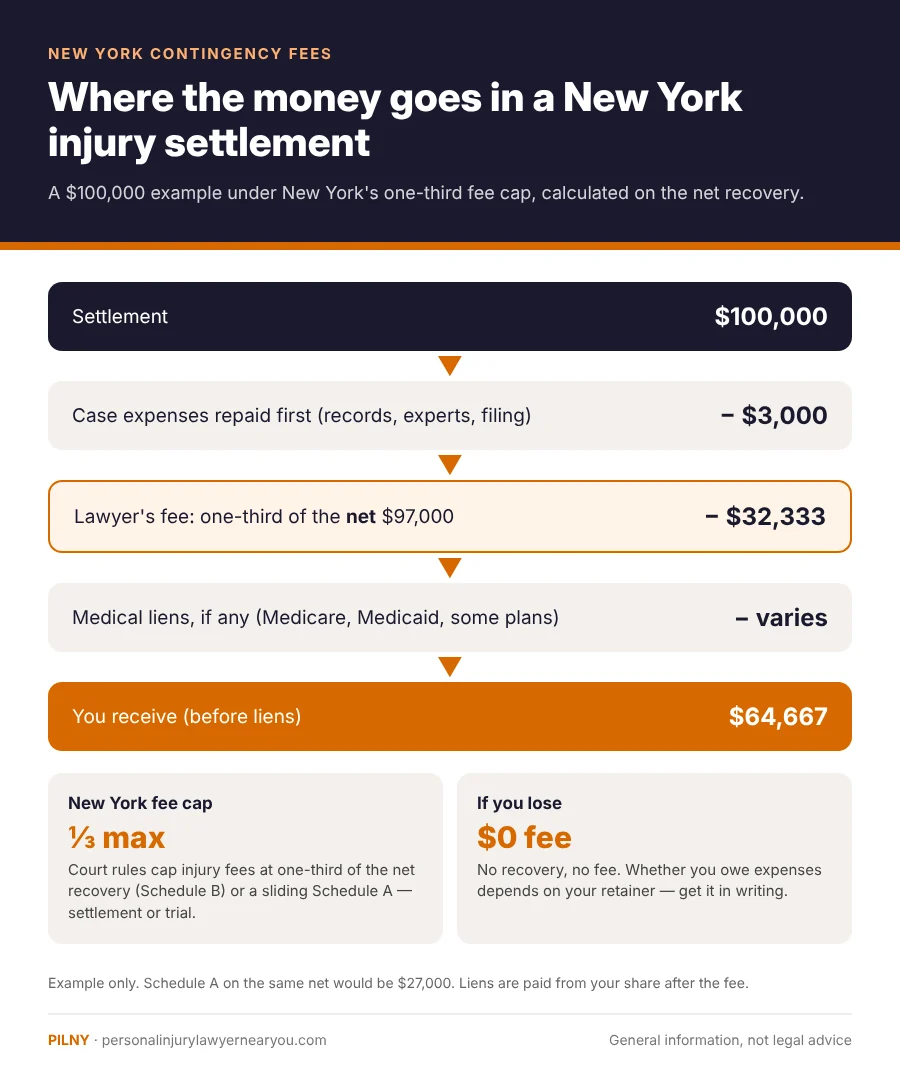
Suppose a case settles for $100,000 and the lawyer advanced $3,000 in expenses — medical records, an expert’s report and filing fees.
| Method | Fee | You receive (before liens) |
|---|---|---|
| One-third of the net (expenses deducted first) | $32,333 | $64,667 |
| Schedule A on the net | $27,000 | $70,000 |
| One-third of the gross (lawyer absorbs the $3,000) | $33,333 | $66,667 |
The gap between the methods grows with the expenses. In a case with $25,000 of expert and reconstruction costs, the choice is worth thousands of dollars. Medical liens are paid from your share after the fee in every method. To see what a case like yours may be worth before any of these deductions, try our personal injury settlement calculator.
What Happens to Expenses If You Lose
This is the clause people skip and later regret. New York’s Rules of Professional Conduct let a lawyer advance case costs and make repayment depend on the outcome, and in a contingency case the lawyer may pay those costs on their own account. In plain terms, a New York firm is allowed to promise that you owe nothing at all — fee or expenses — if the case is lost.
Many firms do exactly that; some do not. Look for wording such as “the client shall not be responsible for disbursements in the event of no recovery.” If the retainer is silent, ask, and get the answer added in writing.
Changing Lawyers Partway Through
You can discharge your lawyer at any time, for any reason. You do not pay two full fees. When a case is moved:
- The first lawyer usually keeps a lien on the file for the value of the work done, but cannot hold your case hostage.
- The new lawyer and the old lawyer typically agree how to divide a single contingency fee, often in proportion to the work each did. If they cannot agree, a court decides.
- If the first lawyer was discharged for real misconduct, they may forfeit the fee entirely.
The total fee still has to fit inside the caps described above. The practical lesson: if a lawyer is not returning calls, you are not trapped. Our guide on how to find a personal injury lawyer after an accident covers what to look for the second time round.
Contingency Fee Attorney vs Settlement Mill
Every injury firm in New York works on contingency, including high-volume “settlement mills” that sign up hundreds of cases and settle them quickly. The contingency model rewards a bigger recovery, but it also rewards speed: a firm that settles fast for less, across enough files, can earn more than one that spends a year building each case.
Signs you are dealing with the second kind:
- You have never spoken to an actual attorney, only intake staff or a case manager.
- You are encouraged to settle before your treatment is finished or your doctors have given a prognosis.
- No one can explain how the offer compares with the value of your injuries.
- The firm never files suit, so the insurer knows there is no trial risk.
The fee is the same either way; the recovery often is not. Read more on what a settlement mill lawyer is and how to avoid one.
Is Hiring a Contingency Lawyer Worth It?
For a minor injury that has fully healed with small medical bills, some people handle the property damage and a small bodily-injury claim themselves. For anything more, representation usually pays for itself. Insurers value unrepresented claims lower because they know the claimant cannot credibly threaten a lawsuit, and New York claims carry traps that are easy to miss — no-fault deadlines, the serious-injury threshold in car cases, and 90-day notice-of-claim deadlines against the City.
The useful question is not “is a third worth it?” but “will this lawyer add more than a third?” A free consultation is the time to ask that directly.
Questions to Ask Before You Sign
- Which fee schedule does your retainer use — A or one-third?
- Is the fee calculated on the net or gross recovery?
- If we lose, do I owe anything for expenses?
- Will you personally handle my case, or is it referred to another firm?
- Do you file lawsuits and try cases, or settle everything pre-suit?
- Will I get a written closing statement showing every deduction?
Frequently Asked Questions
What is a contingency fee personal injury attorney?
A lawyer who is paid a percentage of the money they recover for you, by settlement or verdict, and nothing if there is no recovery. There is no upfront payment or hourly billing.
How much does a contingency fee lawyer charge in New York?
New York court rules cap personal injury and wrongful death fees at one-third of the net recovery (Schedule B) or a sliding Schedule A. The cap applies whether the case settles or goes to trial; anything higher needs a judge’s written approval.
Can a New York lawyer charge 40% if my case goes to trial?
Not in an ordinary personal injury case without a written court order. A “40% at trial” clause is a national template and is above New York’s limit.
Do I pay expenses if I lose my case?
It depends on the retainer. New York rules allow a lawyer to make repayment of costs depend on the outcome, so many firms charge nothing at all if the case is lost. Get the answer in writing before you sign.
Can I switch lawyers if I signed a contingency agreement?
Yes, at any time. You do not pay two full fees: the old and new lawyers divide one fee, usually by the work each did, and a court resolves any dispute.
How do I spot a settlement mill?
You never speak to an attorney, you are pushed to settle before treatment ends, nobody explains how the offer was valued, and the firm rarely files lawsuits.
Key Takeaways
✅ No upfront cost — the fee comes only from a recovery
✅ New York caps injury fees at one-third or Schedule A, trial or not
✅ Net vs gross and expenses-on-a-loss are the clauses that vary most
✅ You can change lawyers at any time without paying twice
✅ Same fee, different results — choose a lawyer who will actually litigate
Get a Free Case Review
PILNY connects injured New Yorkers with experienced contingency fee attorneys across all five boroughs. The review is free, and the fee is explained in writing before you sign anything. If your case involves a crash, see also what a car accident lawyer costs in New York.
Pay Nothing Unless You Win — Free Case Review
No upfront cost. Retainer terms explained before you sign.
