
TL;DR — Quick Summary
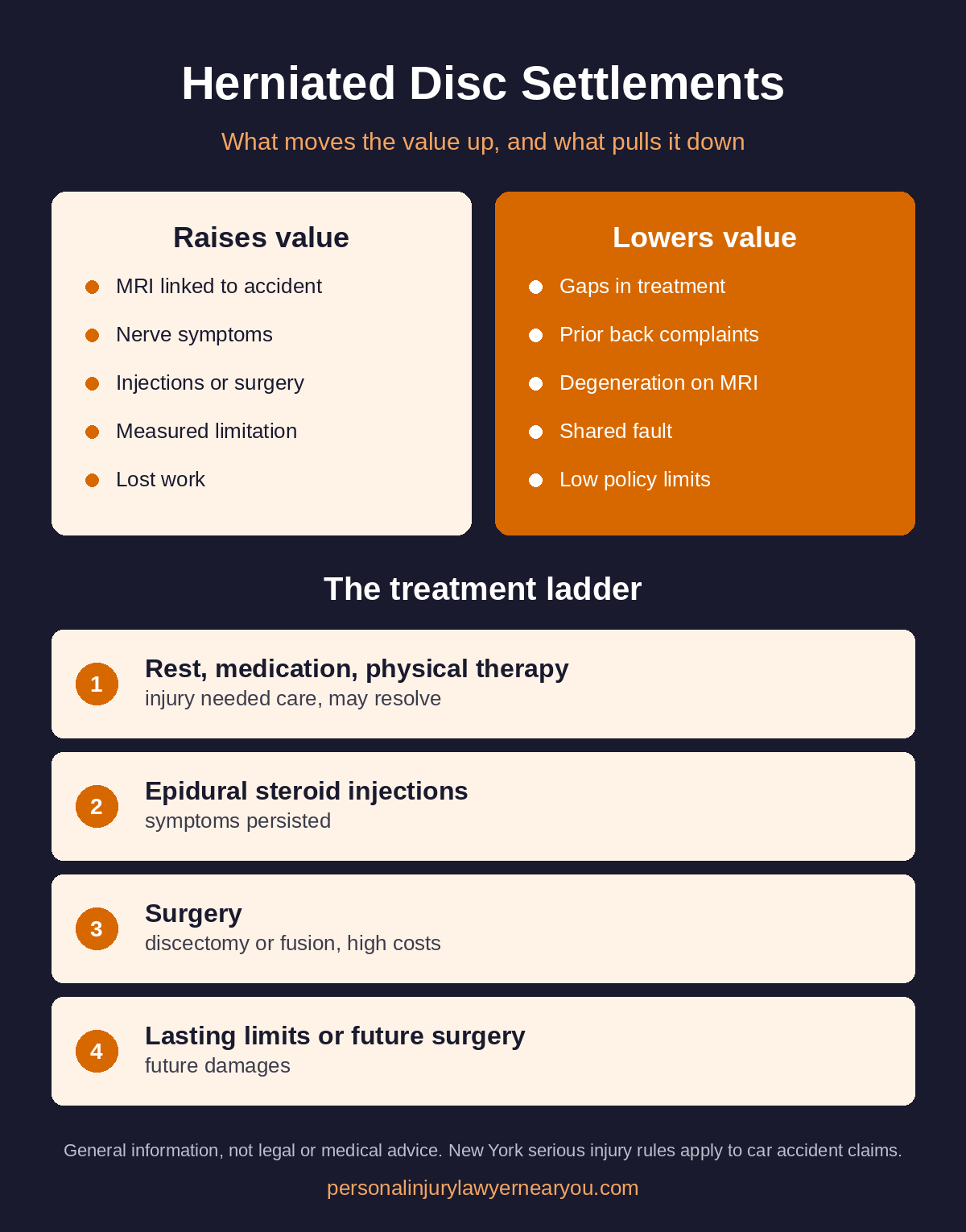
There is no standard figure for a herniated disc personal injury settlement. Value rises with objective proof (an MRI tied to the accident), the treatment ladder (therapy, then injections, then surgery), lasting limitation and lost work. The insurer’s main defense is that the disc was already degenerating. In New York car cases, a herniated disc only supports pain and suffering if it meets the serious injury threshold, which has one fewer route to qualify for lawsuits filed since May 26, 2026.
A herniated disc is one of the most common injuries in car, truck and fall claims, and one of the most disputed. Herniated disc personal injury settlement values range from modest to very large, and the difference usually comes down to evidence rather than pain.
This guide explains what insurers look for, how treatment changes the value, and the arguments you should expect.
What a Herniated Disc Is
Spinal discs sit between the vertebrae and act as cushions. A herniation happens when the soft inner material pushes through the tougher outer layer, which can press on nearby nerves and cause back or neck pain, numbness, tingling or weakness in an arm or leg. MedlinePlus describes the condition and its usual treatments.
A sudden impact, such as a rear-end crash or a hard fall, can cause a herniation or make an existing one worse. Proving which happened is the center of most disc claims.
What Drives the Value of a Disc Claim
| Factor | Why it matters |
|---|---|
| Objective imaging | An MRI showing the herniation, ideally compared with any earlier scans |
| Timing of symptoms | Pain that starts at or soon after the accident links the injury to it |
| Nerve involvement | Radiating pain, numbness or weakness usually means a more serious injury |
| Treatment path | Therapy, injections and surgery each add cost and show severity |
| Measured limitation | Range-of-motion testing compared with normal values |
| Lost work | Time off and any change in the job you can do |
| Fault and policy limits | Your share of fault and the at-fault driver’s coverage cap the recovery |
How Treatment Changes the Claim
Insurers often use the treatment path as a rough measure of severity. Each step up tends to increase the value of the claim, because it adds cost and shows the injury did not resolve on its own.
| Stage | What it shows |
|---|---|
| Rest, medication and physical therapy | Injury needed treatment but may resolve |
| Epidural steroid injections | Symptoms persisted despite conservative care |
| Surgery (such as discectomy or fusion) | Serious injury with high medical costs and recovery time |
| Ongoing limits or future surgery | Lasting impairment and future damages |
Gaps in this ladder hurt. Weeks without treatment invite the argument that something else caused the pain. See how the different damages in a New York personal injury claim are counted.
The “Pre-Existing Degeneration” Defense
Disc degeneration is common with age, and many adults have changes on an MRI without symptoms. Insurers use this to argue the accident did not cause the problem. The answer is evidence that things changed after the accident:
- No back or neck complaints, or far milder ones, in earlier medical records
- Symptoms that started at or soon after the accident
- A doctor’s opinion explaining the difference between old degeneration and a new or aggravated herniation
New York lets you recover for aggravating a pre-existing condition, but only for the worsening the accident caused.
Herniated Discs and New York’s Serious Injury Threshold
After a New York car accident, you can claim pain and suffering only if your injury meets the legal definition of a serious injury. A herniated disc is not automatically enough. Courts look for objective evidence, such as an MRI, plus measured limits on movement or function compared with normal. The 2026 reform removed the 90/180-day category for lawsuits filed on or after May 26, 2026, so disc cases now depend even more on proving a significant or permanent limitation. Our guide to what the serious injury threshold now demands explains the change, and our article on truck accident injuries and the threshold shows how it applies to spinal injuries.
Putting a Number on the Claim
Settlements are built from medical bills, lost income, future care and pain and suffering, then adjusted for fault and policy limits. Our step-by-step guide to calculating a car accident settlement shows the math, and average settlement amounts in New York gives the wider context. If you were hurt in Manhattan, a Manhattan car accident lawyer can review your imaging and treatment records for free.
Frequently Asked Questions
How much is a herniated disc personal injury settlement worth?
There is no standard amount. Value depends on objective proof such as an MRI, the treatment needed from therapy to surgery, lasting limitations, lost income, fault and the available insurance. Surgery cases are usually worth far more than cases that resolve with therapy.
Does a herniated disc count as a serious injury in New York?
Not automatically. After a car accident, you must show objective evidence and a significant or permanent limitation to claim pain and suffering. For lawsuits filed on or after May 26, 2026, the 90/180-day category no longer exists, so disc cases rely on proving limitation.
What if I had back problems before the accident?
You can still recover for the worsening the accident caused. Earlier medical records, the timing of new symptoms and a doctor’s opinion help separate old degeneration from new injury.
Do I need an MRI for a herniated disc claim?
In practice, yes. An MRI is the main objective evidence of a herniation, and insurers and courts rely on it heavily when deciding whether the injury is real and serious.
Do injections or surgery increase a herniated disc settlement?
Generally yes. Each step up in treatment adds medical costs and shows the injury did not resolve on its own, which usually increases the value of the claim.
How long does a herniated disc case take to settle?
Often a year or more, because the claim should not settle until treatment ends or doctors can predict future care. Cases involving surgery or a lawsuit can take longer.
Key Takeaways
✅ No standard figure exists; evidence drives disc settlement value
✅ An MRI tied to the accident is the core proof
✅ Each step up the treatment ladder usually raises the value
✅ Expect the pre-existing degeneration defense and prepare for it
✅ New York car cases still need a serious injury, now without the 90/180 route
Herniated Disc After an Accident?
Disc claims are won or lost on medical evidence. A free case review looks at your imaging, treatment and the threshold that applies, and tells you what the claim may realistically be worth.
Herniated Disc From an Accident? Get It Reviewed Free
Free case review. No win, no fee. No upfront cost.
Want more NYC injury guides and legal news from PILNY in your Google results?
