
TL;DR — Quick Summary
Who pays depends first on your state. In at-fault states, the at-fault driver’s liability insurer pays. In no-fault states like New York, payment comes in layers: your own no-fault (PIP) coverage pays medical bills and lost wages up to $50,000 regardless of fault; the at-fault driver’s bodily injury coverage pays pain and suffering if your injury is serious enough; and your own UM/SUM coverage steps in when the other driver has no insurance or too little. Car repairs are a separate claim.
Who pays personal injury claims after a car accident? Most people assume it is simply “the other driver’s insurance.” Sometimes it is. But depending on your state, your own policy may pay first — and several different coverages can end up contributing to one claim.
Here is how the money flows in a car accident personal injury claim, using New York as the worked example.
At-Fault States vs No-Fault States
| At-fault (tort) states | No-fault states (e.g. New York) | |
|---|---|---|
| Who pays medical bills first | The at-fault driver’s insurer (after fault is established) | Your own policy, regardless of fault |
| Pain and suffering | Claimed from the at-fault driver’s insurer | Only if the injury meets a legal threshold |
| Speed of first payments | Slower — often waits for fault to be accepted | Faster — bills paid while fault is still argued |
Only around a dozen states use a no-fault system. If you are not sure how it works, our guide to personal injury protection (PIP) insurance explains which states require it and what it covers.
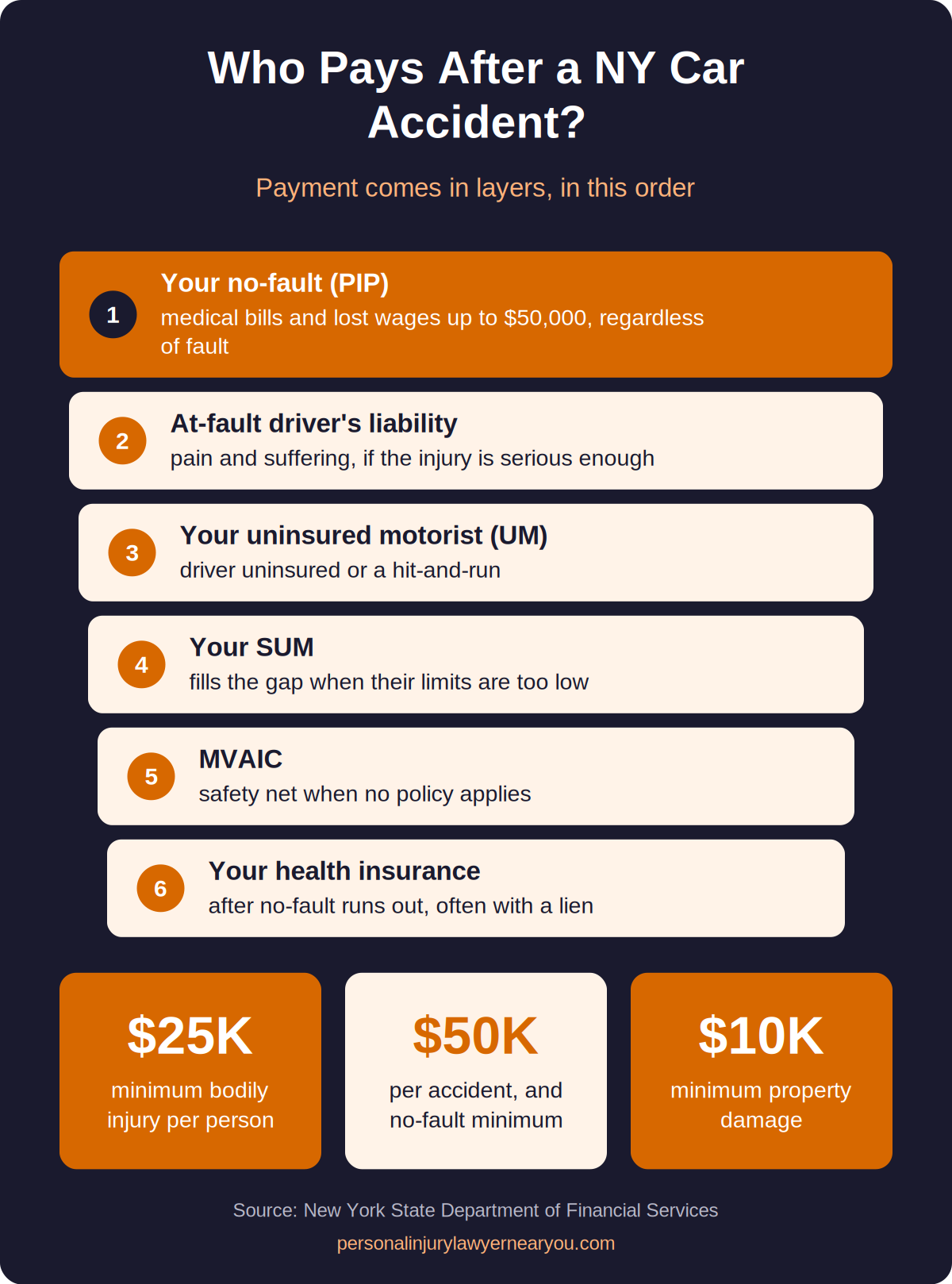
Who Pays in New York: The Layers, in Order
| Source | What it pays | When it applies |
|---|---|---|
| 1. Your no-fault (PIP) | Medical bills, part of lost wages, some other costs — up to $50,000 | Always first, regardless of fault |
| 2. At-fault driver’s bodily injury liability | Pain and suffering, plus economic loss beyond no-fault | If the injury meets the serious injury threshold |
| 3. Your uninsured motorist (UM) | What the at-fault driver’s insurer would have paid | At-fault driver uninsured, or a hit-and-run |
| 4. Your SUM | The gap between their limits and your losses, up to your SUM limit | At-fault driver underinsured |
| 5. MVAIC | A safety net for eligible victims | No insurance policy is available to you at all |
| 6. Your health insurance | Treatment once no-fault is exhausted or denied | Often with a lien on any settlement |
The first layer has strict rules of its own, including a 30-day application deadline — our guide to New York no-fault insurance covers it in detail. Pedestrians and passengers are covered by no-fault too, usually through the policy of the vehicle involved or a policy in their own household.
When the At-Fault Driver’s Insurer Pays
In New York, you can only step outside no-fault and claim pain and suffering from the other driver if your injury meets the legal definition of a “serious injury” — for example a fracture, a significant limitation of a body function, or permanent loss of use. The 2026 reform removed one of the qualifying categories, so the threshold is now harder to meet; see what the serious injury threshold now demands.
Once you clear it, the at-fault driver’s bodily injury liability coverage pays — but only up to its limit. That limit can be very low. According to the New York State Department of Financial Services, drivers must carry at least $25,000 for bodily injury to one person and $50,000 for all persons in one accident, plus $10,000 for property damage and $50,000 in no-fault coverage. Every policy must also include uninsured motorist coverage.
When the Other Driver Has No Insurance — or Not Enough
If the at-fault driver is uninsured or drove off, your own UM coverage generally takes their place. If they are insured but their limits are too small for your injuries, SUM coverage on your own policy can fill the gap up to your SUM limit. Our guide to uninsured and hit-and-run accidents in NYC covers both, along with MVAIC.
There may also be other parties to look to. In New York, a vehicle’s owner can be liable for a driver using the car with permission, and an employer can be responsible when the driver was working. A commercial vehicle usually means a much larger policy.
Who Pays for the Car?
No-fault does not cover vehicle damage. Repairs are paid by the at-fault driver’s property damage liability coverage, or by your own collision coverage if you carry it — your insurer then recovers the cost from the other side. Property damage is usually settled separately from the injury claim, and settling it does not end your injury claim as long as the release covers only the vehicle.
To see how all of these pieces add up to a single figure, read our guide to calculating a car accident settlement, or our overview of car accident claims.
Who Pays Personal Injury Claims After a Car Accident for Passengers, Pedestrians and Cyclists?
The layers above are written from a driver’s point of view. If you were not driving, the order is similar, but which policy pays first can change.
Passengers
A passenger usually claims no-fault benefits first, often through the policy of the vehicle they were riding in, or a policy in their own household. If the injury is serious enough, the passenger can then claim against whichever driver was at fault — including the driver of their own vehicle. Passengers are rarely at fault themselves, which can make these claims more straightforward.
Pedestrians and cyclists
In New York, a pedestrian or cyclist hit by a car is generally covered by no-fault, usually through the policy of the vehicle that hit them or a policy in their household. Beyond that, the at-fault driver’s bodily injury coverage applies for serious injuries, and the injured person’s own household policy may provide UM or SUM coverage if the driver was uninsured or underinsured.
Rideshare, taxis and work vehicles
When a commercial vehicle is involved — a taxi, a rideshare car, a delivery van — there is often a commercial policy with higher limits, and sometimes more than one insurer. The coverage that applies can depend on what the driver was doing at the moment of the crash, which is exactly the kind of detail insurers dispute.
Whatever your role in the crash, the question of who pays personal injury claims after a car accident comes down to the same steps: identify every policy that could apply, file the no-fault application on time, and then look at the at-fault side’s coverage and your own UM and SUM. Missing one policy can leave real money unclaimed.
Frequently Asked Questions
Who pays for my injuries after a car accident?
It depends on your state. In at-fault states, the at-fault driver’s liability insurer usually pays. In no-fault states like New York, your own policy pays first for medical bills and lost wages, and the at-fault driver’s insurer pays pain and suffering if your injury is serious enough.
Does my own insurance pay if the accident wasn’t my fault?
In New York, yes. Your no-fault coverage pays your medical bills and part of your lost wages up to $50,000, regardless of who caused the crash. You can then claim against the at-fault driver for losses beyond that if your injury meets the serious injury threshold.
What if the at-fault driver has no insurance?
Your own uninsured motorist coverage usually pays. In New York every auto policy must include it. If no policy at all applies, such as some hit-and-run cases, MVAIC may be the fallback.
What if the other driver’s insurance isn’t enough?
Supplementary uninsured/underinsured motorist (SUM) coverage on your own policy can pay the gap, up to your SUM limit. Other parties, such as the vehicle owner or the driver’s employer, may also be responsible.
What are New York’s minimum car insurance limits?
New York requires at least $25,000 for bodily injury to one person, $50,000 for bodily injury to all persons in one accident, $10,000 for property damage, and $50,000 in no-fault coverage. Uninsured motorist coverage is also required.
Who pays for my car repairs in New York?
No-fault does not cover vehicle damage. The at-fault driver’s property damage liability coverage pays for your repairs, or you can claim on your own collision coverage, if you have it, and let your insurer recover from the other side.
Key Takeaways
✅ In no-fault states like New York, your own policy pays first — up to $50,000
✅ The at-fault driver’s insurer pays pain and suffering only for a serious injury
✅ New York’s minimum bodily injury limit is just $25,000 per person
✅ UM and SUM on your own policy cover uninsured and underinsured drivers
✅ Car repairs are a separate claim from your injuries
Not Sure Which Policy Should Be Paying?
With several insurers involved, claims fall through the gaps — a missed no-fault deadline here, an unclaimed SUM policy there. A free case review identifies every source of payment available to you and makes sure none of them is missed.
Hurt in a Car Accident? Find Out Who Owes You
Free case review. No win, no fee. No upfront cost.
Want more NYC injury guides and legal news from PILNY in your Google results?
