
TL;DR — Quick Summary
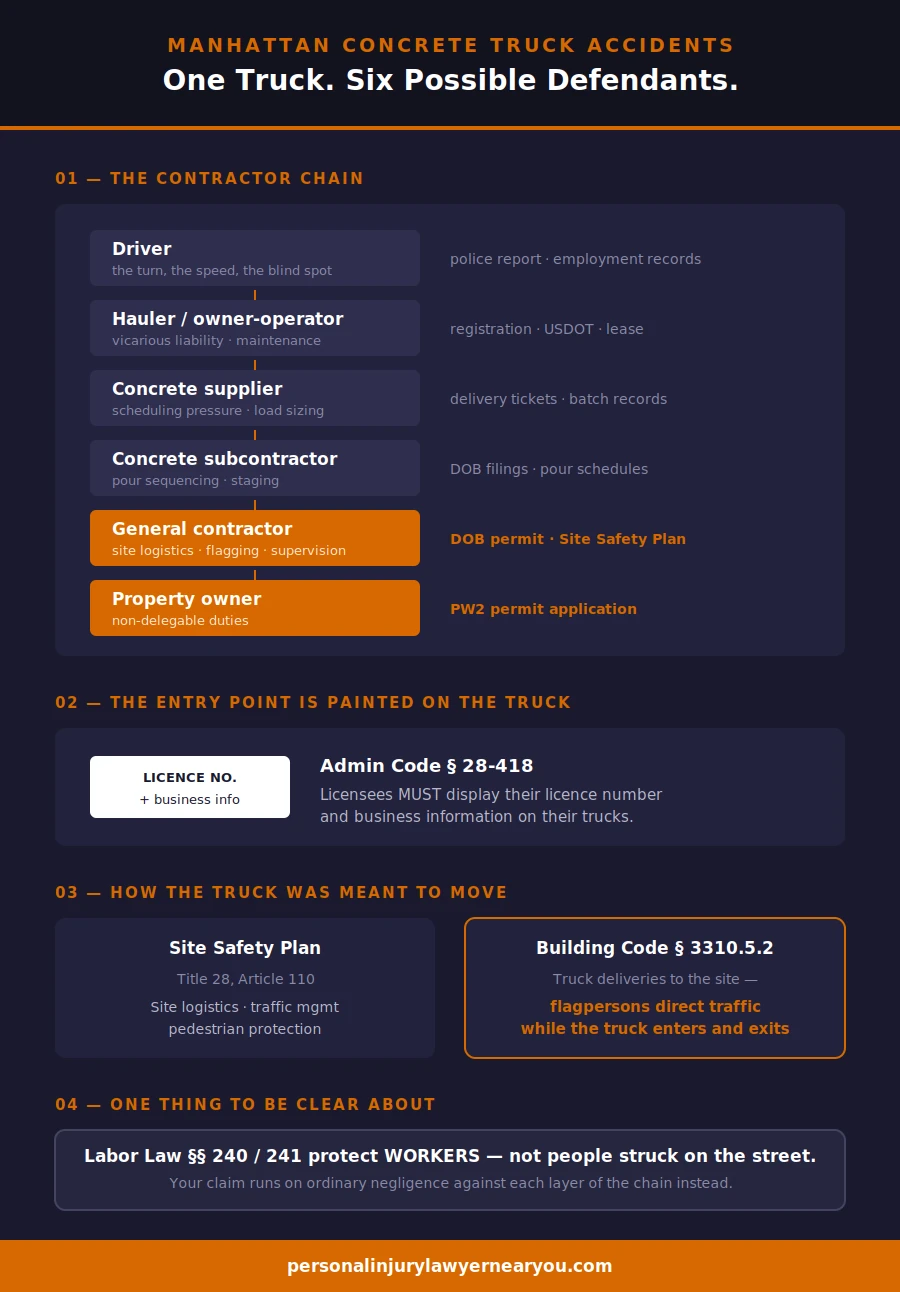
A concrete truck is the visible end of a long chain — driver, hauler, concrete supplier, subcontractor, general contractor, property owner. In Manhattan that chain is unusually well documented, because DOB permits name the contractor and the owner, Admin Code § 28-418 requires the licence number to appear on the truck itself, and a Site Safety Plan governs how vehicles were supposed to enter and leave. The driver’s employer is often the smallest policy in the chain. The documents that reach the larger ones are public.
A Manhattan concrete truck accident looks like a straightforward vehicle claim. A mixer pulled out of a site, someone was hit, and there is a driver and a truck to point at.
That framing is what leaves most of the value on the table, because the company painted on the door is frequently the least-insured party involved.
The Chain Behind the Wheel
Concrete delivery in New York is layered. A mixer arriving at a Midtown site may be owned by an owner-operator, hauling for a supplier, under a subcontract to a concrete subcontractor, working for a general contractor, on a site owned by somebody else entirely. Five or six parties, one truck.
| Layer | Why they may be liable | Where it is documented |
|---|---|---|
| Driver | The conduct itself — the turn, the speed, the blind spot | Police report, licence, employment records |
| Hauler / owner-operator | Vicarious liability, maintenance, hiring and training | Vehicle registration, USDOT number, lease |
| Concrete supplier | Scheduling pressure, load sizing, selecting the hauler | Delivery tickets, batch records, dispatch |
| Concrete subcontractor | How pours were sequenced and how deliveries were staged | DOB filings, pour schedules |
| General contractor | Site logistics, flagging, pedestrian protection, supervision | DOB permit, Site Safety Plan, logbook |
| Property owner | Non-delegable duties, and authorising the permit filing | PW2 permit application, property records |
Each layer typically carries its own policy. A registered general contractor in New York City must hold general liability insurance with a minimum of one million dollars per occurrence, and DOB may require project-specific coverage on top. That is frequently a different order of magnitude from what an owner-operator carries — an issue explored in our breakdown of when the $750,000 federal minimum does not apply.
The Licence Number Is Painted on the Truck
This is the detail that makes Manhattan construction cases different, and almost nobody at the scene knows to look for it.
Under New York City Administrative Code § 28-418, every licensee must display their licence number and business information on their trucks, as well as on business cards and advertisements. It is not a courtesy. It is a legal requirement.
So a photograph of the vehicle’s flank is not just evidence of the crash. It is the entry point into DOB’s licensing and permit records, which then lead to the registered general contractor, the safety endorsements that contractor holds, the insurance on file, and the permit filing that names the property owner who authorised the work.
The Site Safety Plan Says How the Truck Was Meant to Move
Major New York City construction projects must have a Site Safety Plan, and under Article 110 of Title 28 it has to address the actual conditions at that specific site. Generic templates and plans borrowed from another job do not satisfy it. The plan covers site logistics, traffic management and pedestrian protection — which is to say, it covers exactly how trucks were supposed to enter and leave.
The Building Code is more specific still. Section 3310.5.2 addresses when a site safety manager need not be present, and one listed activity is truck deliveries to the site — but only where the delivery occurs within the site with the gate closed and flagpersons are provided to direct traffic while the truck is entering and exiting.
Read that as a standard rather than an exemption. The Code contemplates flagging as the ordinary condition of a truck crossing the public way at a construction site. If a mixer reversed across a Manhattan sidewalk with nobody controlling pedestrians, the question is not merely whether the driver looked. It is why the site was operating without the control the plan and the Code contemplate — and that is the general contractor’s responsibility, not the driver’s.
One Thing to Be Clear About
New York’s Labor Law §§ 240 and 241 impose powerful, effectively absolute duties on owners and contractors — and they come up constantly in construction discussions.
They protect workers engaged in the work. A pedestrian, cyclist or driver struck by a concrete truck on the street is not covered by them. Anyone suggesting otherwise is setting an expectation the statute does not support.
That is not a weakness in your case. It means the case runs on ordinary negligence against each layer of the chain — the driver’s conduct, the hauler’s supervision, the contractor’s site logistics, the owner’s non-delegable duties — rather than on a single statutory shortcut. It is a different route to the same defendants.
What to Capture, and What to Request
- The licence number and business name on the truck, required by § 28-418
- The site address and the DOB permit board, which is posted visibly at the site for the duration of the work
- Whether a flagperson was present, and where they were standing
- The site gate, fencing and pedestrian walkway — how people were meant to pass
- The delivery ticket, which ties the truck to the supplier and the pour
- The DOB logbook and Site Safety Plan, requested through counsel
Where the mixer was also off its designated route, the arguments in our post on Manhattan truck route violations apply on top of these, and a cyclist struck during a turn should also read our post on right-hook crashes in Manhattan bike lanes. The general first-steps sequence is in our guide on what to do after a truck accident in New York.
The Limits That Still Apply
If the site is a City or State project, or the vehicle belongs to a public entity, a Notice of Claim is required within 90 days — the same trap covered in our post on Manhattan sanitation truck accidents. Otherwise the ordinary three-year period applies. Comparative negligence reduces recovery by your share of fault, and under the 2026 reform a plaintiff found mostly at fault in a motor vehicle case cannot recover non-economic damages. The serious injury threshold under Insurance Law § 5102(d) governs pain and suffering where a motor vehicle is involved.
Frequently Asked Questions
Who can be sued after a concrete truck accident in Manhattan?
Potentially the driver, the hauling company or owner-operator, the concrete supplier, the concrete subcontractor, the general contractor and the property owner. Each occupies a different position in the chain and typically carries separate insurance. Identifying all of them early matters because the driver’s employer is often the smallest policy involved.
How do I find out which contractor the truck was working for?
Start with the truck. New York City Administrative Code § 28-418 requires licensees to display their licence number and business information on their trucks. That number leads into DOB licensing and permit records, which name the registered general contractor and the owner who authorised the permit filing. The permit itself must also be posted visibly at the work site.
Does the Scaffold Law help me if I was hit on the street?
No. Labor Law §§ 240 and 241 protect workers engaged in covered construction activity. A pedestrian, cyclist or motorist struck by a construction vehicle on the roadway is outside their scope. The claim proceeds on ordinary negligence principles against the parties in the contractor chain instead.
Was a flagperson required when the truck crossed the sidewalk?
The Building Code treats flagging as the expected condition for truck movements at a site — section 3310.5.2 permits a site safety manager to be absent during truck deliveries only where the delivery occurs within the site with the gate closed and flagpersons direct traffic while the truck enters and exits. Whether flagging was in place, and what the Site Safety Plan required, are central questions.
What is a Site Safety Plan and can I get a copy?
It is a site-specific document DOB requires on many major projects, covering site logistics, traffic management, pedestrian protection and work sequencing, and it must address the actual conditions at that site rather than rely on a template. It is normally obtained through counsel in the course of the claim rather than over the counter.
The site is on a City project. Does that change anything?
Yes, significantly. Where a City or State entity is involved, a Notice of Claim is generally required within 90 days and the limitations period is shortened. If there is any possibility of public-entity involvement, that deadline should be treated as running from the date of the incident.
Key Takeaways
✅ One concrete truck can mean six potential defendants, each separately insured
✅ § 28-418 puts the contractor’s licence number on the truck by law
✅ The Site Safety Plan defines how trucks were meant to enter and leave
✅ The Code contemplates flagpersons directing traffic during deliveries
✅ The Scaffold Law protects workers, not people struck on the street
Trace the Chain Before It Goes Cold
Manhattan construction sites generate an unusual amount of paper, and most of it is either public or reachable through discovery. The difficulty is that permits expire, sites finish, and trucks move on to other jobs. The framework is the same as any Manhattan personal injury claim, with a chain of defendants sitting behind a single vehicle. The case review is free, and there is no fee unless you win.
Talk to a Manhattan Truck Accident Lawyer Today
Free case review. No win, no fee. No upfront cost.
Want more NYC injury guides and legal news from PILNY in your Google results?
