
TL;DR — Quick Summary
In a right-hook, a truck turns right across a bike lane into a cyclist going straight. Most claims stop at the turn — but there are usually two separate failures. The first is the turn itself, governed by a state statute requiring right turns to be made close to the right-hand curb. The second is the truck: New York City law requires side guards on City fleet trucks, City-contracted vehicles and trade waste trucks over 10,000 lbs — the exact equipment that stops a cyclist being pulled beneath the wheels. Whether that truck had them is a question with a documented answer.
A Manhattan bike lane truck accident is rarely a mystery about what happened. The truck turned right. You were going straight in the lane the city painted for you. The physics did the rest.
The part that gets missed is that two different things can be wrong in the same crash — and only one of them is about the driver.
Manhattan Is Where This Happens
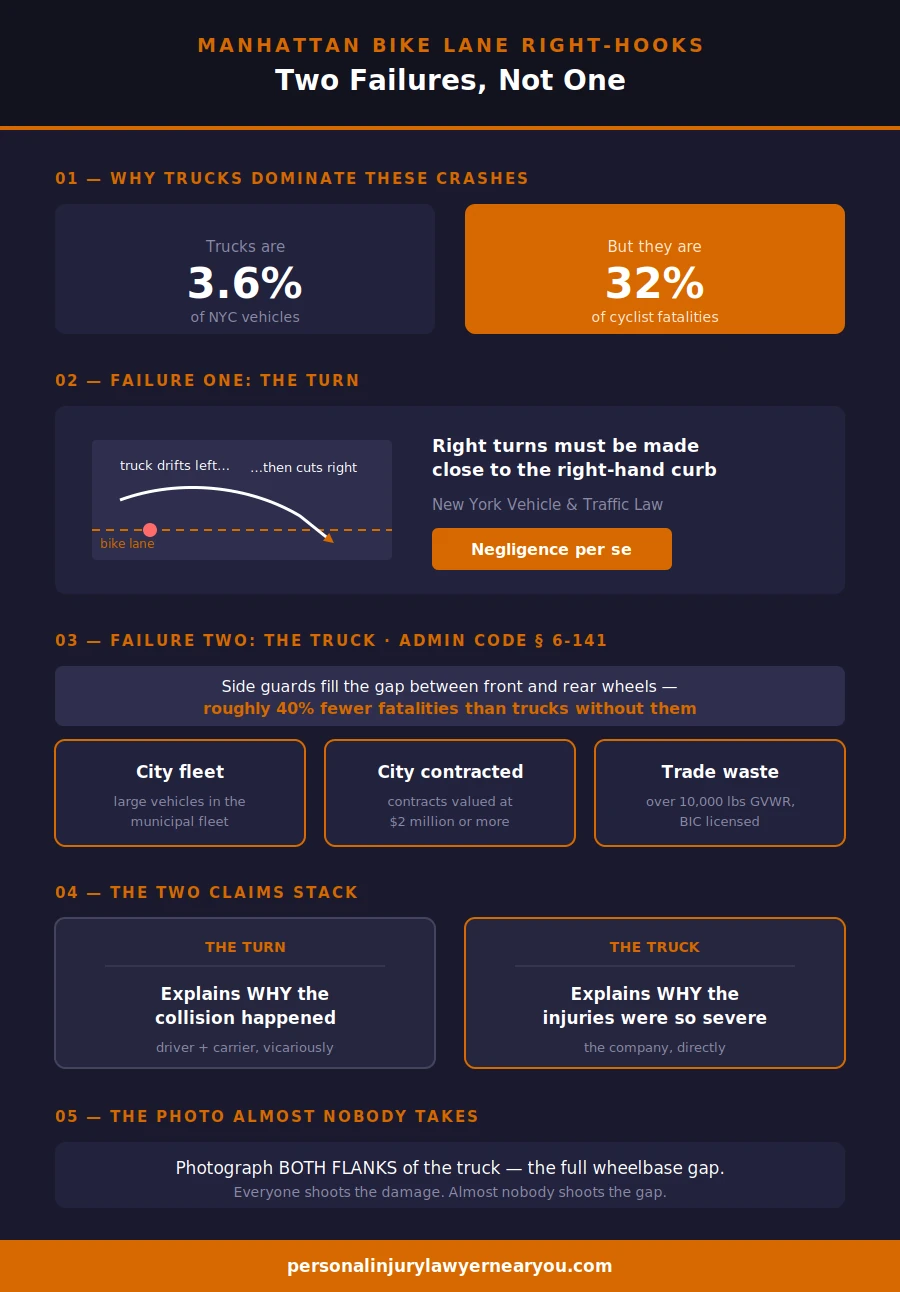
The numbers are stark, and they come from the City itself. When New York announced its truck side guard programme, it reported that trucks make up only 3.6 percent of vehicles on New York City roads — yet they account for 12.3 percent of pedestrian fatalities and 32 percent of bicyclist fatalities.
Roughly one in three cyclists killed in this city dies in a collision with a vehicle type that represents one in twenty-eight on the road.
Manhattan concentrates that risk. It has the densest network of protected and painted bike lanes in the city, and it also has the heaviest delivery traffic — trucks crossing those lanes at every intersection and every loading stop, all day.
Failure One: The Turn
New York’s Vehicle and Traffic Law requires that both the approach for a right turn and the turn itself be made as close as practicable to the right-hand curb or edge of the roadway.
Large trucks routinely do the opposite. To swing a long body around a tight Manhattan corner, a driver drifts left first, then cuts right across everything beside them — including the bike lane. From the cab it feels necessary. Legally it is the sequence that creates the right-hook, and it is governed by a state statute, which in New York means a violation is negligence per se rather than merely evidence of negligence.
That distinction runs through this whole area of law. Our post on the FDR Drive commercial vehicle ban sets out why state statutes and city rules produce very different outcomes from the same set of facts.
Failure Two: The Truck Itself
Here is the question almost nobody asks after a right-hook, and it is often the more valuable one.
In a side-impact collision, the injury that kills or maims is usually not the initial contact. It is being drawn into the gap between the front and rear wheels and passing beneath the vehicle. Side guards — rails fitted along that gap — exist specifically to prevent it, and DCAS has cited a reduction in fatalities of around 40 percent compared with trucks without them.
New York City does not treat side guards as optional for every truck. Under Administrative Code § 6-141, introduced by Local Law 56 of 2015 and expanded by Local Law 108 of 2021, three categories of vehicle are required to have them:
| Vehicle category | Requirement | How to check |
|---|---|---|
| City fleet trucks | Large vehicles in the City fleet must be equipped with side guards | Municipal livery and fleet number |
| City contracted vehicles | Large vehicles used weekly or more under a City contract valued at $2 million or more, phased in after notice to proceed | The contract itself — City contracts must contain the requirement |
| Trade waste trucks | Trade waste vehicles over 10,000 lbs GVWR, licensed or registered with the Business Integrity Commission | BIC registration and carting markings |
The enforcement provision is worth noting too: City contracts must carry the requirement, with a penalty of up to $4,000 per non-compliant vehicle. That is a compliance record someone is keeping.
The third row connects directly to our post on Manhattan sanitation truck accidents — waste trucks are simultaneously among the most dangerous vehicles for cyclists and among the most heavily regulated on this specific point.
Two Claims, Side by Side
These are not alternatives. They stack, and they are proved in completely different ways.
| The turn | The truck | |
|---|---|---|
| Legal basis | Vehicle and Traffic Law — right turns made close to the right-hand curb | NYC Admin Code § 6-141 — side guard requirement |
| Standard | State statute — negligence per se | City law — some evidence of negligence |
| Defendant | Driver, and the carrier through vicarious liability | The company directly — an equipment and compliance failure |
| What proves it | Camera footage, vehicle position, witness accounts, telematics | Photographs of the vehicle sides, contract records, BIC registration |
| Goes to | Why the collision happened | Why the injuries were as severe as they were |
That last row is the one that changes case value. Even where a driver’s turn is defensible, a missing side guard speaks to how a survivable impact became a catastrophic one — and that is a claim against the company, not the person behind the wheel.
Photograph the Sides of the Truck
If you take nothing else from this, take this: after a right-hook, somebody needs to photograph both flanks of the vehicle, showing the space between the front and rear wheels.
Everyone photographs the damage. Almost nobody photographs the gap. Once the truck leaves the scene, establishing what equipment it carried on that date becomes a discovery fight instead of a fact.
- Both sides of the truck, wide enough to show the full wheelbase
- The BIC number or City fleet number, and the carrier name
- The bike lane itself — protected, painted, or shared, and whether it continued through the intersection
- The truck’s final resting position relative to the curb, which speaks directly to the turn
- Any mirrors, cameras or sensors fitted, and where they point
Where the truck was also off-route or unlawfully positioned before the turn, the arguments in our post on Manhattan truck route violations apply on top of these. The general first-steps sequence is in our guide on what to do after a truck accident in New York.
What the Insurer Will Argue
Expect two things. First, that you rode into the truck’s blind spot — which reframes a design and equipment problem as your mistake. Second, that you should have anticipated the turn, even where no signal was given until the manoeuvre had started.
Comparative negligence means your share of fault reduces recovery, and under the 2026 reform a plaintiff found mostly at fault in a motor vehicle case cannot recover non-economic damages at all. The serious injury threshold under Insurance Law § 5102(d) applies as it does in any motor vehicle claim — though in right-hook cases the injuries are frequently well past it.
Frequently Asked Questions
What is a right-hook crash?
It is a collision where a vehicle turning right crosses the path of a cyclist travelling straight ahead on its right side, typically in a bike lane. With large trucks the danger is compounded because the driver often swings left before turning right, and because a cyclist knocked down can be drawn beneath the vehicle between the front and rear wheels.
Are trucks in New York City required to have side guards?
Certain categories are. Under Administrative Code § 6-141, introduced by Local Law 56 of 2015 and expanded by Local Law 108 of 2021, side guards are required on large vehicles in the City fleet, on City contracted vehicles used under contracts valued at $2 million or more, and on trade waste vehicles over 10,000 pounds GVWR licensed or registered with the Business Integrity Commission. There is no blanket requirement covering every private truck.
What if the truck was not required to have side guards?
Then that particular claim is unavailable, but the turn itself is unaffected. The state statutory requirement that right turns be made close to the right-hand curb applies to every vehicle regardless of ownership or contract status, and that is the stronger of the two arguments in most cases.
The driver says I was in his blind spot. Does that defeat my claim?
Not by itself. A cyclist lawfully occupying a marked bike lane is where the road design intends them to be. A driver’s duty includes managing known blind spots through mirrors, cameras and positioning before turning across a lane of travel, and the existence of a blind spot is not on its own a defence to turning into someone occupying it.
Does it matter whether the bike lane was protected or just painted?
It affects the factual picture rather than the legal duty. A protected lane strengthens the argument that a cyclist was positioned exactly where the road design directed and could not simply move aside. A painted lane still establishes lawful positioning. In both cases the turning driver’s obligations are the same.
How quickly do I need to act?
Immediately, whatever the formal deadlines say. The three-year limitations period is not the constraint — the constraint is that camera footage overwrites within days, and the truck’s equipment configuration on the date of the crash becomes difficult to establish once the vehicle returns to service.
Key Takeaways
✅ Trucks are 3.6% of NYC vehicles but 32% of cyclist fatalities
✅ Right turns must be made close to the right curb — a state statute
✅ City fleet, City contracted and trade waste trucks must carry side guards
✅ The turn explains the crash — the equipment explains the injuries
✅ Photograph both flanks of the truck before it leaves the scene
Start Your Manhattan Bike Lane Claim
A right-hook is not one failure. It is a turn that should have been made differently and, often, a vehicle that should have been equipped differently — and the second question is the one that usually goes unasked. The framework is the same as any Manhattan personal injury claim, with an equipment investigation running alongside it. The case review is free, and there is no fee unless you win.
Talk to a Manhattan Truck Accident Lawyer Today
Free case review. No win, no fee. No upfront cost.
Want more NYC injury guides and legal news from PILNY in your Google results?
