
TL;DR — Quick Summary
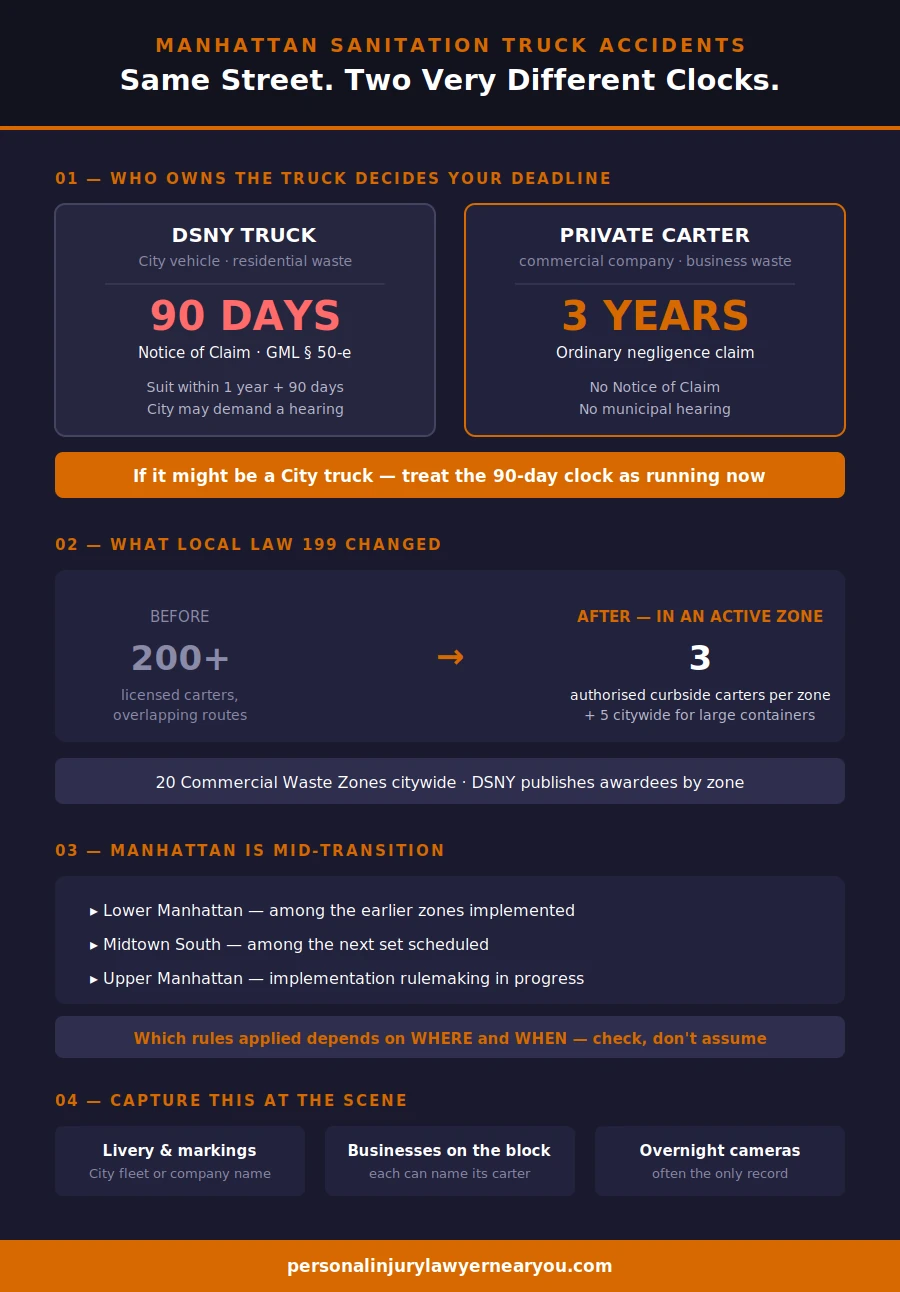
Two garbage trucks can look identical on a Manhattan street and put you on completely different legal tracks. A DSNY truck is a City vehicle — you have 90 days to file a Notice of Claim or the case is generally over. A private carter is an ordinary company, and you have three years. Identifying which one hit you is now far easier than it used to be: under Local Law 199, Manhattan’s commercial waste is being moved to zones served by just three authorised carters each, from a field that once ran past 200.
A Manhattan sanitation truck accident is one of the few injury cases where the first question is not how it happened. It is who owned the truck.
Get that wrong and the strongest liability case in the world will not save the claim, because the deadline you were working to was the wrong one.
DSNY or Private Carter — the Deadline Changes Completely
New York City’s Department of Sanitation collects residential waste. Businesses — every restaurant, hotel, shop and office building in Manhattan — must hire private carters instead. Both types of truck work the same streets at the same hours, and to anyone standing on a corner they look much alike.
Legally they are nothing alike.
- A DSNY truck is a municipal vehicle. A claim against the City requires a Notice of Claim within 90 days of the incident under General Municipal Law § 50-e, and the lawsuit itself must generally be brought within one year and 90 days. There is also a statutory hearing the City can demand before suit.
- A private carter is a commercial company like any other. No Notice of Claim, no municipal hearing, and the ordinary three-year personal injury limitations period applies.
Ninety days against three years. That gap is why misidentifying the truck is the single most expensive mistake available in these cases, and why a Manhattan truck accident lawyer will settle ownership before anything else.
What Local Law 199 Changed
Until recently, identifying a private carter was genuinely hard. More than 200 licensed carters operated across New York City, running long overlapping routes through neighbourhoods where they had a handful of customers. Any given Manhattan block might see trucks from a dozen different companies in one night.
Local Law 199 of 2019 rebuilt that system. Codified in Title 16-B of the Administrative Code, it divided the city into 20 Commercial Waste Zones. Through a competitive process, DSNY authorised three carters per zone for curbside collection, plus five carters citywide for large containers of ten cubic yards and up. Those carters are called awardees, and DSNY publishes the list of awardees by zone.
For an injured person, that is a significant change. In an implemented zone the universe of possible defendants is no longer “one of two hundred companies.” It is a published, closed list of three, plus five container carriers — and the business whose waste was being collected can identify its own contracted carter immediately.
Manhattan Is Mid-Transition — and That Matters
The zones are being switched on in phases rather than all at once, and Manhattan is spread across that timeline.
Queens Central went first, becoming fully operational at the start of 2025. The Bronx zones followed, then further Queens and Brooklyn zones, then Lower Manhattan. Midtown South was among the next set of zones scheduled, and Upper Manhattan has been working through its own implementation rulemaking.
The practical consequence: whether the zone rules applied depends on where in Manhattan the crash happened and when. A collision in Lower Manhattan after that zone went live sits inside the new framework, with a short list of authorised carters and contractual safety obligations attached. The same collision uptown before implementation sits in the old system, where the field is wider and identification is harder.
Because the rollout is still moving, the zone status for a particular address and date has to be checked rather than assumed. It is a question with a documented answer — DSNY publishes implementation dates by zone — but it is not one to guess at.
The Contract Standards Are Part of Your Case
There is a second consequence of the zone system that gets almost no attention.
Awardee carters do not simply hold a licence. They hold a contract with the City, and those contracts carry standards covering safety, environmental health, service and reporting. Local Law 199 was explicitly framed as a worker-safety reform of an industry with a poor record — long night routes, exhausted drivers, aggressive schedules.
Where an authorised carter’s own contractual safety obligations were not met, that is evidence available in your case, alongside the reporting and records requirements DSNY imposed on awardees. It is a category of proof that simply did not exist under the old licensing system.
Identifying the Truck at the Scene
Most of this becomes straightforward if the right things are captured in the first hour.
- DSNY markings — City sanitation trucks are liveried and numbered as municipal vehicles, and that is the fastest way to tell the tracks apart
- The carter’s name and licence markings on the body of a private truck
- The plate and any USDOT number
- The businesses being serviced on that block — each can name its contracted carter, and in an active zone must display a DSNY decal
- Time of collection, which helps establish the route being run
- Nearby cameras — commercial waste collection runs overnight and early morning, when private security footage is often the only record
If there is any possibility the truck was a City vehicle, the 90-day clock should be treated as running from day one. A Notice of Claim filed unnecessarily costs little. One filed late usually cannot be fixed. The broader first-steps sequence is covered in our guide on what to do after a truck accident in New York.
Where the Other Truck Rules Still Apply
A waste truck is still a truck. The Manhattan route restrictions apply to it, and a collection vehicle materially off its designated route raises the same questions covered in our post on Manhattan truck route violations.
Coverage works the same way too. A private carter’s insurance depends on the same for-hire, interstate and weight questions set out in our breakdown of when the $750,000 federal minimum does not apply — and a local carter running entirely within the city may sit outside it. Against the City, the analysis is different again, since municipal liability is not an insurance-limits question in the same way.
The usual New York limits still apply: the serious injury threshold under Insurance Law § 5102(d) governs pain and suffering in a motor vehicle case, comparative negligence reduces recovery by your share of fault, and under the 2026 reform a plaintiff found mostly at fault cannot recover non-economic damages at all.
Frequently Asked Questions
How do I tell a DSNY truck from a private carter?
DSNY vehicles carry City of New York Department of Sanitation livery and municipal fleet numbers. Private carters display their own company name and carting licence markings. DSNY collects residential waste while businesses must contract with private carters, so a truck servicing restaurants, hotels or shops is almost always private — but the markings should be photographed rather than inferred.
What is the deadline if a City sanitation truck hit me?
A Notice of Claim must generally be served within 90 days of the incident under General Municipal Law § 50-e, and the action itself brought within one year and 90 days. The City may also demand a statutory hearing before suit. These requirements are strict and missing them will usually end the claim regardless of how strong the liability case is.
What are Commercial Waste Zones?
Under Local Law 199 of 2019, New York City was divided into 20 Commercial Waste Zones. DSNY selected three private carters to provide curbside commercial collection in each zone, plus five carters citywide for large containers of ten cubic yards and above. Businesses in an implemented zone must contract with one of the authorised carters for their zone.
Does the zone system make it easier to identify the truck?
Considerably. Previously more than 200 licensed carters operated across the city on overlapping routes. In an implemented zone the authorised carters are a published list of three for curbside collection, and the businesses on the block can name the carter they contract with.
Is the zone system already in effect across Manhattan?
Not uniformly. The rollout has been phased, with Lower Manhattan among the earlier zones and other Manhattan zones following on their own schedules. Whether the zone framework applied depends on the specific location and the date of the collision, so the implementation date for that zone needs to be checked.
Can the business whose trash was being collected be liable?
Sometimes. The carter is normally the responsible party for its own driver’s conduct, but a business can face exposure where its own arrangements contributed — for example how and where waste was staged on the sidewalk, or conditions it created at the collection point. It is worth investigating rather than assuming the carter is the only defendant.
Key Takeaways
✅ DSNY truck means a 90-day Notice of Claim — private carter means three years
✅ Businesses use private carters; DSNY handles residential waste
✅ Local Law 199 cut the field from 200+ carters to three per zone
✅ Awardee carters hold City contracts with safety standards attached
✅ If the truck might be City-owned, treat the 90-day clock as running now
Find Out Which Clock Is Running
If a garbage truck hit you in Manhattan, the most urgent question is not fault — it is ownership, because one answer gives you three years and the other gives you ninety days. That question can usually be answered in days. The framework is the same as any Manhattan personal injury claim, with an identification question that has to come first. The case review is free, and there is no fee unless you win.
Talk to a Manhattan Truck Accident Lawyer Today
Free case review. No win, no fee. No upfront cost.
Want more NYC injury guides and legal news from PILNY in your Google results?
