
TL;DR — Quick Summary
The $750,000 federal minimum everybody quotes after a truck crash is narrower than it sounds. Under 49 CFR 387.9 it applies only to for-hire carriers, in interstate commerce, with a GVWR of 10,001 pounds or more. Miss any one of those three and the federal floor does not apply at all. Manhattan runs on box trucks and sprinter vans making local deliveries for the companies that own them — which is precisely the profile that falls outside it. Before anything else, find out which regime the truck was operating under.
After a Manhattan box truck accident, someone will tell you there is at least $750,000 of coverage behind it. It is the most repeated number in truck accident law, and it is repeated far more often than it is checked.
Sometimes it is right. In Manhattan, quite often it is not — and the difference decides whether your claim is fought over liability or over money that was never there.
What the $750,000 Rule Actually Says
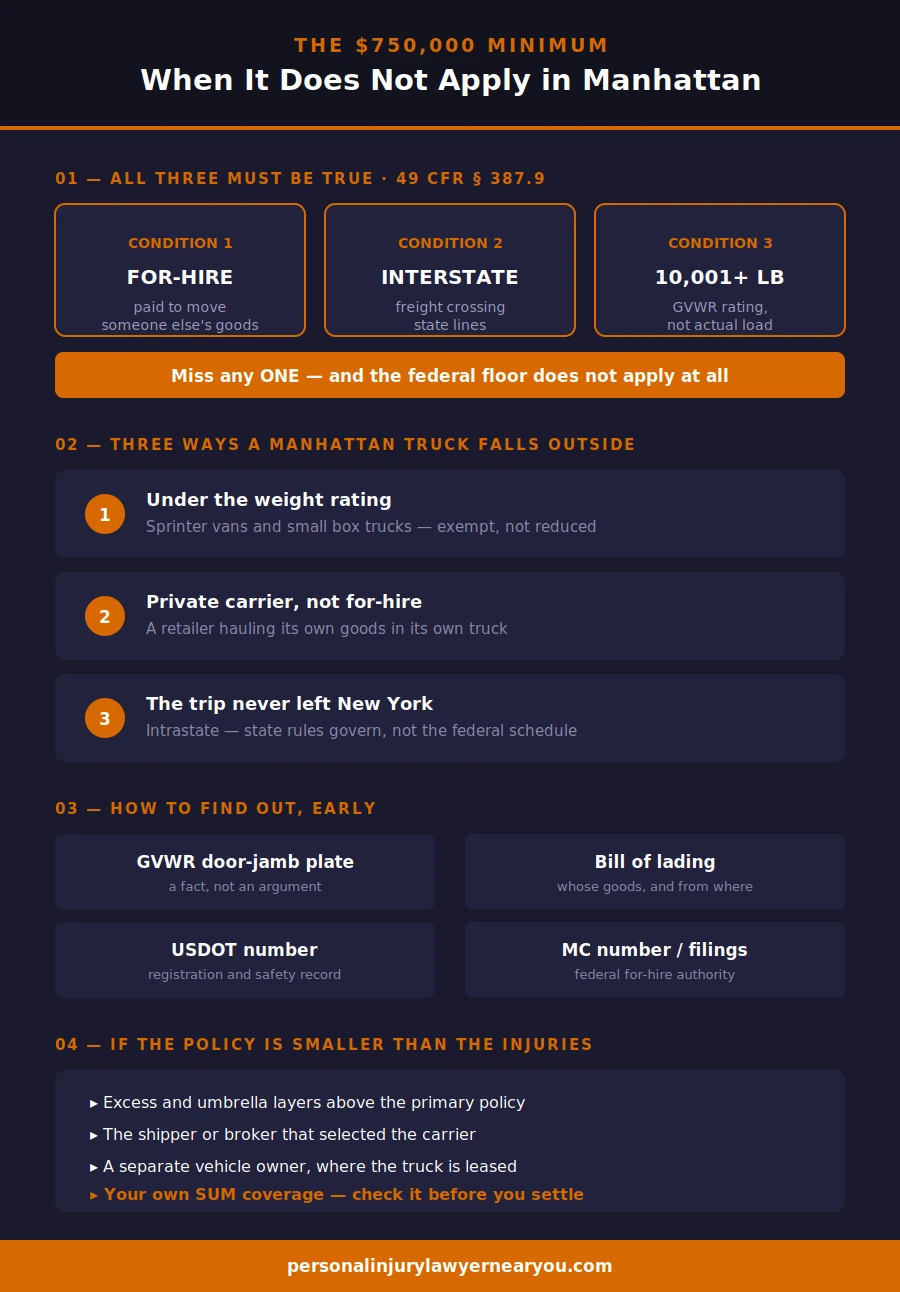
The figure comes from 49 CFR § 387.9, the FMCSA’s schedule of minimum financial responsibility. Read the first line of that table carefully, because every word in it is doing work:
- For-hire — the carrier is paid to move someone else’s goods
- In interstate or foreign commerce — the freight is crossing state lines
- GVWR of 10,001 pounds or more — the vehicle’s rating, not its actual load
All three have to be true together. The higher tiers — $1,000,000 and $5,000,000 — attach to hazardous materials, oil and certain bulk cargo, not to ordinary freight.
And the exemption at the bottom is blunt. Property carriers operating vehicles with a GVWR under 10,001 pounds are exempt from these minimum levels entirely, unless they are carrying specific hazardous materials. Not reduced. Exempt.
Three Ways a Manhattan Truck Falls Outside It
Each of these is common on Manhattan streets, and any one of them is enough on its own.
1. The vehicle is under the weight rating
Manhattan’s streets, loading zones and low overpasses select for smaller vehicles. Sprinter vans, cutaway cargo vans and the smaller class of box truck are everywhere precisely because the larger equipment cannot work here. Plenty of them sit under a 10,001-pound GVWR — and the federal minimum simply does not reach them.
2. The carrier is private, not for-hire
This is the one that surprises people. The $750,000 line covers for-hire carriers of general freight. A company hauling its own goods in its own truck is a private carrier, and for general freight it falls outside that line. A supermarket chain restocking its Manhattan stores, a furniture retailer running its own deliveries, a contractor moving its own materials — none of them is being paid to carry anyone else’s property.
3. The trip never left New York
The federal minimums for general freight attach to interstate commerce. A truck that loaded in Queens and was delivering in Manhattan is running intrastate, and state rules govern instead. Those requirements are set separately from the federal schedule and are not the $750,000 figure — which is exactly why the carrier’s operating authority has to be established rather than assumed.
How to Find Out Which Regime Applies
This is answerable, and early. It is not something to discover at mediation.
- The USDOT number painted on the door — it opens the carrier’s public safety record and registration details
- Whether there is an MC number as well, which points to federal for-hire operating authority
- The carrier’s declared operation type — interstate versus intrastate, for-hire versus private
- Federal insurance filings, where a for-hire interstate carrier’s coverage is on record
- The vehicle’s GVWR, which is stamped on the door jamb plate and is a fact rather than an argument
- The bill of lading or delivery manifest, which shows whose goods were being moved and where they came from
The GVWR plate and the manifest are the two that decide most cases, and both are at the scene or in the vehicle. A Manhattan truck accident lawyer will want them before the vehicle is repaired and the paperwork is filed away.
When the Policy Is Smaller Than the Injuries
A modest policy is not the end of the claim. It just means the recovery has to be assembled from more than one place.
- Excess and umbrella coverage — many carriers buy well above their legal minimum, and contracts with shippers frequently demand it
- The shipper or broker — a company that hired an underinsured carrier without checking can face its own negligent selection claim
- The vehicle’s owner, where the truck is leased or owned separately from the operating company
- Your own SUM coverage — supplementary uninsured/underinsured motorist benefits on your policy respond when the at-fault policy runs out, and this is the piece most people forget they are paying for
- Other defendants — a property owner, a loading contractor, a second vehicle
SUM is worth checking on day one. It has notice requirements, and consenting to settle with the truck’s insurer without following them can forfeit the benefit entirely. Where routing or road-restriction failures are also in play, our posts on Manhattan truck route violations and the FDR Drive commercial vehicle ban cover how those add defendants rather than just arguments.
Why Insurers Settle These Differently
Coverage size changes behaviour, and it is worth understanding what you are dealing with.
A carrier sitting on a large policy has room to litigate and an incentive to test your case. A small local operator with a thin policy and personal exposure behind it often has the opposite incentive — settle early, settle within limits, and do it before anyone starts asking about the company’s assets or its other insurance.
That early offer can look generous against a policy you have not yet measured. Against your actual damages it frequently is not, and accepting it usually closes the door on everything behind it. Running the numbers through our free personal injury settlement calculator before responding is a reasonable first step.
The Limits That Still Apply
None of this changes the underlying rules of a New York motor vehicle claim. You still have to meet the serious injury threshold under Insurance Law § 5102(d) before pain and suffering is available. Comparative negligence still reduces recovery by your share of fault, and under the 2026 reform a plaintiff found mostly at fault cannot recover non-economic damages at all. Preserving the vehicle records early is covered in our guide on what to do after a truck accident in New York.
Frequently Asked Questions
Does every commercial truck carry at least $750,000 in coverage?
No. Under 49 CFR § 387.9 that minimum applies to for-hire carriers of general freight operating in interstate or foreign commerce with a gross vehicle weight rating of 10,001 pounds or more. All three conditions must be met. Property carriers operating vehicles rated under 10,001 pounds are exempt from those minimum levels unless they carry specified hazardous materials.
What is the difference between a for-hire and a private carrier?
A for-hire carrier is paid to transport someone else’s goods. A private carrier moves its own property in its own vehicles as part of another business — a retailer restocking its stores, for example. The $750,000 general freight minimum is directed at for-hire carriers, which is why identifying whose goods were in the truck matters.
How do I find out what insurance the truck actually had?
Start with the USDOT number on the vehicle, which opens the carrier’s registration and safety record, and check whether federal operating authority and insurance filings exist. The vehicle’s GVWR is on the door jamb plate, and the bill of lading shows whose freight was aboard. Together these establish which regime applies before any policy is disclosed.
What happens if my injuries are worth more than the policy?
Several routes may remain — excess or umbrella coverage above the primary policy, claims against a shipper or broker that selected the carrier, claims against a separate vehicle owner, additional defendants, and your own supplementary uninsured/underinsured motorist coverage. SUM has strict notice and consent requirements, so it should be identified early rather than after settling.
Does the $750,000 figure apply to a truck that never left New York?
The federal general freight minimums attach to interstate and foreign commerce. A purely intrastate operation is governed by state requirements instead, which are set separately from the federal schedule. Establishing the carrier’s operating authority is what settles the question.
Is a rented moving truck treated the same way?
Usually not. A rental truck driven by an individual moving their own belongings is neither a for-hire carrier nor operating under commercial authority, so the FMCSA financial responsibility schedule does not apply. Coverage then depends on the rental agreement, any supplemental protection purchased, and the driver’s own policy.
Key Takeaways
✅ $750,000 requires all three — for-hire, interstate, GVWR 10,001 lb or more
✅ Under 10,001 lb GVWR, property carriers are exempt, not merely reduced
✅ A company hauling its own goods is a private carrier — a common Manhattan profile
✅ The GVWR plate and the bill of lading answer this faster than any argument
✅ Check your own SUM coverage before settling — notice rules are unforgiving
Find Out What Is Really Behind the Truck That Hit You
The coverage question is not a detail to sort out later. It shapes the strategy from the first week, and the records that answer it sit on the vehicle and in the carrier’s files. The framework is the same as any Manhattan personal injury claim, with a coverage investigation running underneath it. The case review is free, and there is no fee unless you win.
Talk to a Manhattan Truck Accident Lawyer Today
Free case review. No win, no fee. No upfront cost.
Want more NYC injury guides and legal news from PILNY in your Google results?
