
TL;DR — Quick Summary
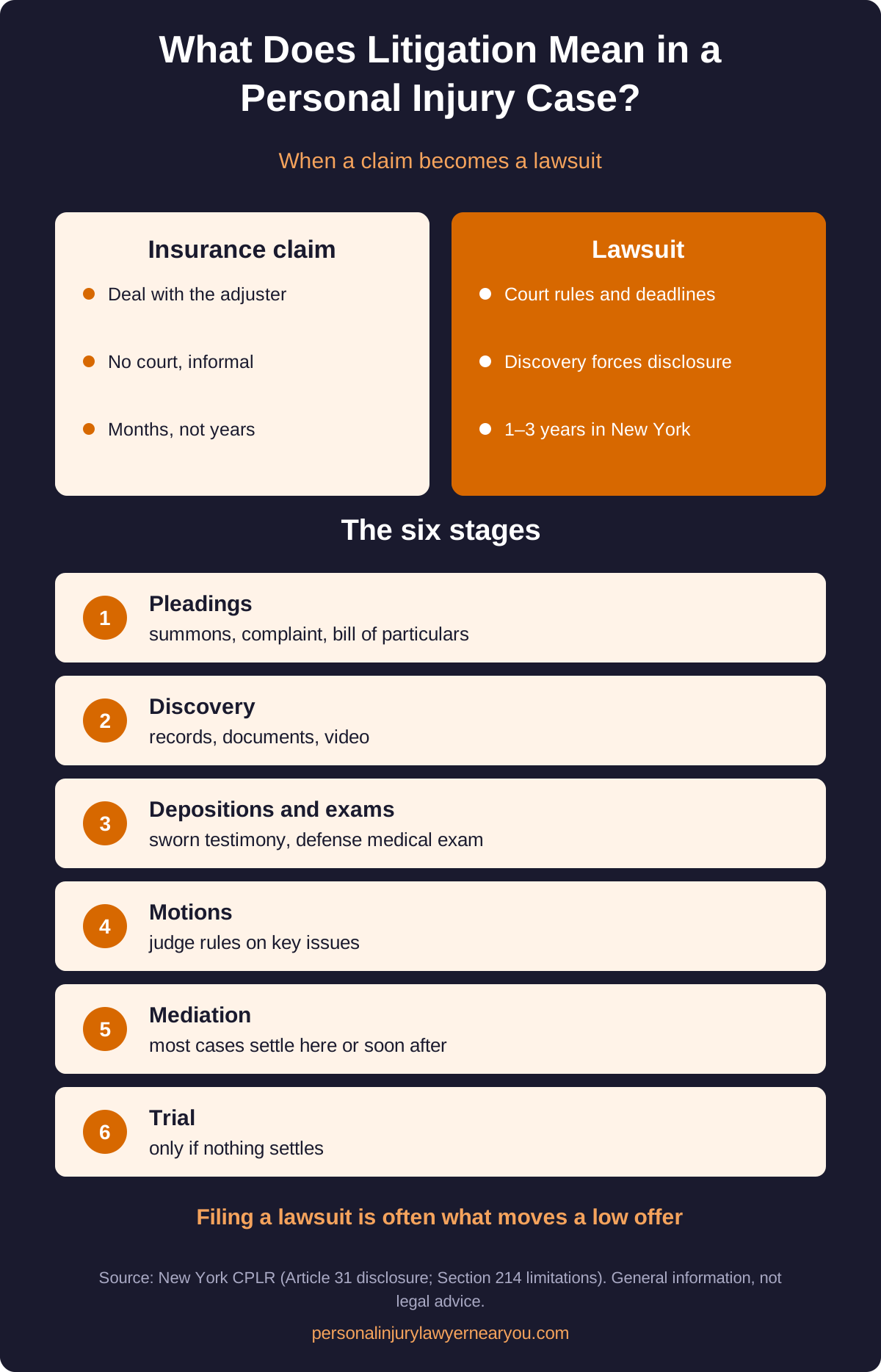
Litigation means your personal injury claim has become a lawsuit. Instead of only negotiating with an insurance adjuster, your lawyer files a summons and complaint in court, and the case follows court rules and deadlines: pleadings, discovery, depositions, motions, mediation and, if needed, trial. It does not mean you are headed to a jury. Most lawsuits still settle, and filing is often what moves a low offer. In New York, most injury lawsuits must be filed within three years.
What does litigation mean in a personal injury case? It means the claim has moved out of the insurance company’s hands and into the court system. Up to that point, everything happened through phone calls, letters and a demand package sent to an adjuster. Once your lawyer files a lawsuit, the case gets a court index number, a judge, formal deadlines and legal tools that can force the other side to hand over evidence.
People often hear “we’re moving to litigation” and assume something has gone wrong. Usually it hasn’t. Litigation is a normal step when an insurer won’t offer a fair amount, when liability is disputed, or when a filing deadline is coming up. Here is what actually changes, what each stage involves and how long it takes.
Claim vs Lawsuit: What Changes When a Case Goes Into Litigation
The difference between a claim and a lawsuit in personal injury comes down to who decides and what rules apply.
| Insurance claim | Lawsuit (litigation) | |
|---|---|---|
| Who you deal with | The at-fault party’s insurance adjuster | The defendant’s defense lawyer and the court |
| Rules | Informal; the insurer sets the pace | Court rules, deadlines and judge’s orders |
| Evidence | Only what each side chooses to share | Discovery forces both sides to disclose |
| Testimony | Usually none, or a recorded statement | Sworn depositions under oath |
| Who decides | You and the insurer agree, or nothing happens | A settlement, or a judge or jury verdict |
| Typical timeline | A few months to a year | One to three years in New York |
| Cost | Low | Higher: filing fees, experts, transcripts |
A claim can only end in an agreement. A lawsuit can end in an agreement or a decision the insurer has to pay. That change in leverage is the real reason lawyers file.
Why a Personal Injury Case Goes Into Litigation
Most cases that end up in court get there for one of five reasons:
- The offer is too low. The insurer won’t move to a fair number, and filing is the next pressure point.
- Fault is disputed. The insurer denies its driver or customer was to blame, and only a court can settle that.
- The injury is serious. High-value claims involve future care and lost earning capacity that insurers rarely pay without a fight.
- The deadline is close. A lawsuit has to be filed before the statute of limitations runs out, even if talks are still going.
- More evidence is needed. Discovery is the only way to get the other side’s documents, video or phone records.
The deadline point matters more than people think. New York gives most injury claims three years, but some defendants, such as the City, require a notice of claim within 90 days. Our guide to the personal injury statute of limitations in New York lists every clock that can apply.
The Stages of Personal Injury Litigation
1. Pleadings: the summons and complaint
Your lawyer files a summons and complaint that names the defendants, explains what happened and says what you are asking for. The defendant is served and has a set time to file an answer, which usually denies responsibility. In New York, the plaintiff also serves a bill of particulars that lists the injuries and losses in more detail.
2. Discovery
This is the longest stage. Each side sends written questions, requests documents and asks for records such as medical files, photos, maintenance logs and video. New York’s civil procedure rules require full disclosure of anything material and necessary to the case, so a defendant can’t simply refuse to share evidence that hurts it.
3. Depositions and the medical exam
Depositions are sworn question-and-answer sessions recorded by a court reporter. You will be questioned by the defense lawyer, and your lawyer will question the other driver, the property manager or other witnesses. The defense will also usually send you to an independent medical examination with a doctor it chooses.
4. Motions
Either side can ask the judge to decide part of the case early. A defendant may argue there is no evidence of negligence, or in a New York car case that the injury doesn’t meet the serious injury threshold, which got stricter in 2026 as our article on the Staten Island serious injury threshold explains. Winning or losing a motion often decides whether a case settles.
5. Mediation and settlement talks
Many courts send injury cases to mediation, where a neutral mediator works with both sides to reach a deal. Settlement talks also continue throughout the case and often speed up after depositions or a key ruling.
6. Trial
If nothing settles, the case goes to a jury or a judge. Even here, many cases settle the week before trial or during jury selection. Our look at what percentage of personal injury cases go to trial shows how rare a full verdict actually is.
How Long Does Personal Injury Litigation Take?
| Stage | Typical length (New York) |
|---|---|
| Filing and the defendant’s answer | 1–2 months |
| Discovery and records exchange | 6–12 months |
| Depositions and medical exams | 3–6 months |
| Motions, mediation and settlement talks | 2–6 months |
| Waiting for and holding a trial | 6–12+ months in busy city courts |
Put together, most New York injury lawsuits resolve somewhere between one and three years after filing. Simple cases with clear liability are faster. Cases against multiple defendants, or with large future-care claims, take longer.
Where Personal Injury Litigation Happens in New York City
Most injury lawsuits in the city are filed in the State Supreme Court for the county where the crash happened or where a party lives: Kings County for Brooklyn, New York County for Manhattan, Bronx County, Queens County and Richmond County for Staten Island. Smaller claims can go to the Civil Court, which handles cases up to $50,000.
Each court has its own pace. Brooklyn and the Bronx carry some of the heaviest injury dockets in the state, which can stretch the wait for a trial date. A Brooklyn car accident lawyer, for example, will plan a case around Kings County’s calendar and its early mediation program, while claims against a public body follow separate rules from day one.
What Litigation Costs: Fees and Expenses
Litigation is more expensive than a claim, and that shows up in two places. First, many contingency fee agreements charge a higher percentage once a lawsuit is filed. In New York it is common to see about a third before suit and a little more after, as explained in our breakdown of personal injury lawyer fees in New York. Second, case expenses grow: court filing fees, deposition transcripts, record retrieval and expert witnesses.
Those costs are usually advanced by the law firm and repaid out of the settlement. Ask how expenses are handled before you sign, and whether they come off before or after the fee is calculated.
Can You Handle Litigation Without a Lawyer?
You can file a lawsuit yourself, but litigation is where self-represented injury claimants struggle most. Court deadlines are strict, discovery rules are technical, and the other side will be represented by a defense lawyer who does this every day. Some small, clear claims can be settled with an insurer directly, as our guide to a personal injury claim without a lawyer explains. Once a case needs a lawsuit, most people are better off with representation.
What Does Litigation Mean in a Personal Injury Case for You? What to Expect Day to Day
Knowing the legal stages is one thing. Knowing what litigation asks of you is what most people actually want. Here is the practical side.
Your role is smaller than you think
Most of the work happens between the lawyers and the court. You won’t attend routine conferences or motion arguments. Your main jobs are to keep treating, keep records, and respond quickly when your lawyer needs information.
Expect a few key appointments
You will typically answer written questions with your lawyer’s help, sit for one deposition that may last a few hours, and attend a defense medical exam. Preparing well for the deposition matters, because your sworn testimony can raise or lower what the case is worth.
Stay consistent and stay off social media
Defense lawyers compare your medical records, deposition answers and online activity. A photo of you lifting something heavy, or an answer that doesn’t match what you told a doctor, can be used against you. The safest approach is to say less online until the case is over.
Settlement can come at any point
Offers often improve after depositions, after a motion is decided, at mediation, or just before trial. Your lawyer must pass every offer to you, and the decision to accept is always yours.
Keep treating and keep receipts
Gaps in medical care are one of the first things a defense lawyer looks for. Keep your appointments, follow your doctor’s advice and save every bill, mileage note and pay stub. These records are what turn an injury into a number a jury or insurer can accept.
Ask for regular updates
Litigation has long quiet stretches while records are gathered. Agree with your lawyer how often you’ll hear from them. A short update every few weeks is reasonable, even if the news is that nothing has changed.
So, what does litigation mean in a personal injury case for you personally? Mostly patience, a few important appointments, and consistency. The lawyers handle the courtroom side; your part is to be a credible, well-documented plaintiff.
Frequently Asked Questions
What does litigation mean in a personal injury case?
Litigation means your claim has moved from negotiating with an insurance company to a formal lawsuit in court. Your lawyer files a summons and complaint, both sides exchange evidence in discovery, and the case continues toward trial unless it settles first, which most cases do.
What is the difference between a claim and a lawsuit in personal injury?
A claim is a demand for payment made directly to the at-fault party’s insurer, with no court involved. A lawsuit is a case filed in court against the at-fault party, with deadlines, rules of evidence and, if needed, a judge or jury deciding the outcome.
Does going into litigation mean my case will go to trial?
No. Filing a lawsuit is often what pushes an insurer to settle. The large majority of personal injury lawsuits settle during discovery, at mediation or shortly before trial, and only a small share are decided by a jury.
How long does personal injury litigation take in New York?
Once a lawsuit is filed, most New York personal injury cases take one to three years to resolve. Discovery and depositions take the most time, and busy courts in the city can add months before a trial date is available.
Does my lawyer charge more if my case goes into litigation?
Often, yes. Many contingency fee agreements charge a higher percentage once a lawsuit is filed or the case goes to trial, and litigation costs such as filing fees, court reporters and expert witnesses also increase. Your fee agreement should spell this out in writing.
Do I have to go to court if my case is in litigation?
Not usually for most of it. Your lawyer handles court filings and conferences. You will normally need to answer written questions, attend a deposition and possibly a medical exam, and you would testify only if the case actually reaches trial.
Key Takeaways
✅ Litigation means a claim has become a lawsuit filed in court
✅ A claim is handled by the insurer; a lawsuit follows court rules and deadlines
✅ Stages: pleadings, discovery, depositions, motions, mediation, trial
✅ Most lawsuits still settle, often after depositions or at mediation
✅ In New York, most injury lawsuits must be filed within three years
Is Your Claim Ready for Litigation?
If the insurer’s offer doesn’t match your injuries, or the deadline is getting close, a free case review can tell you whether filing a lawsuit makes sense and what it would mean for your case.
Insurance Offer Too Low? Find Out Your Options
Free case review. No win, no fee. No upfront cost.
Want more NYC injury guides and legal news from PILNY in your Google results?
