
TL;DR — Quick Summary
To find a good slip and fall lawyer near you in New York: shortlist two or three lawyers who regularly handle premises cases in your borough, check each one’s registration and discipline record with the courts, bring your evidence to a free consultation, and ask the same questions of each. Be wary of anyone who contacts you first — New York bars lawyers from soliciting injury clients in the first 30 days after an accident. If the City, NYCHA or NYC Transit may be responsible, start within weeks, because a 90-day notice of claim applies.
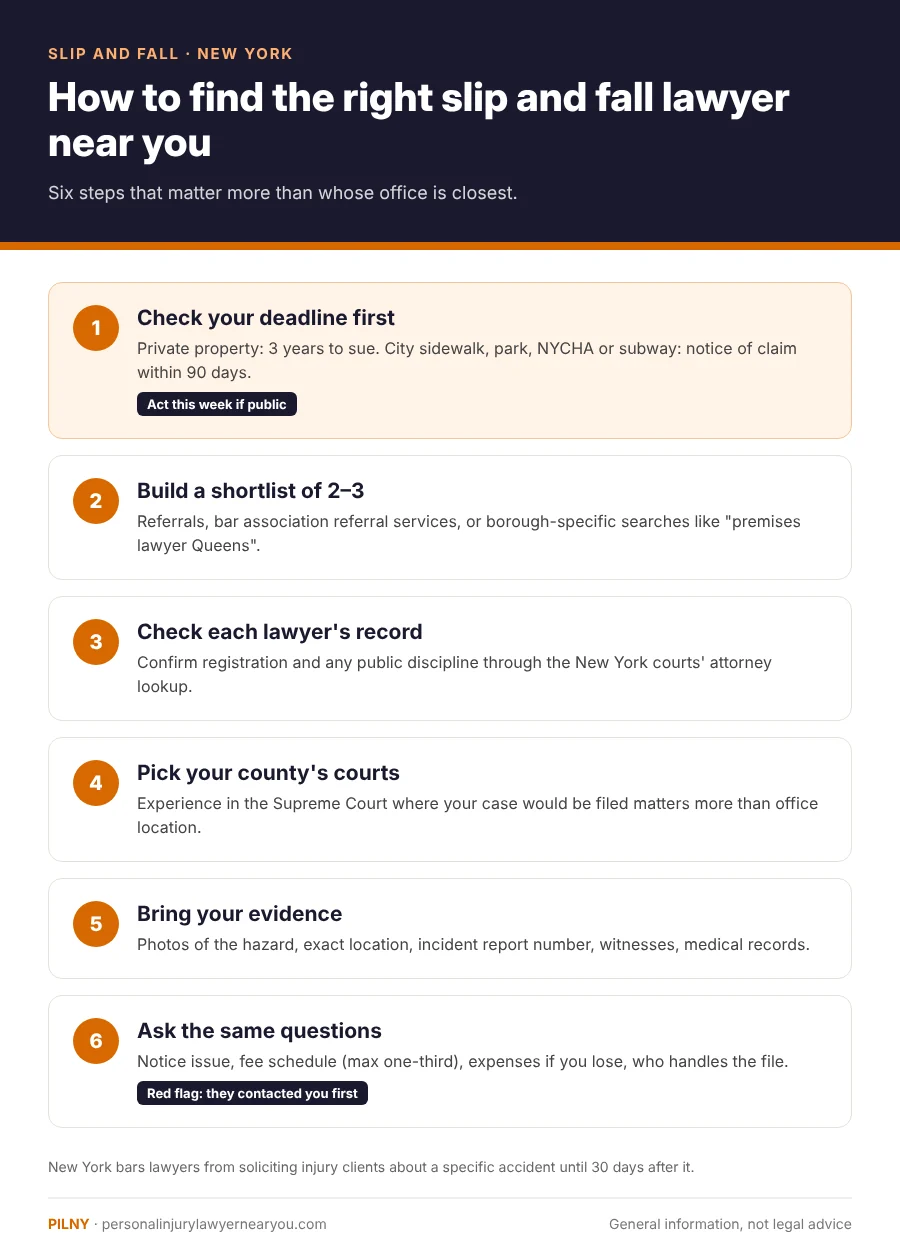
Searching “slip and fall lawyer near me” in New York returns pages of ads, directories and firms that all promise the same thing. Location matters less than you might think — what matters is whether the lawyer knows premises law, handles cases in the courts where yours would be heard, and will actually work your file. This guide is a practical process for choosing one. For the legal rules themselves, see our guide to what a slip and fall attorney in New York looks at first.
Step 1: Know How Fast You Need to Move
Before you compare lawyers, work out your clock:
- Fell in a store, office or private building? The deadline to sue is three years, but surveillance video and the hazard itself can disappear within days. Aim to speak to a lawyer within one to two weeks.
- Fell on a City sidewalk, in a park, in a NYCHA building or in the subway? A notice of claim is due within 90 days. Start this week; the lawyer needs time to investigate before serving it.
Our guide to New York personal injury deadlines lists every variation.
Step 2: Build a Shortlist
Good places to find candidates:
- Personal referrals from people who had an injury case, or from a lawyer you already know in another field.
- Bar association referral services, such as those run by the New York City Bar and the New York State Bar Association, which screen lawyers for experience in the area of law.
- Borough-specific searches such as “premises liability lawyer Queens”, which tend to surface lawyers who actually appear in that county’s Supreme Court.
- A free matching service such as PILNY, which connects you with lawyers who handle slip and fall cases in your borough.
Two or three names is enough. More than that and the consultations blur together.
Step 3: Check Each Lawyer’s Record
Every lawyer licensed in New York is registered with the court system, and public discipline is published by the Appellate Divisions. The New York courts’ law library explains how to research an attorney, including the registration lookup. Check that:
- the lawyer’s registration is current;
- there is no public discipline, or that you understand any that exists;
- the lawyer has practised long enough to have taken premises cases through depositions and motions, not just pre-suit negotiation.
Step 4: Why “Near You” Means Your Court, Not Your Street
A slip and fall case in New York City is usually filed in the Supreme Court for the county where the fall happened or where a party lives. Appeals go to the Appellate Division — the First Department for Manhattan and the Bronx, the Second Department for Brooklyn, Queens and Staten Island. The two departments have developed their own lines of decisions on issues that matter in fall cases, such as trivial defects and notice. A lawyer who regularly litigates in your county will know those decisions, the local judges’ practices and how long cases take to reach trial there. Whether their office is five blocks or five miles away hardly matters; most of the work happens by phone, email and in court.
Borough pages: Brooklyn, Bronx, Manhattan, Queens and Staten Island.
Step 5: Bring the Right Things to the Consultation
| Bring | Why the lawyer needs it |
|---|---|
| Photos and video of the hazard | Shows the condition and helps prove how long it had been there |
| Exact address and spot of the fall | Decides who owns or controls it, and so which deadline applies |
| Incident report number and witness names | Lets the lawyer request records and contact witnesses quickly |
| Medical records and bills so far | The basis for valuing the case |
| Proof of time off work | Supports a lost-earnings claim |
| Any letters from an insurer | Shows who is handling the claim and what has been said |
Step 6: Ask Every Lawyer the Same Questions
- How many premises liability cases have you handled in this county in the last few years, and how many went to trial?
- Who owns or controls the place where I fell, and which deadline applies?
- What will the other side say about notice, and how would you answer it?
- Will you personally handle the case, or will it be referred to another firm?
- How will you keep me updated, and how quickly do you return calls?
- Which fee schedule does your retainer use, and do I owe expenses if we lose?
Comparing the answers side by side tells you more than any website. For a fuller list, see questions to ask a personal injury lawyer.
Red Flags When Choosing a Slip and Fall Lawyer
- They contacted you first. New York’s Rules of Professional Conduct prohibit lawyers from soliciting personal injury clients about a specific accident until 30 days after it, and generally ban in-person and phone solicitation of strangers. A “runner” at the hospital or a call out of the blue is a reason to say no.
- A fee above one-third, or “more if we go to trial”. New York caps injury fees at one-third of the net recovery or a sliding schedule unless a court approves more. See how a contingency fee agreement works.
- A guaranteed result or a specific dollar figure at the first meeting.
- No one can explain the notice issue in your case. Notice decides most fall cases; a lawyer who has not thought about it has not looked closely.
- You only ever speak to intake staff.
After You Hire: What a Good Lawyer Does First
In the first weeks, expect your lawyer to send a preservation letter for video and maintenance records, identify the owner, tenant and any contractor from property and permit records, serve any notice of claim, and get your medical treatment documented. If that is not happening, ask why. You can change lawyers at any time without paying two full fees.
Frequently Asked Questions
How do I find a good slip and fall lawyer near me in New York?
Shortlist two or three lawyers who regularly handle premises cases in your borough, check their registration and discipline record, bring your evidence to a free consultation and ask each the same questions about experience, notice, deadlines and fees.
Does the lawyer need to be in my borough?
Not physically, but they should regularly litigate in the county’s Supreme Court where your case would be filed and know the appellate decisions that apply there.
How quickly should I contact a slip and fall lawyer?
Within one to two weeks for a fall on private property, and immediately if the City, NYCHA or NYC Transit may be responsible, because a notice of claim is due within 90 days.
Is it a bad sign if a lawyer contacts me first after my fall?
Yes. New York bars lawyers from soliciting injury clients about a specific accident until 30 days after it, and generally bans in-person and phone solicitation of strangers.
How much does a slip and fall lawyer cost?
Nothing upfront. The fee is a percentage of the recovery, capped at one-third of the net or a sliding schedule, and there is no fee if nothing is recovered.
What should I bring to the first consultation?
Photos of the hazard, the exact location, the incident report number, witness names, your medical records, proof of time off work and any letters from an insurer.
Key Takeaways
✅ Shortlist two or three lawyers and compare the same answers
✅ Check registration and discipline through the New York courts
✅ “Near me” should mean experience in your county’s courts
✅ Lawyers who solicit you in the first 30 days are breaking the rules
✅ City, NYCHA and transit falls need action within 90 days
Get Matched With a Slip and Fall Lawyer
PILNY connects people hurt in falls across all five boroughs with experienced premises liability lawyers. The review is free and there is no obligation to hire.
Find the Right Slip and Fall Lawyer — Free
Matched by borough. No fee unless you win.
