
TL;DR — Quick Summary
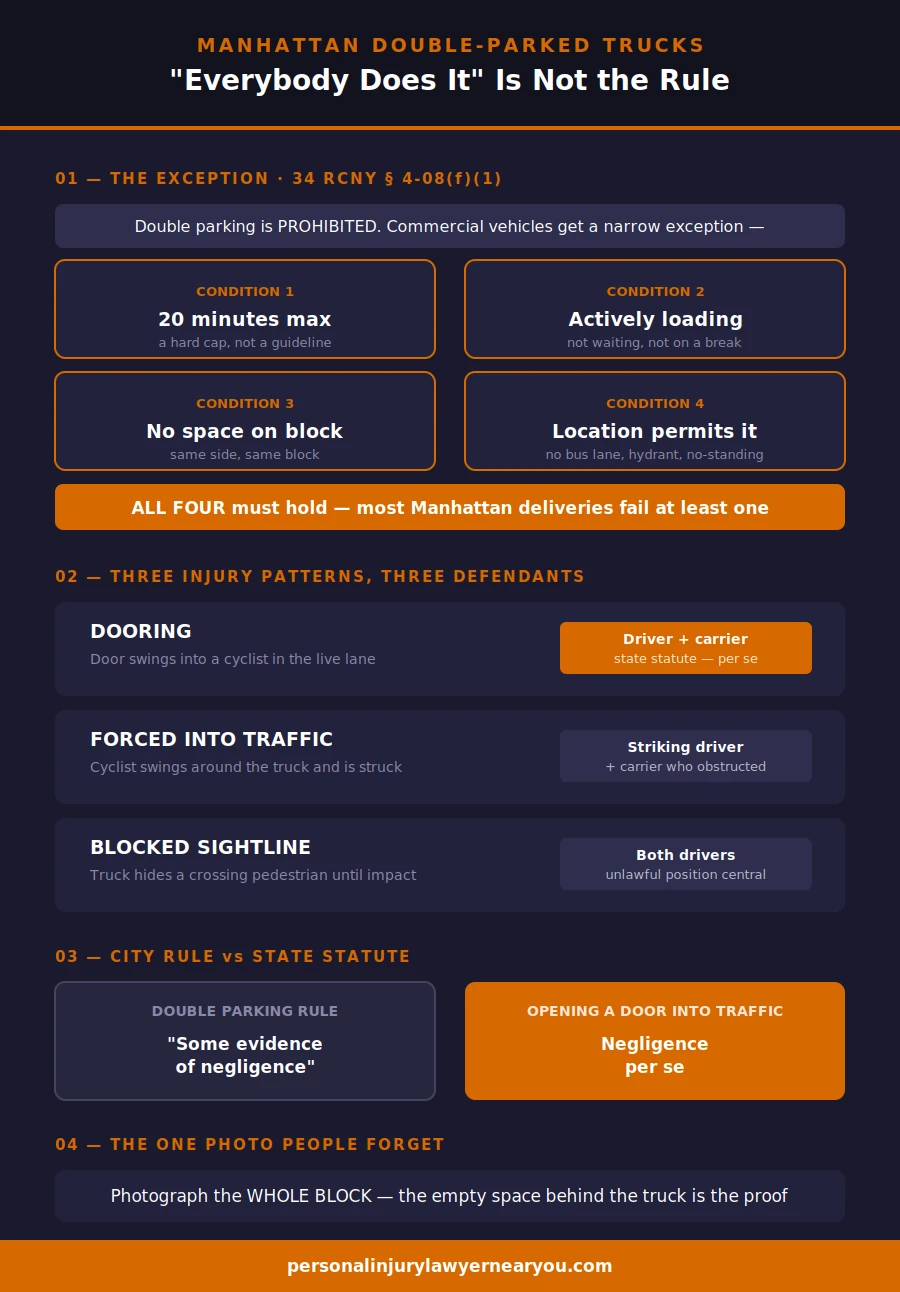
Double parking in New York City is prohibited. There is a narrow exception for commercial vehicles, but it carries four conditions under 34 RCNY § 4-08(f)(1) — a hard 20-minute cap, active loading, no available space or loading zone on the same block, and compliance with VTL § 1102. Every one must hold. Most Manhattan deliveries fail at least one, and a truck parked unlawfully in a live traffic lane is not just a ticket — it is a defendant that created the hazard which put you in hospital.
A Manhattan double parked truck accident gets brushed off with a shrug. Everybody double parks here. It is how the city works.
That is a good story for a parking ticket. It is a poor one in an injury case, because the rule is far narrower than the habit suggests — and the gap between them is where your claim sits.
The Exception Has Four Conditions, Not One
Under 34 RCNY § 4-08(f)(1), standing on the roadway side of a vehicle parked at the curb is prohibited. A commercial vehicle may do it only where every one of the following holds:
| Condition | What the rule requires | How it commonly fails |
|---|---|---|
| 20-minute cap | No more than 20 minutes standing | Long multi-drop stops in office and residential buildings |
| Actively loading | Actively engaged in loading or unloading for a pickup, delivery or service call | Driver inside the building, on a break, or waiting on paperwork |
| No space available | No unoccupied space or designated loading zone on the same side of the street within the same block | An open loading zone mid-block that the driver did not use |
| Location permits it | Standing allowed at that location and hour, and compliant with VTL § 1102 | Bus lanes, hydrants, no-standing zones, restricted Midtown areas |
Read the third condition again, because it is the one nobody expects. The exception only applies when there was nowhere else on that block. A driver who double parked outside the address for convenience, while a legal space sat forty feet away, was never inside the exception at all.
And this is checkable after the fact. Street imagery, camera footage and witness accounts establish what the block looked like, which turns “everybody does it” into a factual question with a documented answer.
Three Ways These Trucks Cause Injuries
A double-parked truck rarely hits anyone while moving. It causes harm by sitting where it should not, and the injury pattern determines who you are actually suing.
| Injury pattern | What happens | Who is usually liable |
|---|---|---|
| Dooring | A cab or cargo door swings into a cyclist or passing vehicle in the live lane | The driver, plus the carrier — VTL § 1214 is a state statute, so this is the strongest of the three |
| Forced into traffic | A cyclist or pedestrian must swing around the truck into a moving lane and is struck | Shared — the striking driver and the carrier that created the obstruction |
| Blocked sightline | The truck hides a crossing pedestrian from an approaching driver until impact | Both drivers, with the truck’s unlawful position central to the argument |
The middle and third rows are where most claims are undervalued. The instinct is to sue only the vehicle that made contact. But a truck standing unlawfully in a traffic lane is a proximate cause of the situation that produced the collision, and leaving the carrier out of it usually leaves the better-insured defendant out of it too.
Dooring Sits on Different Legal Ground
Of the three patterns, dooring has the firmest footing, and the reason is a doctrinal one worth understanding.
The double parking rule itself is a city rule, so breaching it is only some evidence of negligence in New York. Useful, but not decisive. Opening a door into traffic is different: it is governed by the Vehicle and Traffic Law, a state statute — and violating a state statute is negligence per se, which settles breach rather than merely suggesting it.
That same distinction runs through our post on the FDR Drive commercial vehicle ban, where posted signage is what converts a city restriction into a statutory one. In a dooring case you do not need that bridge — the statute is already there.
Why the Carrier Is the Real Defendant
Drivers do not choose to double park out of laziness. They do it because the delivery schedule leaves no time to circle for parking, and because the company’s route was planned as if kerb space were available.
That makes double parking a systemic decision rather than an individual one, and it opens the same direct-negligence route covered in our post on Manhattan truck route violations — a claim against the company for how it planned and supervised the work, not only for its driver’s conduct. Delivery window data, stop counts per route and driver instructions all speak to it.
Coverage matters here too. Many Manhattan delivery vehicles are smaller than people assume, and whether the federal minimum applies at all is set out in our breakdown of when the $750,000 minimum does not apply.
Evidence Worth Capturing Immediately
- The whole block, not just the truck — photographs showing whether any legal space or loading zone was open
- Timestamps establishing how long the vehicle had been standing, which speaks to the 20-minute cap
- Whether anyone was actively loading at the moment of the collision
- Posted signage at that location and the applicable hours
- Delivery records showing the scheduled window and the number of stops on the route
- Nearby business and building cameras, which capture kerbside activity far better than traffic cameras
The first item is the one people miss. Photographing the truck is instinctive; photographing the empty loading zone thirty feet behind it is what actually defeats the exception. The broader sequence is in our guide on what to do after a truck accident in New York.
The Limits That Still Apply
A cyclist or pedestrian claim still runs into New York’s motor vehicle framework. The serious injury threshold under Insurance Law § 5102(d) governs pain and suffering, comparative negligence reduces recovery by your share of fault, and under the 2026 reform a plaintiff found mostly at fault cannot recover non-economic damages. Expect the insurer to argue you should have anticipated the obstruction — which is precisely why documenting the block matters more than documenting the impact.
Frequently Asked Questions
Is double parking legal for delivery trucks in Manhattan?
Only within a narrow exception. Under 34 RCNY § 4-08(f)(1) a commercial vehicle may stand alongside a curbed vehicle for no more than 20 minutes while actively loading or unloading, at a location and hour where standing is not otherwise prohibited, and only where no unoccupied space or designated loading zone is available on the same side of the street within the same block. All of those must be true together.
A truck door hit me while I was cycling past. Who is responsible?
Opening a vehicle door into moving traffic is governed by the Vehicle and Traffic Law, and because that is a state statute a violation is negligence per se rather than merely evidence of negligence. Both the person who opened the door and the carrier that employs them are typically defendants.
Can I sue the truck if a different vehicle actually hit me?
Often yes. A vehicle standing unlawfully in a live traffic lane can be a proximate cause of the collision it forced, whether by pushing you into moving traffic or by hiding you from an approaching driver. New York allows liability to be shared among multiple defendants, and the carrier is frequently the better-insured one.
Does a parking ticket prove the truck was negligent?
No. The double parking rule is a New York City rule, and a municipal rule violation is treated as some evidence of negligence rather than negligence per se. It supports the claim but does not decide it, which is why the surrounding facts — available space, duration and whether loading was underway — carry the weight.
What if there genuinely was nowhere else to park?
Then that condition of the exception is satisfied, but the others still have to be. The 20-minute cap, active loading, and the location and hour restrictions all apply independently. A truck lawfully double parked can also still be liable if the injury came from how it was positioned or how a door was opened.
How long do I have to bring a claim?
Generally three years for a personal injury claim against a private company, and 30 days to file your no-fault application. If a City or State vehicle or entity is involved, a Notice of Claim is required within 90 days. Camera footage from nearby businesses typically overwrites within days, so the practical deadline is far shorter than the legal one.
Key Takeaways
✅ The double parking exception has four conditions — all must hold together
✅ An open loading zone on the same block defeats the exception outright
✅ Dooring is governed by state statute — negligence per se, not just evidence
✅ The truck can be liable even when another vehicle made contact
✅ Photograph the whole block — the empty space behind the truck is the proof
Start Your Manhattan Delivery Truck Claim
“Everybody double parks” is not a defence, and in most cases it is not even accurate — the truck was outside the exception before you were ever hurt. Proving it means documenting the block while it still looks the way it did. The framework is the same as any Manhattan personal injury claim, with a rule most people assume does not exist sitting underneath it. The case review is free, and there is no fee unless you win.
Talk to a Manhattan Truck Accident Lawyer Today
Free case review. No win, no fee. No upfront cost.
Want more NYC injury guides and legal news from PILNY in your Google results?
