
TL;DR — Quick Summary
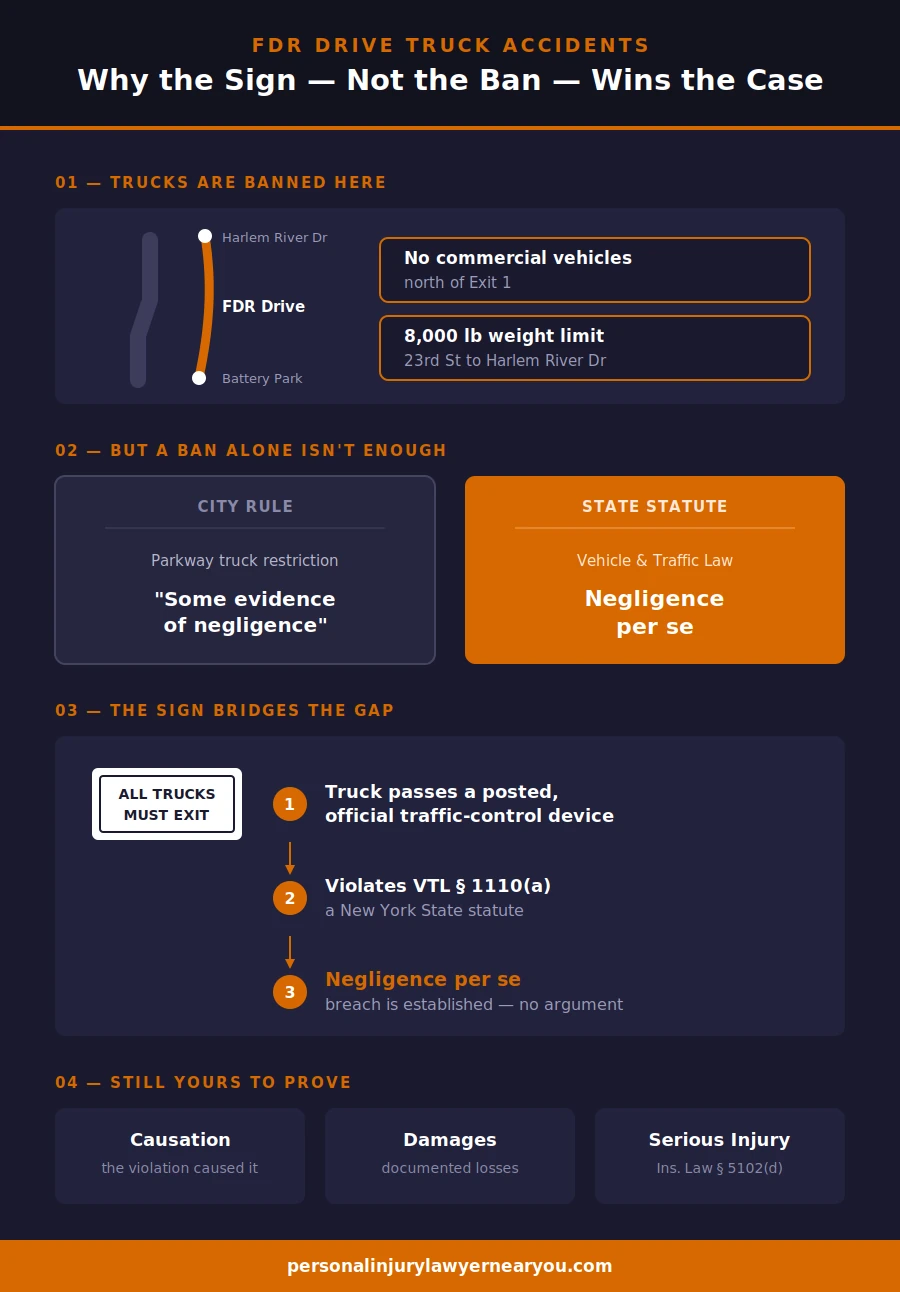
Commercial vehicles are banned from the FDR Drive — NYC DOT lists it by name in its parkway truck restrictions, and a 8,000-pound weight limit is posted from 23rd Street to the Harlem River Drive. That matters more than most people realise. New York treats a violation of a city rule as only some evidence of negligence, but a violation of a state statute as negligence per se. The posted signage is what bridges the two: ignoring an official traffic-control device violates VTL § 1110(a), a state statute — which removes the duty and breach fight from your case entirely.
An FDR Drive truck accident is not the ordinary crash most people assume it is. Two vehicles, one at fault, insurance sorts it out — that is how these cases get treated, and it leaves the strongest fact on the table.
The vehicle that hit you was not allowed to be on that road at all — and in a New York injury claim, that is not a detail. It is the foundation.
Trucks Are Not Permitted on the FDR Drive
The FDR is a parkway, and commercial vehicles are prohibited on it. The New York City Department of Transportation lists it by name alongside the Belt Parkway in its parkway truck restrictions. The ban applies north of Exit 1, and between 23rd Street and the Harlem River Drive a weight limit of 8,000 pounds is posted in both directions.
Eight thousand pounds is not a high bar. A loaded box truck clears it easily. A tractor-trailer clears it several times over. Even a rented cargo van counts as a commercial vehicle for this purpose, whoever happens to be driving it.
So if a commercial vehicle struck you on the FDR, the driver was not merely careless. The driver was somewhere the law says that vehicle cannot go. A Manhattan truck accident lawyer looks at that first, because it changes what you have to prove.
Negligence Per Se — and the Distinction Most Pages Get Wrong
In an ordinary negligence case you prove four things: duty, breach, causation, damages. Duty and breach are where insurers fight hardest. Was the driver really going too fast? Was the lane change really unsafe? It becomes one account against another.
Negligence per se removes that fight. Where a driver violates a safety statute, the violation itself is the breach. You are left proving only causation and damages.
But New York does not apply that doctrine to every rule a driver breaks, and this is where a great deal of what you will read online is simply wrong:
- A state or federal statute — violation is negligence per se. The violation is negligence.
- A city ordinance or administrative agency rule — violation is only some evidence of negligence. A jury may weigh it; it does not decide the question.
New York’s highest court has applied that distinction even to a section of the New York City Administrative Code carrying what it described as the “force of statute.” Force of statute makes a rule binding. It does not change the tort consequences of breaking it.
Which matters here, because the FDR truck ban is a city restriction. Standing alone, it falls in the weaker category — and a page that tells you an illegal truck is automatically negligence per se has skipped a step.
How the Posted Sign Closes the Gap
The ban is not enforced by an invisible rule. It is enforced by signage — and in 2017 the City installed large “All Trucks Must Exit” signs and pavement markings along the FDR for exactly this reason.
Under the Vehicle and Traffic Law, a traffic-control device means any sign, signal, marking or device placed by a public authority to regulate, warn or guide traffic. And VTL § 1110(a) — a state statute — requires every driver to obey official traffic-control devices unless a police officer directs otherwise.
So the chain runs: the truck passed a posted, official sign prohibiting it; disobeying that sign violates a state statute; violating a state statute is negligence per se. The city rule alone would have been evidence. The sign is what makes it law.
Why Trucks Keep Ending Up There
Mostly navigation. Consumer GPS apps route for passenger cars and have no idea the vehicle following them is commercial. The City has said so publicly — announcing the new FDR signage, NYC DOT pointed directly at GPS-enabled phone apps and reported that oversize vehicles struck bridges 52 times across New York City in a single year.
The rest is schedule pressure. The FDR looks like the fast way up the East Side, and a driver running behind takes it and hopes.
Neither reason helps the carrier. “My GPS told me to” is not a defence to a posted sign, and a dispatcher who set an impossible delivery window becomes part of your case rather than a way out of it. The same routing and dispatch records that prove it are covered in our guide on what to do after a truck accident in New York.
The Low-Clearance Crash Pattern
The FDR was built for passenger cars in the 1950s. Its overpasses and ramp structures are low, the lanes are narrow, and for long stretches there is no usable shoulder. That produces a crash type you rarely see elsewhere:
- A truck wedges under an overpass and stops dead in a live traffic lane
- Traffic behind it has no shoulder, no sightline, and no time
- The vehicles destroyed are the cars that hit the stopped truck, not the truck
If that was your crash, do not assume you are at fault because you struck the truck from behind. New York presumes the rear driver is at fault in a rear-end collision, but the presumption is rebuttable — and a commercial vehicle stopped in a travel lane on a road it was banned from is close to the strongest rebuttal available.
What the Illegal Presence Does Not Do
This is the part the marketing pages leave out.
It does not win the case by itself. Negligence per se establishes breach. You still have to prove the violation caused your injuries. If the truck was illegally on the FDR but you were struck because a third car swerved into you, its presence on the wrong road did not cause your harm.
It does not erase your own conduct. New York applies comparative negligence, and under the 2026 reform a plaintiff found mostly at fault in a motor vehicle case can no longer recover non-economic damages at all.
It does not lower the serious injury threshold. Insurance Law § 5102(d) still governs whether you can recover for pain and suffering in a motor vehicle case, and the 2026 reform eliminated the 90/180-day category that previously helped claimants with temporarily disabling injuries.
The illegal presence is powerful. It is a foundation, not a verdict.
Evidence That Disappears First
An FDR case turns on proving the vehicle was there and that it was commercial. That proof has a short shelf life.
- Traffic and NYPD camera footage — the corridor is heavily monitored, but retention runs in days, not months
- The engine control module — speed, braking and throttle before impact, with no federal rule requiring a heavy truck’s ECM data to be preserved
- Driver logs and dispatch records — these show the route the company assigned, which is frequently the whole case
- The police report’s vehicle classification — errors are common and get harder to correct later
- Photographs of the signage the truck passed, and of its commercial markings, DOT number and plates
A preservation letter from an attorney is what stops a carrier overwriting this in the ordinary course of business. The Manhattan accident checklist covers the local corridors and camera systems in more detail.
Three Clocks, Running at Different Speeds
- 30 days to file your no-fault application, or your own insurer can deny medical bills and lost wages regardless of fault
- 90 days for a Notice of Claim where a City or State entity is involved — live on the FDR, which is maintained by both NYSDOT and NYCDOT
- Three years for the personal injury lawsuit, shorter in a wrongful death case
Three years sounds generous until you remember the evidence above vanished in the first month. Our breakdown of New York’s filing deadlines covers the exceptions that shorten or pause the clock, and it is worth running the numbers through our free personal injury settlement calculator before accepting any figure.
Frequently Asked Questions
Are all trucks banned from the FDR Drive, or only large ones?
All commercial vehicles are prohibited north of Exit 1, regardless of size, and a posted 8,000-pound weight limit applies in both directions between 23rd Street and the Harlem River Drive. A rented box truck or cargo van counts as a commercial vehicle for this purpose even when a private individual is driving it.
Does a truck being illegally on the FDR mean I automatically win?
No. It establishes breach, which removes the largest area of dispute in most cases. You still have to prove the violation caused your injuries and document your damages, and your own share of fault can still reduce or, under the 2026 reform, eliminate non-economic recovery.
Why isn’t the city ban alone enough to prove negligence?
Because New York treats a municipal rule or administrative regulation as only some evidence of negligence, not negligence per se. The posted sign is what converts it — disobeying an official traffic-control device violates VTL § 1110(a), which is a state statute, and statutory violations carry the stronger standard.
The truck was stopped under an overpass and I hit it. Am I at fault?
Not necessarily. The rear-driver presumption applies but is rebuttable by showing the truck created a sudden and unlawful hazard. A commercial vehicle wedged under a low overpass on a road it was banned from is a strong basis for that argument.
What if the trucking company says its GPS routed the driver there?
That is not a defence. VTL § 1110(a) contains no exception for navigation errors. If anything it points at the carrier’s own failure to supply commercial routing to its drivers, which supports a direct negligence claim against the company rather than only the driver.
What if the driver received a ticket for it?
A guilty plea to a traffic charge is admissible as some evidence of negligence but is not conclusive — the driver is entitled to explain that the plea was a matter of convenience. The underlying statutory violation is what carries the weight, not the citation.
Key Takeaways
✅ Commercial vehicles are banned on the FDR north of Exit 1 — 8,000 lb limit posted
✅ A city rule alone is only evidence of negligence in New York
✅ The posted sign triggers VTL § 1110(a) — a statute, and negligence per se
✅ Breach is settled, but causation and damages are still yours to prove
✅ Camera footage and ECM data are gone in days unless preserved
Start Your FDR Drive Truck Accident Claim
A truck on the FDR Drive was breaking the law before it ever reached you. That is a genuine advantage — but only if the evidence proving it still exists when someone goes looking for it. The framework is the same as any Manhattan personal injury claim, with a statutory violation sitting underneath it. The case review is free, and there is no fee unless you win.
Talk to a Manhattan Truck Accident Lawyer Today
Free case review. No win, no fee. No upfront cost.
Want more NYC injury guides and legal news from PILNY in your Google results?
