
TL;DR — Quick Summary
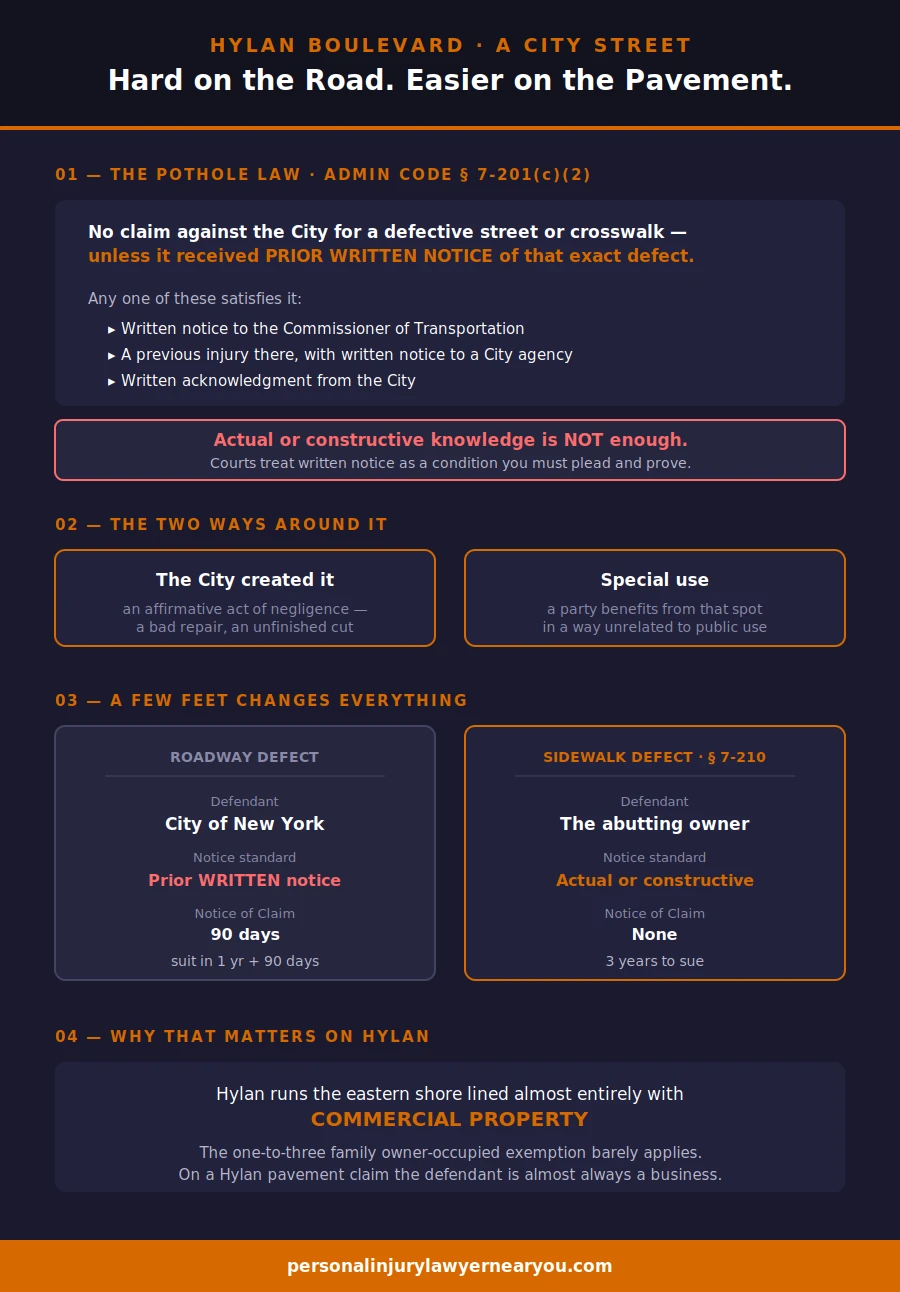
Hylan Boulevard is a City street, and that makes it the hardest jurisdiction on Staten Island to sue over a road defect. Under the Pothole Law (Admin Code § 7-201(c)(2)) the City cannot be held liable for a defective street or crosswalk unless it received prior written notice of that exact defect — and the courts treat this as a condition you must plead and prove. Actual knowledge is not enough. But the reverse is true on the pavement: under § 7-210, sidewalk liability sits with the abutting property owner, who needs no written notice at all. On a commercial strip like Hylan, that is almost always a business.
A Hylan Boulevard truck accident looks like the simplest kind of case on Staten Island. No bridge authority, no Court of Claims, no bistate agency — just a City street.
It is the opposite. If the road surface played any part in your crash, this is the hardest defendant on the island to reach.
Why a City Street Is Harder, Not Easier
Everywhere else on Staten Island, a road-condition claim turns on ordinary negligence: did the owner know or should it have known, and did it act reasonably. On a City street there is a gate in front of all of that.
Administrative Code § 7-201(c)(2) — the Pothole Law — says no civil action may be maintained against the City for injury caused by a street, highway, bridge, culvert, sidewalk or crosswalk being out of repair, unsafe, dangerous or obstructed, unless one of these is true:
- Written notice of that condition was actually given to the Commissioner of Transportation or a person authorised to receive it
- There was a previous injury at the same location and written notice of it went to a City agency
- There was a written acknowledgment from the City of the condition
In each case the City must then have failed to repair within fifteen days.
New York courts treat prior written notice as a condition precedent — something the injured person has to plead and prove, not something the City has to disprove. Without it the claim is dismissed.
And the part that surprises people most: actual knowledge is not enough. In Tucker v City of New York, the Appellate Division held that absent prior written notice the City could not be liable “even if it had actual or constructive notice of the alleged defect.” City crews can have driven past a crater for months. Without the written notice, that does not carry the claim.
Staten Island Side by Side
| Where | To sue over the road you must show | Notice deadline |
|---|---|---|
| Hylan Blvd & City streets | Prior written notice of that exact defect — actual knowledge does not suffice | 90 days |
| Staten Island Expwy | Ordinary negligence — the State knew or should have known | 90 days |
| Port Authority bridges | Ordinary negligence | 1 year to sue |
| The trucking company | Ordinary negligence | None — 3 years |
The top row is the outlier, and it is the one most Staten Island crashes happen on. The full map is in our guide to which authority owns the road you crashed on.
The Two Ways Around the Pothole Law
Courts have recognised two exceptions, and both are narrow.
The City created the defect. Where the condition was caused by the City’s own affirmative act of negligence — a repair done badly, a cut left unfinished — prior written notice is not required. The argument turns on whether the City made the hazard rather than merely failed to fix it.
Special use. Where a party derives a special benefit from a portion of the roadway unrelated to public use, that party can be liable for its condition.
There is also a historical wrinkle worth knowing. For years the Big Apple Pothole and Sidewalk Protection Corporation surveyed City streets and served detailed maps on DOT, and those maps operated as prior written notice for everything marked on them. That programme wound down after the 2003 sidewalk reform, which means establishing prior written notice today is considerably harder than it was twenty years ago.
On the Pavement, Everything Reverses
This is where Hylan Boulevard becomes interesting, and it is the opposite of what most people expect.
Since September 2003, Administrative Code § 7-210 has placed responsibility for maintaining a sidewalk on the owner of the abutting property — including the curb. The Court of Appeals has described this as a nondelegable duty. And because the defendant is a private owner rather than the City, the prior written notice requirement does not apply at all.
| Roadway defect | Sidewalk defect | |
|---|---|---|
| Defendant | City of New York | The abutting property owner |
| Notice standard | Prior written notice — a condition precedent | Actual or constructive notice is enough |
| Notice of Claim | Required within 90 days | Not required |
| Time to sue | 1 year and 90 days | 3 years |
| Exception | City created the defect, or special use | One-to-three family owner-occupied homes stay with the City |
Now look at Hylan Boulevard. It runs roughly the length of the island’s eastern shore and it is lined almost continuously with commercial property — shopping strips, dealerships, restaurants, service businesses. The owner-occupied residential exemption barely applies. On a Hylan pavement claim the defendant is nearly always a business with insurance and no written notice defence.
That is why identifying exactly where you were standing or walking matters so much here. The premises side of this is covered further in our Staten Island slip and fall resources.
Why Hylan Produces So Many Truck Crashes
Hylan Boulevard is not a highway, and that is precisely the problem.
It is a long commercial corridor with constant kerbside activity — delivery vehicles stopping, reversing into loading bays, pulling across traffic into shopping centre entrances. It carries heavy local delivery traffic while also functioning as a through route for drivers avoiding the expressway. Pedestrians cross it all day.
Most of the truck traffic on it is local rather than long-haul, which raises the questions covered in our post on when the $750,000 federal minimum does not apply — a small local carrier running entirely within New York may carry far less coverage than people assume.
What to Establish Early
- Roadway or sidewalk — this single fact decides the defendant, the notice standard and the deadline
- The abutting property, if the sidewalk is involved — the business, the owner, and whether it is commercial or a small owner-occupied home
- Whether the defect was recently repaired — City work at that spot supports the created-the-defect exception
- 311 and DOT complaint history at that location, which is where prior written notice may exist
- The carrier’s USDOT number, which opens the claim that needs no notice at all
- Photographs of the condition before it is repaired
Treat the 90-day clock as running from day one if the City might be involved. The wider first-steps sequence is in our guide on what to do after a truck accident in New York.
The New York Rules That Still Apply
You have 30 days to file your no-fault application. The serious injury threshold under Insurance Law § 5102(d) governs pain and suffering in a motor vehicle case, and comparative negligence reduces recovery by your share of fault — with a plaintiff whose fault exceeds the defendants’ combined share unable to recover non-economic damages under the 2026 reform. Our free settlement calculator gives you a working range before any offer is discussed.
Frequently Asked Questions
What is the New York City Pothole Law?
It is Administrative Code § 7-201(c)(2). It bars a civil action against the City for injury caused by a street, sidewalk, crosswalk or similar being out of repair or dangerous, unless prior written notice of that condition was given to the Commissioner of Transportation, or there was a previous injury at that location with written notice to a City agency, or the City gave written acknowledgment — and then failed to repair within fifteen days.
The City clearly knew about the pothole. Is that enough?
No. New York courts have held that without prior written notice the City cannot be liable even where it had actual or constructive notice of the defect. Prior written notice is treated as a condition precedent that the injured person must plead and prove, so knowledge on its own does not carry the claim.
Are there exceptions to the prior written notice rule?
Two, and both are narrow. The requirement does not apply where the City created the defect through an affirmative act of negligence, or where a party made special use of that portion of the roadway and derived a benefit from it unrelated to public use.
Who is liable if I was injured on the sidewalk rather than the road?
Generally the owner of the abutting property. Administrative Code § 7-210 placed the duty to maintain a sidewalk, including the curb, on abutting owners in 2003, and the Court of Appeals has treated it as nondelegable. One-to-three family owner-occupied residential properties are exempt and remain the City’s responsibility.
Is a sidewalk claim easier than a roadway claim?
Usually, yes. A private owner is subject to ordinary negligence principles, so actual or constructive notice is sufficient and no prior written notice or Notice of Claim is required. On a commercial corridor such as Hylan Boulevard the abutting owner is almost always a business rather than an exempt small homeowner.
What were the Big Apple maps?
The Big Apple Pothole and Sidewalk Protection Corporation surveyed New York City streets and served detailed maps of defects on the Department of Transportation, and those maps operated as prior written notice for the conditions marked on them. The programme wound down after the 2003 sidewalk reform, which makes establishing prior written notice harder today.
Key Takeaways
✅ On a City street the Pothole Law requires prior written notice of the exact defect
✅ Actual or constructive knowledge by the City is not enough
✅ Two narrow exceptions — the City created the defect, or special use
✅ On the sidewalk, § 7-210 puts liability on the abutting owner with no written notice needed
✅ Hylan is almost entirely commercial — the exempt small-homeowner carve-out rarely applies
Work Out Which Claim You Actually Have
On Hylan Boulevard a few feet can change everything — roadway or pavement, City or business, written notice or none, ninety days or three years. It is worth settling that question before the surface is repaired and the answer becomes unprovable. Speak to a Staten Island truck accident lawyer while all of it is still open. The framework is the same as any Staten Island personal injury claim. The case review is free, and there is no fee unless you win.
Talk to a Staten Island Truck Accident Lawyer Today
Free case review. No win, no fee. No upfront cost.
Want more NYC injury guides and legal news from PILNY in your Google results?
