
TL;DR — Quick Summary
If you were hit by an Amazon, FedEx, UPS, or food delivery vehicle, finding a delivery truck accident lawyer in Brooklyn starts with one question nobody warns you about: who actually employs the driver? Amazon delivery vans are usually operated by independent Delivery Service Partners, not Amazon. FedEx Ground routes often run through contracted service providers. That structure is deliberate, and it decides which insurance policy pays you. The good news is that the contractor label does not automatically end your claim — courts look at who really controlled the work.
Brooklyn gets more delivery vehicles per square mile than almost anywhere in the country. Amazon vans in Bay Ridge, FedEx trucks double-parked on Flatbush Avenue, UPS on Atlantic, and a constant layer of food delivery vehicles moving through neighborhoods that were built long before any of this existed.
When one of them hits you, the first instinct is to assume you are making a claim against a household-name company with deep pockets. Sometimes that is true. Often it is not — and understanding the difference before you speak to anyone is what protects your claim.
The Structure Nobody Explains to You
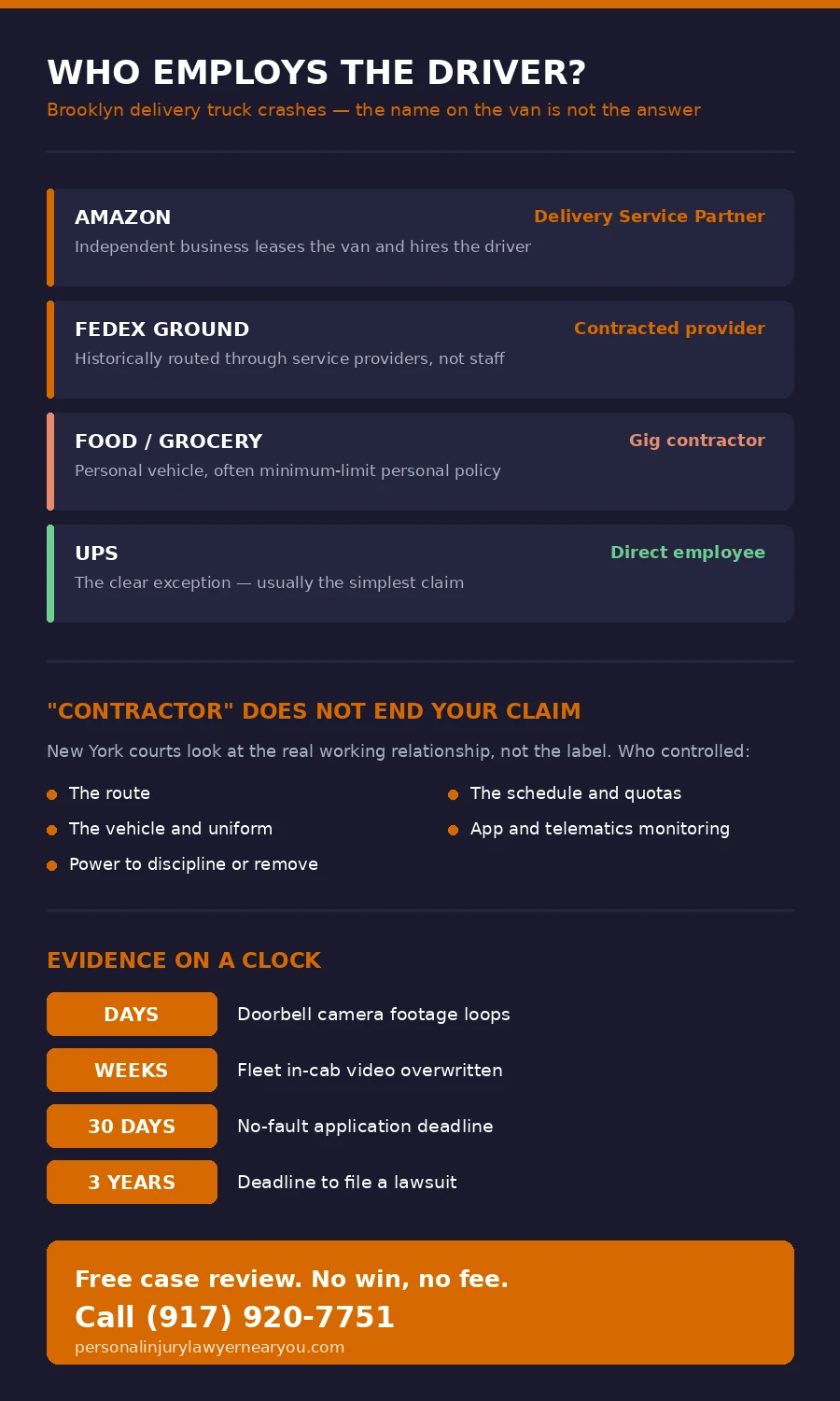
Most large delivery operations do not directly employ the drivers you see on Brooklyn streets.
- Amazon largely runs deliveries through Delivery Service Partners — separate small businesses that lease branded vans and hire their own drivers. The van says Amazon. The employer usually is not Amazon.
- FedEx Ground has historically operated through contracted service providers rather than direct employees, a structure that differs from FedEx Express.
- Food and grocery delivery platforms typically classify drivers as independent contractors using personal vehicles, which often means personal auto policies with minimum limits.
- UPS is the notable exception — its drivers are generally direct employees, which usually makes those claims more straightforward.
This matters enormously, because it determines whether you are claiming against a national corporation’s coverage or a small contractor’s policy. A Brooklyn truck accident lawyer works this question first, before anything else.
Why the Contractor Label Does Not End Your Claim
Here is the part that gets buried under bad internet advice. A company cannot escape responsibility just by writing “independent contractor” into an agreement.
New York courts look at the actual working relationship, not the label. The factors that matter include who set the route, who dictated the delivery schedule and package quotas, who supplied the vehicle and the uniform, who monitored the driver through an app or telematics, and who could discipline or remove the driver.
When a national brand controls the route, the timing, the branding, and the performance monitoring, that control is an argument for liability regardless of the paperwork. Several theories can reach the parent company:
- Actual control over the manner and means of the work
- Negligent selection of a contractor with a poor safety record
- Apparent authority — branded vans and uniforms that present the driver as the company’s own
- Direct negligence in setting quotas that make safe driving impractical
None of these are automatic. They require evidence, and they are fought hard. But “the driver was a contractor” is the beginning of the analysis, not the end of it. The same question drives every other party in the chain — our guide to who is liable in a Brooklyn truck accident walks through all seven. For the recent jury verdicts against Amazon over Delivery Service Partner crashes, see our guide for people hit by a delivery truck in Queens.
Why Delivery Vehicles Cause a Distinct Kind of Crash
Delivery collisions in Brooklyn do not look like highway truck crashes. They happen at low speed, on residential streets, and they disproportionately involve people outside vehicles.
The recurring patterns are specific: a van pulling out from a double-parked position into traffic; reversing into a driveway or loading spot with almost no rear visibility; a driver stepping out of the cab directly into a cyclist’s path; a package handler moving between the vehicle and the curb; and wide right turns on narrow streets that catch pedestrians in the crosswalk.
Double parking deserves its own note, because it is where liability often becomes clear. Under New York City’s parking regulations, commercial vehicles get a narrow allowance to stand alongside a parked car while actively loading or unloading — and only where no legal curb space or designated loading zone is available nearby. That allowance is time-limited and conditional, not a blanket permission. A van left blocking a travel lane or a bike lane beyond what the rule permits, or parked there while nobody is actively loading, is a violation that supports a negligence claim. NYC DOT has also been expanding designated loading zones specifically to reduce double parking and blocked bike lanes, which makes the availability of nearby legal space a relevant question after a crash.
Box trucks add a further problem. Their blind zones are far larger than a passenger car’s, particularly directly behind and along the passenger side, and many are not required to carry the same equipment as a tractor-trailer.
Low speed does not mean low injury. A van reversing at ten miles per hour can cause a crush injury or a fracture that clears New York’s serious injury threshold without difficulty.
The Evidence That Actually Wins These Cases
Delivery operations generate far more data than an ordinary driver, which is an advantage — if it is preserved in time.
- Route and telematics data — GPS position, speed, braking, and stop duration, logged continuously
- Delivery scan timestamps — every package scan places the vehicle at a location at an exact moment
- In-cab and outward-facing cameras — increasingly standard on branded fleets
- The contract itself — the document that reveals how much control the parent company really had
- Doorbell cameras — Brooklyn residential streets are saturated with them, and they capture what fleet cameras miss
All of it operates on a retention schedule. Fleet video is frequently overwritten within weeks, and doorbell footage often loops in days. A preservation letter has to reach the right entity — which means identifying the employer first, and quickly.
What These Claims Are Worth
Value tracks the coverage you can reach, which is exactly why the employment question is not academic.
A commercial delivery vehicle operated by a contracted business usually carries commercial auto coverage well above a personal policy. If the parent company can be brought in, the available limits rise again. If the driver was a gig worker in a personal car, you may be looking at a minimum-limits policy — and in that situation your own uninsured or underinsured motorist coverage becomes the difference between partial and full compensation.
Before accepting any offer, run your own numbers through our free personal injury settlement calculator, and read our breakdown of truck accident settlements in New York for realistic ranges.
One 2026 update matters here. In lawsuits started on or after May 26, 2026 — even over earlier crashes — a claimant in a no-fault motor vehicle case whose share of fault is greater than the defendants’ combined share cannot recover non-economic damages such as pain and suffering. Pedestrians and cyclists struck by a vehicle are generally covered by no-fault, so the rule reaches them too. Delivery defendants lean on this, particularly in pedestrian and cyclist cases where they argue you stepped into the roadway. Your fault percentage is negotiable — and now more consequential than it used to be.
What to Do in the First 48 Hours
The general steps in our guide on what to do after a car accident in Brooklyn apply, but delivery crashes add steps that decide the case:
- Photograph the vehicle completely — every marking, the DOT number, the license plate, and any fleet or unit number on the body
- Ask the driver who they work for, not just who is on the van. Get the answer in writing if you can
- Note the exact time — it ties directly to scan and telematics records
- Canvass for doorbell cameras the same day, before footage loops
- Do not give a recorded statement to any adjuster before you know which company you are dealing with
If you were on foot or on a bike, this applies with more force — those claims follow the framework of any Brooklyn personal injury claim, but the defendant is harder to pin down.
Frequently Asked Questions
Can I sue Amazon if one of their vans hit me in Brooklyn?
Possibly, but not automatically. Most Amazon-branded vans are operated by independent Delivery Service Partners who employ the drivers. Reaching Amazon itself requires showing it controlled the manner of the work, selected the contractor negligently, or set quotas that made safe driving impractical. The contractor’s own commercial policy is usually the first source of recovery.
The driver said he is an independent contractor. Is my claim over?
No. New York courts examine the real working relationship rather than the contract label — who controlled routes, schedules, equipment, monitoring, and discipline. A contractor designation is the start of the argument, not the end of your claim.
What if I was hit by a food delivery driver on a bike or scooter?
These claims are harder because the driver may have no commercial coverage and a personal policy with minimum limits. Your own uninsured or underinsured motorist coverage often becomes central. Whether the platform bears any responsibility depends on the specific arrangement and is genuinely contested in New York.
How long do I have to file a delivery truck accident claim in Brooklyn?
Three years from the date of injury for a personal injury lawsuit in New York, and 30 days to file your no-fault application. The practical deadline is far shorter — fleet camera footage and telematics data run on retention schedules measured in weeks, and doorbell footage in days.
The van was double-parked and I hit it. Can I still recover?
Often yes. Illegal double-parking and unsafe placement can establish negligence against the driver and the company. Your recovery reduces by your share of fault, and since the 2026 reform a plaintiff found more at fault than all defendants combined cannot recover non-economic damages in a no-fault motor vehicle case — which makes the fault split worth contesting properly.
Key Takeaways
✅ The name on the van is often not the driver’s employer
✅ A contractor label does not end your claim — courts look at who controlled the work
✅ Telematics and package scan data can place the vehicle to the second
✅ Low-speed reversing and double-parking crashes still cause serious injuries
✅ Identify the employer fast — the preservation letter has to reach the right company
Hit by a Delivery Truck in Brooklyn?
The hardest part of these claims is not proving the crash happened — it is proving who is responsible for the driver. A Brooklyn delivery truck accident attorney can pull the contracting structure, send preservation letters to the right entity, and secure the telematics before the retention window closes. The case review is free, and there is no fee unless you win.
Get Connected With a Brooklyn Delivery Truck Accident Lawyer Today
Free case review. No win, no fee. No upfront cost.
Want more NYC injury guides and legal news from PILNY in your Google results?
