
TL;DR — Quick Summary
Who is liable in a Brooklyn truck accident? Rarely just the driver — and often not the party worth pursuing. Up to seven separate parties can be held responsible: the driver, the trucking company, the vehicle owner, the cargo loader, the maintenance contractor, the parts manufacturer, and the shipper or broker. Each carries its own insurance policy, and commercial policies routinely run into the millions. The evidence that proves who failed — electronic logging device data, maintenance records, dashcam footage — is governed by federal retention rules measured in months, not years.
When a car hits you in Brooklyn, you deal with one driver and one insurance policy. When a truck hits you, you are dealing with a corporate defense operation that may have been notified before the ambulance arrived — and that difference decides how much of your claim survives.
Most people injured in a Brooklyn truck crash assume the case is about the driver. It usually is not. Working out who is liable in a Brooklyn truck accident — and how many parties that actually covers — is the difference between a claim capped at a driver’s personal policy and one that reaches the layered commercial coverage sitting behind him.
Why a Brooklyn Truck Crash Is Legally Different
Brooklyn moves an enormous volume of freight. The Gowanus Expressway, the BQE, Atlantic Avenue, and the industrial corridors around Red Hook and Sunset Park carry tractor-trailers, box trucks, delivery vans, and construction vehicles through streets that were never designed for them.
Three things change once a commercial vehicle is involved:
- Federal regulation applies. Interstate carriers answer to the Federal Motor Carrier Safety Administration, not just New York traffic law. A violation of those rules is powerful evidence of negligence.
- Multiple businesses are in the chain. The driver, the carrier, the truck’s owner, and the company whose cargo is on board are frequently four different entities.
- The response is immediate and professional. Many carriers dispatch a rapid-response team to serious crash scenes. Their investigators are collecting evidence while you are still in the emergency room.
This is why a Brooklyn truck accident lawyer works the case differently from an ordinary collision, and why the first steps in our guide to what to do after a truck accident in New York matter more here than almost anywhere else.
The Seven Parties That Can Be Liable
Identifying every responsible party is not about spreading blame. It is about reaching every insurance policy that could pay for your injuries.
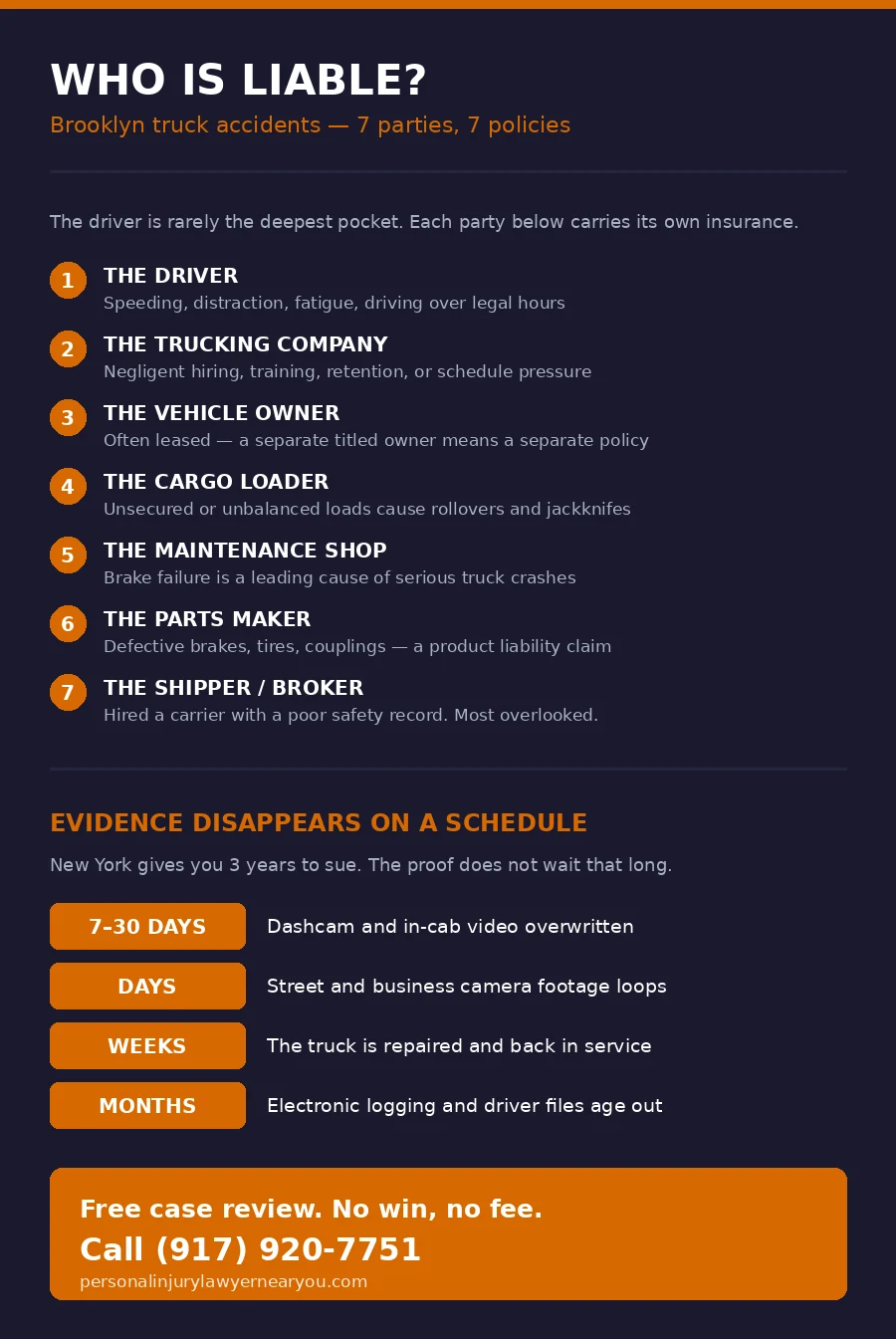
1. The driver
Speeding, distraction, impairment, driving beyond legal hours, or simply failing to account for a loaded vehicle’s stopping distance. The driver’s own conduct is the starting point, though rarely the endpoint.
2. The trucking company
Under New York’s respondeat superior doctrine, an employer is responsible for an employee’s negligence within the scope of employment. Beyond that, carriers face direct claims for negligent hiring, inadequate training, negligent retention of a driver with a known record, and pressuring drivers to meet schedules that force hours-of-service violations. This is usually the deepest pocket in the case.
3. The vehicle owner
Trucks are frequently leased rather than owned by the carrier operating them. The titled owner can carry separate liability, and identifying the lease structure often uncovers an additional policy nobody mentioned.
4. The cargo loader
Improperly secured or unbalanced loads cause rollovers and jackknifes, and shifting cargo is a common factor in truck wreck cases. When a third-party warehouse or terminal loaded the trailer, that company can be liable independently of the driver.
5. The maintenance contractor
Brake failure is one of the most common mechanical causes of serious truck collisions. If an outside shop performed or skipped the inspection, its records — and its insurance — come into play.
6. The parts manufacturer
Defective brakes, tires, couplings, or steering components support a product liability claim against the manufacturer, which sits entirely outside the trucking company’s insurance.
7. The shipper or freight broker
A broker who hired a carrier with a poor safety record, or a shipper who imposed an impossible delivery window, can face a negligent selection claim. This is the most overlooked defendant in the chain.
The Federal Rules That Often Decide Fault
Most truck cases are won on documents rather than eyewitness accounts, and the most important documents are created by federal mandate.
Under 49 CFR Part 395, a commercial driver may not drive without first taking ten consecutive hours off duty, and may not drive after fourteen consecutive hours following that break. Since December 2017, most drivers must record this electronically rather than on paper.
That electronic logging device requirement is a gift to injury claims, for one specific reason: the rules are built so that the original record cannot be altered. Edits are limited, and the underlying data survives them. The regulations also prohibit destroying, defacing, or altering supporting documents. A carrier that pushed a driver past legal hours leaves a trail it cannot quietly erase — but only if someone demands the data before the retention period runs out.
Federal hours-of-service guidance from FMCSA explains the framework in plain terms.
Evidence That Disappears on a Schedule
This is the single most damaging thing about waiting.
- Dashcam and in-cab video — often overwritten within 7 to 30 days
- Electronic logging data — retained for a limited statutory period, not indefinitely
- Driver qualification and drug testing files — retention limits apply
- The truck itself — repaired and back in service within weeks, destroying physical evidence
- Traffic and business camera footage along Atlantic Avenue or the BQE — often looped within days
A spoliation letter demanding preservation has to reach the carrier before these windows close. New York’s three-year statute of limitations is not the deadline that decides your case — the retention schedule is.
The Type of Truck Changes the Case
Not every commercial vehicle claim works the same way.
Tractor-trailers and 18-wheelers carry the highest federal minimum coverage and the most regulatory documentation, which usually makes them the strongest cases. Box trucks and delivery vehicles — increasingly common on Brooklyn residential streets — often involve drivers classified as contractors, which turns the employment relationship into a contested issue and can bring the parent logistics company into the claim. Tow trucks, tankers, and construction vehicles add specialised licensing and hazardous-material rules that create additional grounds for liability.
Vehicle type also drives valuation. Because commercial policies dwarf personal auto limits, truck cases routinely settle far above ordinary crashes — our breakdown of truck accident settlements in New York covers realistic ranges, and you can run your own figures through our free personal injury settlement calculator.
What New York’s 2026 Reform Changed
One update matters here, because truck defendants will use it.
New York previously applied pure comparative negligence, meaning you recovered even at ninety percent fault, reduced by your share. Part EE of Chapter 58 of the Laws of 2026 added CPLR § 1411(b), a modified rule for motor vehicle personal injury actions: a plaintiff found mostly at fault is now barred from recovering non-economic damages in those cases. Below that line, your award is still reduced by your exact percentage.
The same reform eliminated the 90/180-day serious injury category. Practically, this means the fault percentage is now worth fighting over in a way it was not before — and it is another reason the carrier’s investigators want their version of events established first. Note that the change applies based on when the action is commenced, not when the crash happened.
Frequently Asked Questions
Can I sue the trucking company and not just the driver?
Yes, and in most cases you should. Under respondeat superior the employer is responsible for an employee’s negligence within the scope of employment, and carriers also face direct claims for negligent hiring, training, supervision, and scheduling. The company almost always carries far higher coverage than the driver.
What if the truck driver was an independent contractor?
Carriers frequently argue this to avoid liability, and it is one of the most contested issues in delivery truck and box truck claims. Courts look at the actual working relationship — who controlled routes, schedules, equipment, and standards — rather than the job title on paper. A contractor label does not automatically defeat a claim against the company.
How long do I have to file a Brooklyn truck accident claim?
Three years from the date of injury for a personal injury lawsuit in New York, two years for wrongful death. If a City or MTA vehicle is involved, a Notice of Claim is generally due within 90 days. But the practical deadline is much shorter, because logging data and camera footage are governed by retention schedules measured in weeks and months.
The trucking company’s insurer already called me. Should I give a statement?
Not before you understand your own claim. Recorded statements taken early, while you are medicated and before the full extent of your injuries is known, are routinely used to argue that you downplayed symptoms or accepted partial blame. You are not obligated to give one to the other side’s insurer.
What if I was partly at fault for the crash?
You can still recover, but the 2026 reform made this more consequential. Your award reduces by your percentage of fault, and a plaintiff found mostly at fault can no longer recover non-economic damages in a motor vehicle case. The percentage itself is negotiable and heavily disputed, which is exactly why the carrier moves fast to shape the record.
Key Takeaways
✅ Up to seven parties can be liable — the driver is rarely the most valuable one
✅ Federal hours-of-service and logging rules create evidence that cannot be quietly altered
✅ Dashcam footage can be overwritten in as little as 7 days
✅ Delivery and box truck claims turn on the contractor question
✅ The 2026 reform makes your fault percentage worth fighting over
Hit by a Truck in Brooklyn?
The carrier’s investigators may already have the scene documented. A Brooklyn truck accident attorney can send preservation letters for the logging data and camera footage, identify every party in the contracting chain, and reach the commercial policies behind the driver. The case review is free, and there is no fee unless you win. The same urgency applies to any Brooklyn car accident lawyer case, but the evidence windows here are shorter, and a Brooklyn personal injury claim against a commercial carrier rarely resolves without one.
Get Connected With a Brooklyn Truck Accident Lawyer Today
Free case review. No win, no fee. No upfront cost.
Want more NYC injury guides and legal news from PILNY in your Google results?
