
TL;DR — Quick Summary
If an Amazon, FedEx, or UPS delivery truck hit you in Queens, the driver is almost never the only party responsible. Amazon uses a “Delivery Service Partner” (DSP) contractor model designed to push liability onto a small company with a $1 million insurance floor — while Amazon itself hides behind the “independent contractor” label. But that shield is cracking: juries recently returned $16.2 million (Georgia) and $44.6 million (South Carolina) verdicts against Amazon for DSP-driver crashes. This guide explains who you can really sue, what Redditors get right and dangerously wrong, and the Queens-specific deadlines that can quietly end your claim.
Hit by a delivery truck in Queens? The single most important thing to understand is this: the person who hit you probably does not work for the company on the side of the van. When an Amazon, FedEx, or UPS truck causes a crash in Queens, liability can run through the driver, a delivery contractor, and the national brand all at once. That is exactly why a delivery truck accident lawyer in Queens starts by figuring out which parties to name — the difference between a claim worth a small insurance payout and one worth something far larger.
This is exactly the question that fills injury subreddits. Search r/personalinjury or r/legaladvice for “hit by an Amazon van” and you’ll see the same confusion again and again — people told they can “just sue Amazon,” and others insisting “you can’t, the driver’s a contractor.” Both are half-right, and in New York the details matter more than either camp realizes.
Why You Need a Delivery Truck Accident Lawyer in Queens
Queens is one of the busiest delivery corridors in the country. Amazon DSP hubs feed thousands of vans onto residential streets in Flushing, Jamaica, Astoria, Jackson Heights, and Queens Village every day, while JFK and LaGuardia keep the freight and cargo lanes packed. More delivery vehicles means more delivery crashes — and delivery-vehicle claims follow different rules than a two-car fender-bender.
The core difference is the corporate structure sitting behind the driver. In a normal crash, you deal with one driver and one insurer. In a delivery crash, you may be dealing with a driver, the contractor that employs them, and a multibillion-dollar brand that carefully arranged its business so it can say “not our driver.” Knowing how to pierce that arrangement is the whole game — and it works much like liability in any other New York truck accident, only with an extra corporate layer.
Who Is Actually Liable When a Delivery Truck Hits You in Queens?
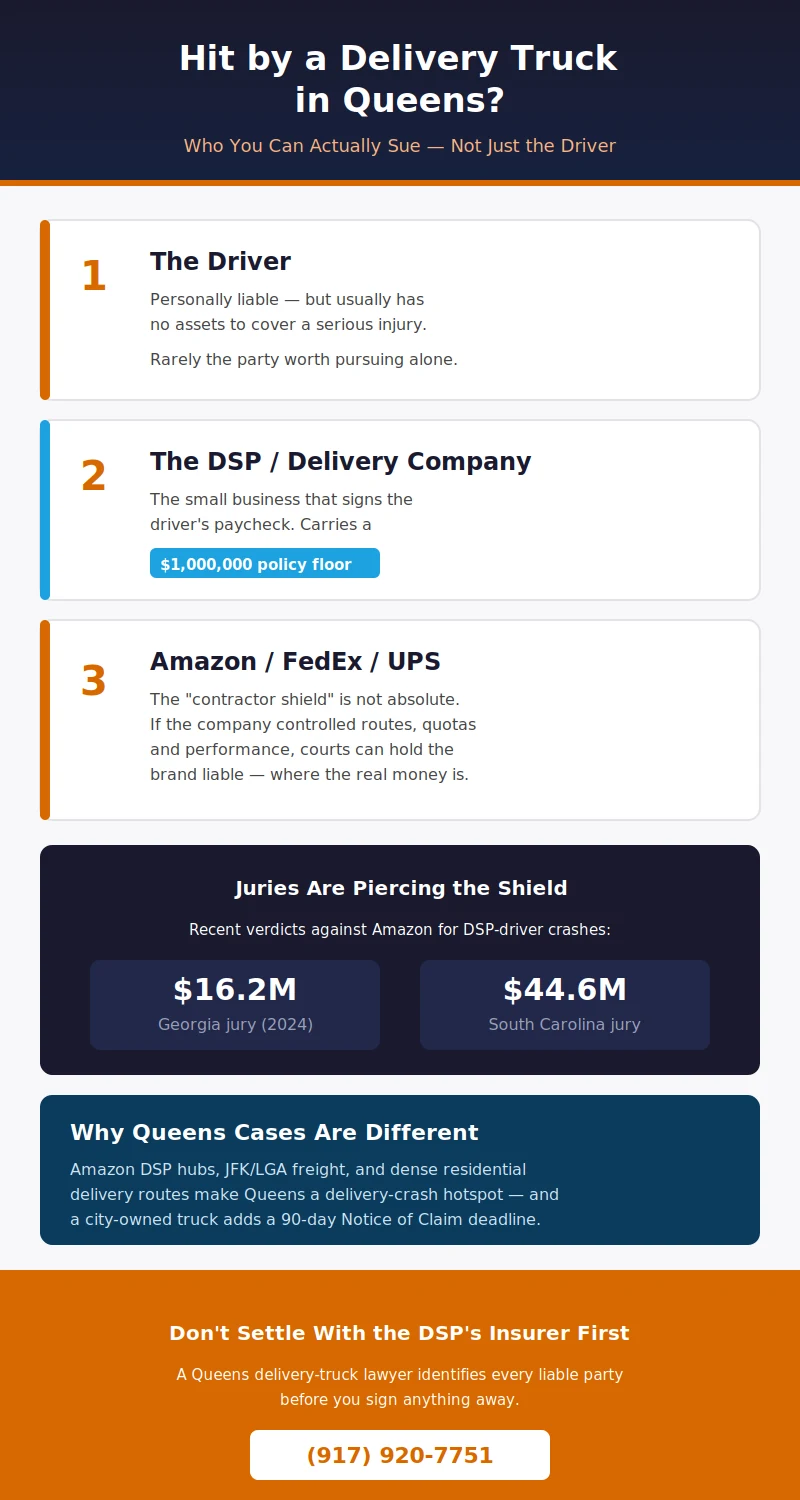
There are usually three layers of potential responsibility, and a strong claim considers all of them:
1. The Driver
The driver who caused the crash is personally liable regardless of who employs them. But suing the driver alone rarely makes sense — most delivery drivers have no assets to cover a serious injury. They are the starting point, not the destination.
2. The Delivery Service Partner (DSP) or Contractor
Most Amazon vans in Queens are operated by a “Delivery Service Partner” — a small, separate company that hires the drivers and signs their paychecks. DSPs are required to carry $1 million in accident insurance, so if your claim stops at the DSP, that policy is typically the ceiling. For a serious injury, that is often not enough.
3. Amazon, FedEx, or UPS Itself
This is the layer that changes everything. Amazon designed its three-tier structure — DSPs, Amazon Flex gig drivers, and a small number of direct employees — specifically to shield itself from liability when its drivers crash. But courts are increasingly rejecting that shield. When there is evidence that Amazon controlled the routes, the delivery quotas, the performance metrics, and the safety requirements, courts can find that the driver was Amazon’s agent in substance even if not in name — making the brand directly liable. FedEx and UPS raise similar questions depending on whether the driver was a direct employee or a contracted operator.
What Reddit Gets Right — and Dangerously Wrong
What Redditors get right: the instinct that Amazon should be on the hook. Threads across r/personalinjury regularly point out that Amazon “runs the operation down to the minute” even though a DSP signs the checks — and legally, that observation is exactly the pressure point a good case is built on.
What Redditors get dangerously wrong: two things. First, the confident “you can’t sue Amazon, it’s a contractor” replies — that is the argument Amazon’s lawyers want you to believe, and juries have repeatedly rejected it. Second, out-of-state advice. A Redditor in another state has no idea that New York’s no-fault system and its serious-injury threshold change your case before you ever get to the question of who to sue. Reddit is useful for understanding the process; it is a terrible place to value your Queens claim.
The proof is in the verdicts. Juries recently returned a $16.2 million verdict against Amazon in Georgia (2024) and a $44.6 million verdict in South Carolina after finding the company vicariously liable for a DSP driver’s negligence, and a California appellate court allowed a DSP-driver case to proceed against Amazon in 2023. The “just a contractor” defense is losing — but only for victims whose lawyers built the control evidence. For how the contractor structure differs between Amazon, FedEx Ground, UPS and gig platforms, and why double-parked vans cause so many crashes, see our guide to delivery truck accident claims in Brooklyn.
The Evidence That Wins Delivery-Truck Cases
Because the whole fight is about control, the evidence that matters is the paper trail showing how much the brand ran the driver’s day:
- The DSP contract between the delivery company and Amazon
- Amazon’s route and dispatch data and delivery-quota requirements
- Telematics and on-board camera data tracking speed and driving behavior
- The driver’s employment, training, and disciplinary records
- Communications between Amazon logistics managers and the DSP about delivery targets
This evidence sits with the companies, and it does not stay available forever. That is why the same rule that governs every truck case applies here: what you do after a truck accident in New York in the first days — especially sending a preservation letter — often decides the case.
Queens-Specific Deadlines That Can End Your Claim
New York’s rules apply to every delivery crash in Queens, and two deadlines catch victims off guard:
- The 30-day no-fault deadline. You must file your NF-2 no-fault application within 30 days of the crash to keep up to $50,000 in medical and lost-wage benefits.
- The 90-day Notice of Claim. If a city-owned truck — a DSNY sanitation truck, a DOT vehicle, or an MTA truck — was involved, you have as little as 90 days to file a formal notice, far shorter than the three-year deadline for suing a private company.
- The 2026 fault rule. In lawsuits started on or after May 26, 2026 — even over earlier crashes — a claimant whose share of fault is greater than the defendants’ combined share cannot recover pain and suffering in a no-fault motor vehicle case. Delivery companies often argue that a pedestrian stepped out between parked vans, so the fault split matters more than ever.
Delivery cases also frequently involve injured pedestrians and children on residential streets, where New York applies special protections. If your child was hurt, the filing timeline works differently and any settlement must be court-approved — another reason not to rely on a generic Reddit checklist. For the full local picture, our Queens truck accident lawyer page breaks down how these claims are handled borough-wide.
What to Do After a Queens Delivery-Truck Crash
The moves that protect a delivery-truck claim are specific:
- Photograph the van’s branding, license plate, and any DSP company name or number — the brand on the van and the company that employs the driver are often different
- Get the driver’s name and the delivery company’s name separately
- Look for witnesses — Queens delivery routes are busy and witnesses scatter fast
- Get medically examined the same day, even if you feel fine
- Do not give a recorded statement to any insurer, and do not accept a fast DSP settlement offer before your injuries have fully surfaced
If you want a realistic sense of what your case could be worth before anyone puts a number in front of you, our free personal injury settlement calculator is a good starting point.
Frequently Asked Questions
Can I sue Amazon if a DSP driver hit me in Queens?
Sometimes yes. Amazon will argue the driver works for an independent contractor (the DSP), not for Amazon. But if your lawyer can show Amazon controlled the driver’s routes, schedules, quotas, and performance, courts can hold Amazon directly liable. Recent jury verdicts of $16.2 million and $44.6 million against Amazon show the “independent contractor” defense does not always work.
How much insurance does an Amazon delivery van carry?
DSP vehicles are generally required to carry $1 million in accident insurance. If your claim is only against the DSP, that policy is usually the maximum recovery. Reaching Amazon’s much larger resources requires proving Amazon’s control over the driver, which is why identifying every liable party early matters so much.
Is Reddit a reliable place to figure out my delivery-truck claim?
Use it for perspective, not for valuation. Reddit is helpful for understanding how these cases work and hearing real experiences, but most answers come from people in other states under different laws. New York’s no-fault system, serious-injury threshold, and 90-day municipal deadline change your Queens case in ways most Redditors never account for.
What if a FedEx or UPS truck hit me instead of Amazon?
The analysis is similar but the employment structure differs. Some FedEx and UPS drivers are direct employees, which can make the company vicariously liable more straightforwardly, while others are contracted operators, which raises the same control questions as Amazon’s DSP model. A lawyer will investigate the driver’s exact employment relationship before naming defendants.
What if my child was hit by a delivery truck in Queens?
Claims involving children follow different rules in New York. The statute of limitations is generally paused until the child turns 18, but the truck and delivery evidence still disappears on the same fast timeline, so acting early still matters. Any settlement for a minor must also be approved by the court to protect the money until adulthood.
Key Takeaways
✅ The driver, the DSP contractor, and the brand (Amazon/FedEx/UPS) can all share liability — the driver alone is rarely enough
✅ DSP vans carry a $1M insurance floor; reaching Amazon’s resources requires proving Amazon’s control over the driver
✅ Recent $16.2M and $44.6M verdicts show the “independent contractor” shield is cracking
✅ Reddit is good for perspective, useless for valuing a New York claim — no-fault and serious-injury rules change everything
✅ File your NF-2 within 30 days; a city-owned truck adds a 90-day Notice of Claim deadline
Hit by a Delivery Truck in Queens? Find Out Who You Can Really Sue
The DSP’s insurer wants to settle fast and keep Amazon’s name out of it. A delivery-truck lawyer identifies every liable party — driver, contractor, and brand — and builds the control evidence before it disappears. The review is free, and there is no fee unless you win.
Get Connected With a Queens Delivery-Truck Accident Lawyer Today
Free case review. No win, no fee. No upfront cost.
Want more NYC injury guides and legal news from PILNY in your Google results?
