
TL;DR — Quick Summary
Yes, in many cases. Most states reduce your compensation by your share of the blame rather than barring the claim. In New York, most injury claims still follow pure comparative fault, so even a mostly-at-fault person can recover something. But since May 26, 2026, car crash lawsuits follow a new rule: if you were more at fault than the other side, you recover nothing for pain and suffering. Your own no-fault coverage still pays medical bills and lost wages regardless of who caused the crash.
Can I claim personal injury if I was at fault? It is one of the first questions people ask after an accident, usually right after an adjuster suggests the crash was partly their fault. The honest answer: often yes, but your share of the blame decides how much you can recover, and in some situations whether you can recover at all.
This guide explains how fault is divided, what changed in New York in 2026, and how to protect a claim when you share some of the responsibility.
Partial Fault Rarely Ends a Claim
Accidents are seldom one person’s fault alone. A driver may have been speeding a little while the other ran a red light. A shopper may have been looking at a phone when they slipped on a spill that should have been cleaned up. Courts and insurers deal with this by dividing fault in percentages, then adjusting the compensation to match.
How that adjustment works depends on the state, and in New York it now depends on the type of case too.
The Four Fault Systems in the US
| System | How it works | Where |
|---|---|---|
| Pure comparative fault | Award reduced by your share of fault; never barred | New York (most claims), California, Florida and others |
| Modified comparative (50% bar) | Barred if your fault is 50% or more | Several states, such as Colorado and Georgia |
| Modified comparative (51% bar) | Barred if your fault is greater than the other side’s | Most states, and now New York car crash lawsuits |
| Contributory negligence | Barred if you were even 1% at fault | Alabama, Maryland, North Carolina, Virginia and Washington, D.C. |
Only a handful of jurisdictions still use the harsh contributory negligence rule. Most states use some form of comparative fault, and the question becomes where the cut-off sits.
How Fault Works in New York Now
Most injury claims: pure comparative fault
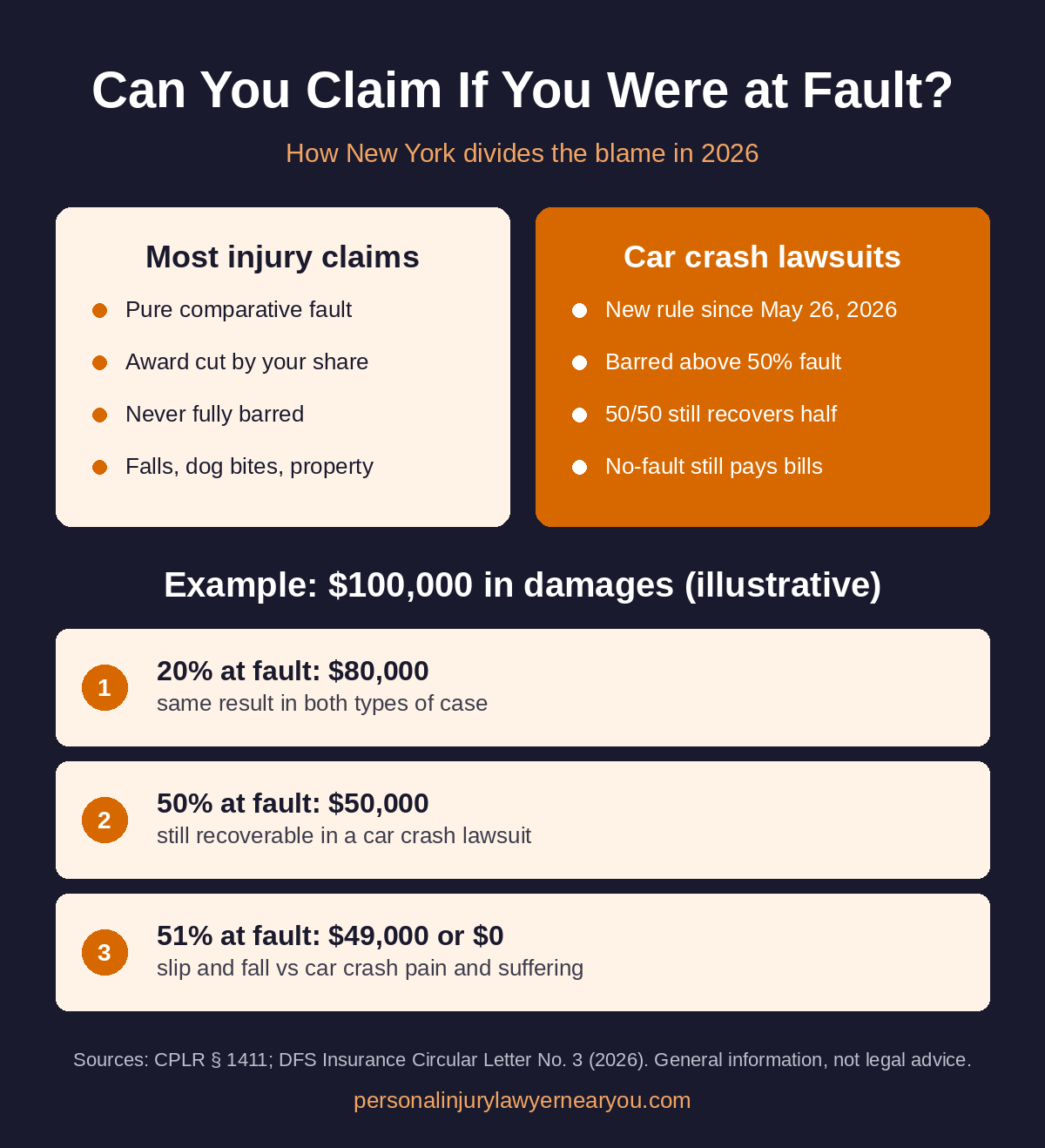
For slip and falls, dog bites, defective property and most other injury claims, New York still applies pure comparative fault under CPLR § 1411. Your award is reduced by your percentage of fault, but it is never wiped out. If you were 70% at fault for a fall, you can still recover 30% of your damages. Our guide to trip and fall vs slip and fall shows how fault arguments differ between the two.
Car crash lawsuits: the new 2026 bar
Since May 26, 2026, lawsuits arising from motor vehicle accidents follow a modified rule. According to DFS Insurance Circular Letter No. 3 (2026), the new CPLR § 1411(b) bars recovery when the injured person’s fault is greater than the combined fault of the people they are suing. At exactly 50/50 you can still recover half; at 51% you recover nothing for pain and suffering.
That is why fault arguments in car and truck cases have become sharper. We cover how it plays out on the street in our guide to where the new 50% fault bar bites.
What You Can Still Claim If You Were at Fault
Even when your share of blame is high, some money is usually still available:
- No-fault (PIP) benefits. After a car crash in New York, your own policy pays medical bills and part of your lost wages up to $50,000 regardless of who caused it. See how New York no-fault insurance works and why the 30-day filing deadline matters.
- A reduced award in non-car cases. Under pure comparative fault, a fall or premises claim keeps its value minus your percentage.
- A claim against more than one party. Fault is compared against everyone you sue combined, so adding a second responsible party, such as a vehicle owner or employer, can change the math.
There is also a separate limit in car cases. A person who was at fault and was driving uninsured, was convicted of impaired driving, or was committing a felony faces a $100,000 cap on non-economic damages, even if they clear the fault bar.
How Fault Percentages Are Decided
| Evidence | Why it matters |
|---|---|
| Police report | Officer’s notes and any tickets issued, though not the final word on fault |
| Video | Dashcam, traffic and store cameras often settle disputes outright |
| Witnesses | Independent accounts carry more weight than either party’s |
| Physical evidence | Vehicle damage, skid marks and the hazard itself |
| Traffic and safety rules | Breaking a rule such as failing to yield can shift fault heavily |
Rear-end crashes are a good example of how presumptions work: the rear driver is usually assumed to be at fault, but not always. Our breakdown of who is at fault in a rear-end collision in NYC explains the exceptions.
Protecting a Claim When You Share the Blame
- Do not admit fault at the scene, to the police, or to the other driver’s insurer. Stick to facts.
- Be careful with recorded statements. Adjusters often ask questions designed to push your percentage up. Know what not to say to an insurance adjuster before the call.
- Collect evidence early. Dashcam and store video, witness names and photos of the scene can move a fault split by 10 or 20 points.
- Get treated and keep records. Fault reduces your damages, so every documented loss matters more, not less. See the full list of damages you can recover in New York.
Example: How a Fault Split Changes the Payout
Take an illustrative injury with $100,000 in total damages:
| Your share of fault | Slip and fall (pure comparative) | Car crash lawsuit (new 2026 rule) |
|---|---|---|
| 20% | $80,000 | $80,000 |
| 50% | $50,000 | $50,000 |
| 51% | $49,000 | $0 for pain and suffering (no-fault still pays medical bills and lost wages) |
The difference between 50% and 51% fault in a car case is the whole pain-and-suffering award, which is why insurers fight hard over a few percentage points. If you were hurt in a crash on Staten Island, where many of these cases now turn on fault, a Staten Island car accident lawyer can review the evidence before you accept any split.
Frequently Asked Questions
Can I claim personal injury if I was at fault?
Often yes. Most states reduce your compensation by your percentage of fault instead of barring the claim. In New York, most injury claims follow pure comparative fault, but car crash lawsuits filed since May 26, 2026 are barred if you were more at fault than the other side.
What happens if I was 50% at fault in New York?
In a New York car crash lawsuit, you can still recover half of your damages at exactly 50% fault. You are barred only if your fault is greater than the combined fault of the people you are suing. In most other injury cases, a 50% share simply cuts your award in half.
Does no-fault insurance pay if the accident was my fault?
Yes. New York no-fault coverage pays medical bills and part of your lost wages up to $50,000 regardless of who caused the crash. You must file your application within 30 days.
Who decides how much of the accident was my fault?
Insurance adjusters assign fault percentages during settlement talks, and a jury decides if the case goes to trial. Evidence such as video, witness accounts and the police report usually drives the numbers.
Should I admit fault after an accident?
No. Stick to the facts with the police and insurers and let the evidence decide fault. A casual apology or guess at the scene can be used to raise your share of the blame.
Can I still sue if I was partly at fault in a slip and fall?
Yes. New York’s pure comparative fault rule still applies to slip and fall and other premises cases, so your award is reduced by your share of fault but not eliminated.
Key Takeaways
✅ Sharing the blame usually reduces a claim rather than ending it
✅ Most New York injury claims still use pure comparative fault
✅ Since May 26, 2026, car crash plaintiffs who are more at fault than the defendants are barred
✅ No-fault pays medical bills and lost wages whoever caused the crash
✅ Never admit fault; evidence decides the percentages
Partly at Fault? Get the Split Checked
A few percentage points can be the difference between a fair settlement and nothing. A free case review looks at the evidence, the rule that applies to your case, and whether the fault split the insurer is offering holds up.
Blamed for the Accident? Find Out Where You Stand
Free case review. No win, no fee. No upfront cost.
Want more NYC injury guides and legal news from PILNY in your Google results?
