
TL;DR — Quick Summary
A Brooklyn truck driver injury claim usually runs on two tracks at once, and most drivers only find out about the second one late. Workers’ compensation covers medical treatment and a portion of lost wages regardless of fault — but pays nothing for pain and suffering, and generally bars suing your own employer. A third-party lawsuit against whoever actually caused the crash does cover pain and suffering, and the two proceed together. The trap: under WCL § 29(5), settling that third-party case without the comp carrier’s written consent or a court order can forfeit your future benefits entirely.
Most of what gets written about truck accidents is written for the person the truck hit. Very little is written for the person driving it.
That is a real gap, because Brooklyn runs on commercial drivers — the terminals in Red Hook and Sunset Park, the distribution traffic feeding the borough’s warehouses, the box truck and delivery routes threading residential streets all day. When one of those drivers is hurt, the advice they get is almost always incomplete: file for workers’ comp and wait. That is half the claim, and usually the smaller half.
What Workers’ Comp Gives You — and What It Takes Away
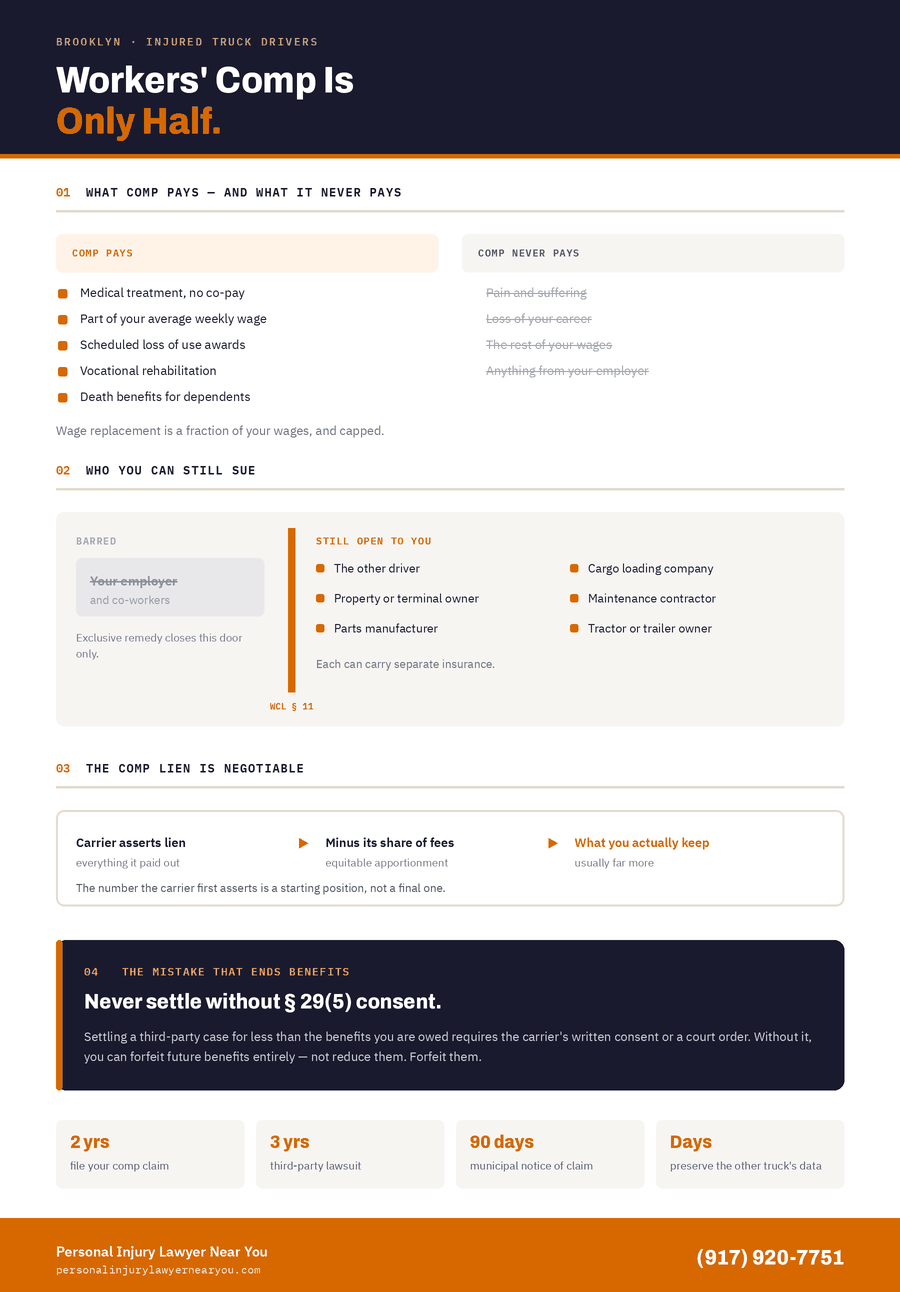
Workers’ compensation is a trade. You get benefits without having to prove anyone was at fault, including yourself. In exchange, you give up the right to sue your employer.
What the New York State Workers’ Compensation Board system covers:
- Medical treatment for the work-related injury, with no deductible or co-pay to you
- Wage replacement — a percentage of your average weekly wage, subject to a statutory maximum
- Scheduled loss of use awards for permanent impairment to specified body parts
- Vocational rehabilitation where you cannot return to driving
- Death benefits for surviving dependents
What it does not cover is the part drivers care most about. There is no compensation for pain, for suffering, for the loss of a career you spent twenty years building, or for what a spinal injury does to the rest of your life. Wage replacement is a fraction of your wages and capped — which for a driver earning well on long routes or overtime often means a serious gap between the benefit and the bills.
The exclusive remedy rule under Workers’ Compensation Law § 11 is what closes the door on suing your employer. It does not close the door on anyone else.
The Third-Party Claim Almost Nobody Mentions
If someone other than your employer or a co-worker caused your injuries, you can sue that party directly — and that claim carries the full range of damages comp excludes.
In a Brooklyn truck driver’s case, the third party is often:
- The other driver who caused the collision
- A cargo loading company whose improperly secured or unbalanced load shifted, caused a rollover, or fell on you
- The property owner or terminal operator where you were injured loading, unloading, or walking the yard
- A maintenance contractor that performed or skipped the work behind a brake or steering failure
- The manufacturer of a defective component, in a product liability claim
- A separate company that owns the trailer or the tractor you were assigned
That last category is why the corporate structure matters so much here. A driver employed by one company can frequently sue several others in the same freight chain without touching the exclusive remedy bar — our guide to who is liable in a Brooklyn truck accident maps every entity in that chain, and the analysis works the same way whether you were in the truck or in front of it.
A Brooklyn truck accident lawyer works both claims in parallel, because decisions in one directly affect the other.
The Lien: Why Your Comp Carrier Cares About Your Lawsuit
Here is where drivers get blindsided. Your workers’ compensation carrier has a statutory lien on your third-party recovery under WCL § 29. Everything it paid out — medical, wage benefits, awards — it can claim back from your settlement.
The lien is real, but it is not absolute, and this is where good representation is worth money rather than costing it. New York applies an equitable apportionment rule: because the carrier benefits from a recovery it did not pay to obtain, its lien is reduced by its proportionate share of the litigation costs and attorney’s fees that produced the result. Where future benefits are involved, the carrier’s credit against those benefits is subject to the same apportionment.
Practically, that means the number your carrier first asserts as its lien is rarely the number it ends up collecting. Negotiating it down is standard work, and it changes what actually lands in your pocket more than almost any other single step.
The § 29(5) Trap That Ends Benefits Permanently
This is the most damaging mistake an injured driver can make, and it is made by people acting entirely reasonably.
Under WCL § 29(5), if you settle your third-party case for an amount less than the compensation benefits you are entitled to, you must obtain either the written consent of the compensation carrier before settling, or a court order approving the settlement — with a limited window to seek that approval after the fact.
Settle without it, and you can forfeit your right to future compensation benefits. Not reduce them. Forfeit them. A driver who accepts a quick offer from the other driver’s insurer to cover immediate bills can extinguish years of medical coverage for a spinal injury in the process — and will usually have no idea until the benefits stop.
No third-party settlement in a comp case should be accepted without the consent question being resolved first. There is no informal version of this step.
Owner-Operators and the Contractor Problem
If you are an owner-operator or lease-purchase driver, you may have been told you are not entitled to workers’ compensation at all. Treat that as a claim to be tested, not a fact.
New York looks at the substance of the working relationship rather than the label on the agreement — who controlled routes and schedules, who supplied and maintained the equipment, who set the rates, whether you could realistically work for anyone else. Drivers classified as contractors on paper are found to be employees often enough that the question is worth putting to the Workers’ Compensation Board rather than accepting.
Two things follow. Where the classification is genuine, occupational accident coverage or your own commercial policy may respond instead — and the third-party claim becomes the primary route to full compensation rather than a supplement. Where the classification is wrong, both claims are available. Either way, the third-party case is doing more work, which makes the evidence questions covered in our guide to truck black box data directly relevant to your own claim, not just to the person you collided with.
How the 2026 Reform Affects a Driver’s Third-Party Claim
Your comp claim is unaffected — it is no-fault by design and the 2026 legislation did not touch it. Your third-party motor vehicle claim is a different matter.
Two changes matter. The serious injury threshold under Insurance Law § 5102(d) still governs whether you can recover pain and suffering in a motor vehicle case, and the 2026 reform eliminated the 90/180-day category that previously helped claimants with temporarily disabling injuries. And under CPLR § 1411(b), a plaintiff found mostly at fault in a motor vehicle case can no longer recover non-economic damages at all.
For a professional driver, that second point deserves particular attention. Defense arguments in these cases lean hard on the driver’s training and experience — the implication being that a commercial driver should have anticipated and avoided what happened. Meeting that argument takes the same documentary evidence that drives any serious commercial claim, of the kind discussed in our guide for anyone dealing with a Brooklyn 18 wheeler accident.
Deadlines Running in Parallel
The two claims have separate clocks, and missing one does not excuse the other.
- Notify your employer of a work injury in writing, promptly — the statutory window is short
- File your comp claim with the Workers’ Compensation Board within two years of the accident
- Three years for a third-party personal injury lawsuit
- 90 days for a Notice of Claim if a municipal vehicle or City property is involved
- Days, not months, for preserving the other vehicle’s data and any camera footage
Before accepting any figure from either side, it is worth working through what the combined claim is realistically worth using our free personal injury settlement calculator.
Frequently Asked Questions
Can I sue my trucking company if I was injured on the job?
Generally no. Workers’ Compensation Law § 11 makes comp your exclusive remedy against your employer and co-workers for a work-related injury. Narrow exceptions exist, including intentional conduct and situations where an employer failed to secure coverage. What the rule does not bar is a claim against any other company that contributed to your injuries.
Can I receive workers’ comp and file a lawsuit at the same time?
Yes, and in most serious cases you should. Comp covers medical treatment and partial wages while the third-party case proceeds. The two are connected through the carrier’s lien on your recovery, so they need to be managed together rather than by separate people who do not speak to each other.
Will the comp carrier take my whole settlement?
Rarely. The lien covers what the carrier paid out, but New York reduces it by the carrier’s equitable share of the attorney’s fees and litigation costs that produced the recovery. The same apportionment applies to the carrier’s credit against future benefits. The lien as first asserted is a starting position, not a final number.
What happens if I settle my case without telling the comp carrier?
You risk forfeiting future compensation benefits entirely. WCL § 29(5) requires the carrier’s written consent or a court order where the settlement is for less than the benefits you are entitled to. This is the single most costly mistake injured drivers make, and it is usually irreversible once the settlement is signed.
I am an owner-operator. Do I have any coverage?
Possibly more than you have been told. Classification as a contractor is not conclusive in New York, and the Workers’ Compensation Board examines the real working relationship. Where the classification holds, occupational accident coverage or your own policies may respond, and the third-party claim becomes the main route to full compensation.
Does no-fault insurance apply if I was hurt driving for work?
Generally workers’ compensation is primary for an injury sustained in the course of employment, so it covers the medical and wage benefits that no-fault would otherwise provide. The serious injury threshold still applies to your third-party claim against the at-fault driver, which is a separate question from which system pays your treatment.
I was hurt loading or unloading, not driving. Does that change anything?
It can broaden your options. Injuries at a terminal, warehouse, or delivery site can support a claim against the property owner or the loading company, and depending on the circumstances New York’s Labor Law provisions covering construction and elevation-related work may come into play. These claims turn heavily on the specific facts and the site, so they are worth reviewing properly rather than assuming comp is all that is available.
Key Takeaways
✅ Comp pays medical and partial wages — never pain and suffering
✅ The exclusive remedy bar covers your employer only, not the rest of the freight chain
✅ The carrier’s lien is reduced by its share of the fees that won the case
✅ Settling without § 29(5) consent can forfeit future benefits permanently
✅ Contractor classification is testable, not final
Start Your Brooklyn Truck Driver Injury Claim
Filing for comp and waiting is what most drivers are told to do, and it leaves the larger claim on the table. A Brooklyn attorney can run both tracks together — protecting your benefits, negotiating the lien down, and pursuing the parties outside the exclusive remedy bar who actually caused your injuries. It follows the same framework as any Brooklyn personal injury claim, with a comp layer sitting over it. The case review is free, and there is no fee unless you win.
Talk to a Brooklyn Truck Driver Injury Lawyer Today
Free case review. No win, no fee. No upfront cost.
Want more NYC injury guides and legal news from PILNY in your Google results?
