
TL;DR — Quick Summary
Brooklyn truck black box data is the most persuasive evidence in a truck accident claim — and the least protected. There is no single black box: crash dynamics live on the engine control module, duty hours live on the electronic logging device, and they are entirely different records. The federal EDR regulation most people have read about, 49 CFR Part 563, applies only to light vehicles under 8,500 pounds — it does not cover the tractor-trailer that hit you. Heavy truck data is manufacturer-designed, with no federally mandated retention period, and a handful of engine restarts or one repair order can overwrite it permanently.
Almost every article about truck crash evidence says the same reassuring thing: the truck has a black box, and the black box will show what happened. That is roughly half true, and the missing half is where cases are lost.
If a commercial vehicle hit you on the BQE, Third Avenue, or an industrial stretch in Sunset Park, the data that could prove your version of events probably exists right now. Whether it still exists in six weeks depends almost entirely on what happens in the next few days.
There Is No Single “Black Box” on a Truck
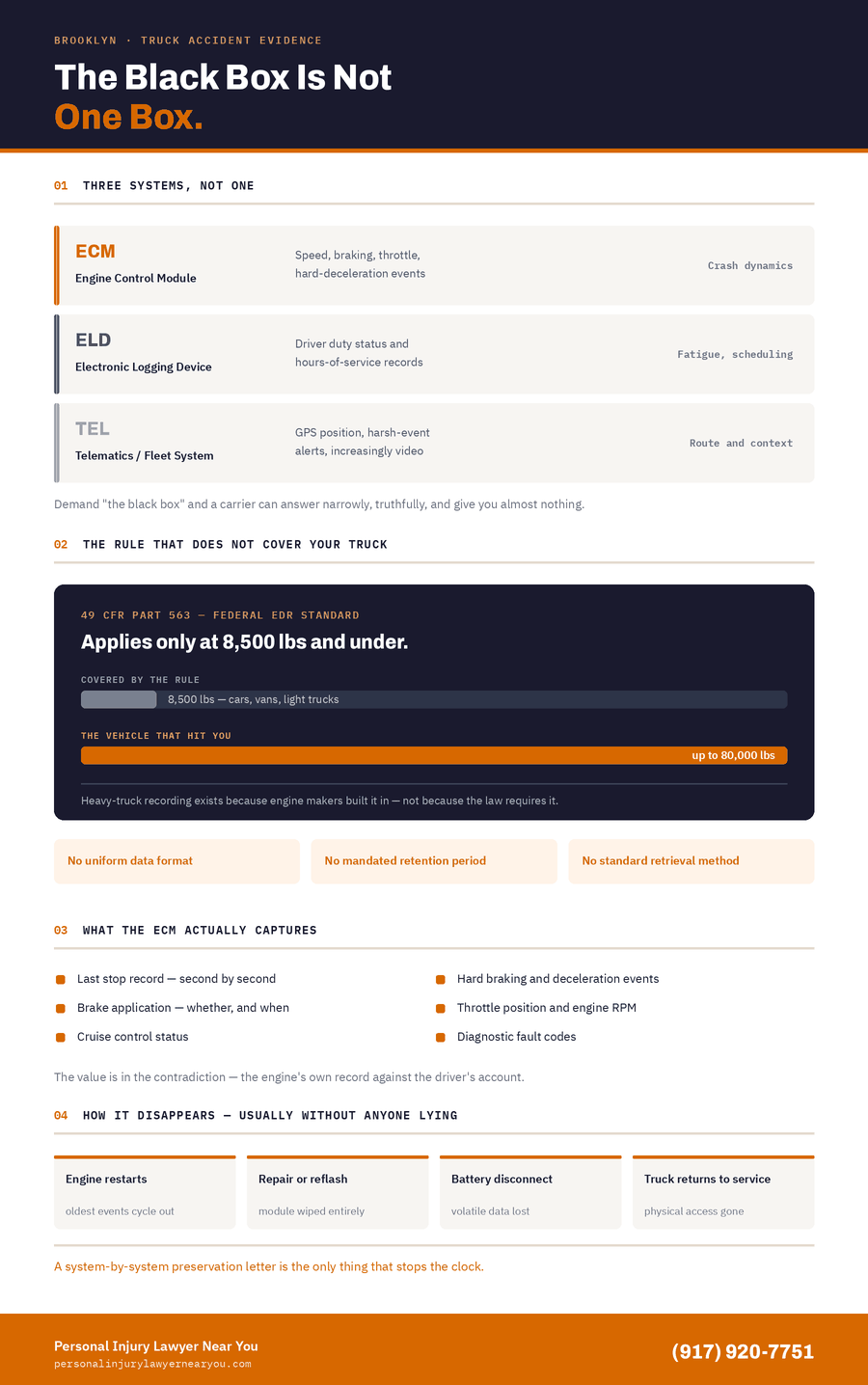
The phrase is borrowed from aviation and it misleads people badly. A commercial truck typically carries three separate data systems that record different things, retain them for different periods, and are obtained in completely different ways.
- The engine control module (ECM) — the engine’s own computer. This is the source of crash dynamics: speed, braking, throttle, and hard-deceleration events. When lawyers say “black box,” this is usually what they mean.
- The electronic logging device (ELD) — a separate system that records the driver’s duty status to enforce hours-of-service limits. It proves fatigue and scheduling violations, not collision mechanics.
- Telematics and fleet systems — third-party GPS and safety platforms that many carriers install, holding position, harsh-event alerts, and increasingly video.
A demand for “the black box” that does not specify which system, in which format, is a demand a carrier can answer narrowly and truthfully while handing over almost nothing. This is one of several reasons a Brooklyn truck accident lawyer drafts preservation demands system by system rather than generically.
The Regulation That Does Not Apply to Your Case
This is the single most misunderstood point in this area, and it is worth being precise about.
Under 49 CFR Part 563, the federal event data recorder rule sets standards for what an EDR must capture, how accurately, how it survives a crash, and how it can be retrieved. Those standards apply to passenger cars, multipurpose passenger vehicles, trucks and buses with a gross vehicle weight rating of 8,500 pounds or less. It is also an “if equipped” rule — it standardizes recorders that manufacturers choose to install rather than requiring them.
A loaded tractor-trailer runs to 80,000 pounds. Even a mid-size box truck clears that threshold comfortably. The regulation that guarantees standardized, retrievable, crash-survivable data simply does not reach the vehicle in most truck cases.
What that means practically: heavy truck ECM recording exists because engine manufacturers built it in for their own diagnostic and warranty purposes, not because Congress required it. There is no uniform data format, no mandated retention period, and no standard retrieval method. Each manufacturer’s system behaves differently, and what one records in detail another may not record at all.
What the ECM Actually Captures
Within those limits, the data is genuinely powerful — often decisive, because it contradicts a driver’s account with the engine’s own record.
Depending on the engine manufacturer and configuration, an ECM download can produce:
- Last stop record — a detailed snapshot of the seconds leading up to a sudden stop, typically including road speed second by second
- Hard braking and sudden deceleration events, with the conditions surrounding each
- Brake application — whether the driver braked at all, and when
- Throttle position and engine RPM across the same window
- Cruise control status, which speaks to attention and reaction
- Trip and idle data, useful for corroborating or contradicting logged duty hours
- Diagnostic fault codes that may reveal a mechanical problem the carrier knew about
The value is in the contradiction. A driver who reports braking hard when a car cut in front of him has a problem if the module shows no brake application and steady throttle. That single line of data can shift the entire fault allocation — which, since the 2026 reform, carries more weight than it used to.
How the Data Gets Destroyed — Usually Without Anyone Lying
Evidence in truck cases is rarely destroyed by someone deciding to destroy it. It is destroyed by ordinary fleet operations continuing as normal.
- Engine restarts overwrite. Many ECM systems hold a limited number of event records and cycle the oldest out. A truck driven back to a depot and put into service can overwrite the crash window within days.
- Repairs wipe the module. Replacing or reflashing an ECM during collision repair erases what was on it. So does replacing the engine.
- Power interruption. Disconnecting batteries during recovery or repair can lose volatile data on some systems.
- The truck leaves. Retrieval generally requires physical access with manufacturer-specific hardware and software. Once the vehicle is repaired, sold, or moved out of state, access becomes a fight in itself.
- Third-party video loops. Fleet camera footage is frequently overwritten in weeks, and the Brooklyn business and doorbell cameras that fill the gaps often loop in days.
By contrast, the duty-status record under 49 CFR Part 395 is comparatively well protected: the rules limit edits, preserve original records behind any changes, and prohibit destroying or altering supporting documents. The irony is that the fatigue evidence is durable while the collision evidence is not.
The Preservation Letter, and What Happens If It Is Ignored
The mechanism that stops the clock is a spoliation letter — written notice to the carrier and its insurer identifying each system by name and demanding that the vehicle and its data be preserved.
An effective letter does not ask for “the black box.” It identifies the ECM, the ELD and its supporting documents, the telematics provider, in-cab and outward-facing video, maintenance and inspection records, and it demands the tractor and trailer be held from repair long enough for an inspection and download.
Where a carrier receives that notice and destroys the evidence anyway, New York courts have real tools. Sanctions can extend to striking pleadings, precluding evidence, or instructing the jury that it may infer the missing data would have been unfavorable to the party that lost it. An adverse inference charge is sometimes worth more than the data itself — but it depends on showing the carrier was on notice, which is why the timing of the letter matters as much as its contents.
Identifying who must receive it is its own problem when a tractor, trailer, and cargo belong to different businesses. Our guide to who is liable in a Brooklyn truck accident maps the full contracting chain.
What Changes by Vehicle Type
The data picture is not uniform across the commercial vehicles moving through Brooklyn.
Long-haul tractor-trailers generally produce the richest record: a sophisticated ECM, a mandated ELD, and often a fleet safety platform with video — the combination discussed in our guide for anyone hit by a Brooklyn 18 wheeler. Local delivery vans sit at the other end: lighter vehicles may fall under the light-vehicle EDR rule after all, short-haul operations can be exempt from ELD requirements, and the richest evidence is often route telematics and package scan timestamps held by a contractor rather than the brand on the door — the structure covered for anyone needing a delivery truck accident lawyer in Brooklyn.
Knowing which category the vehicle falls into determines what to demand — and demanding the wrong thing wastes the only window there is.
What You Can Do in the First Week
You cannot download an ECM yourself, but you can protect the ability to do it later. The general steps in our guide on what to do after a truck accident in New York apply, with three additions specific to preserving data:
- Photograph the USDOT number, license plates, and any unit or fleet number on both the tractor and the trailer — they can belong to different companies
- Record the exact time of the collision, which is what makes ECM and telematics records locatable
- Do not wait for the police report before getting a preservation letter out — reports routinely take weeks, and the data does not
Frequently Asked Questions
Do all commercial trucks have a black box?
Most modern heavy trucks have an engine control module capable of recording crash-related data, but it is not federally required. The federal EDR regulation applies to vehicles rated at 8,500 pounds or less, which excludes tractor-trailers and most box trucks. What a particular truck recorded depends on its engine manufacturer, model year, and configuration.
How long does truck black box data last after a Brooklyn crash?
There is no mandated retention period for heavy truck ECM data. Depending on the system, records can be overwritten within days once the truck returns to service, and are erased outright if the module is replaced or reflashed during repair. This is why preservation notice measured in days matters more than the three-year statute of limitations.
Who owns the data, and can I just ask for it?
The data sits on a vehicle owned by the carrier, the owner-operator, or a leasing company, and they are under no obligation to hand it over voluntarily. Access normally comes through a preservation demand followed by an agreed inspection, or through a court order in litigation. Carriers rarely volunteer a download that hurts them.
Is the ELD the same thing as the black box?
No, and conflating them costs evidence. The electronic logging device records the driver’s duty status to enforce hours-of-service rules — it proves fatigue and scheduling pressure. The engine control module records what the vehicle was doing mechanically. Both matter, and they have to be demanded separately.
What happens if the trucking company destroys the data after being asked to keep it?
New York courts can impose sanctions for spoliation, ranging from precluding evidence to striking a party’s pleadings. A common remedy is an adverse inference instruction telling the jury it may assume the destroyed evidence would have been unfavorable to the party responsible. Establishing that the carrier was on notice before the loss is essential to obtaining it.
Can black box data hurt my case instead of helping it?
It can, and an honest assessment accounts for that. Data showing sudden braking by your own vehicle or an unexpected speed can support the carrier’s fault argument. That is a reason to understand the record early rather than to avoid it, particularly now that a plaintiff found mostly at fault in a motor vehicle case cannot recover non-economic damages.
The truck was already repaired. Is my claim over?
No. Loss of ECM data is a setback, not an ending. Duty-status records, maintenance and inspection files, telematics held by a third-party provider, dashcam footage, roadway and business cameras, and witness accounts all remain available — and if the repair happened after a preservation demand, the destruction itself becomes an issue in your favor.
Key Takeaways
✅ A truck carries several data systems, not one black box
✅ The federal EDR rule covers light vehicles only — not tractor-trailers
✅ Heavy truck ECM data has no mandated retention period
✅ Restarts, repairs, and reflashes overwrite the crash record within days
✅ A system-by-system preservation letter is what stops the clock
Brooklyn Truck Black Box Data Is on a Clock
The evidence that proves what really happened is sitting on a vehicle the other side controls, with no legal obligation to keep it and every operational reason to put the truck back on the road. A Brooklyn truck accident attorney can identify the systems, name them in a preservation demand, and arrange an inspection before the window closes — the same groundwork that any Brooklyn personal injury claim against a commercial carrier depends on. The case review is free, and there is no fee unless you win.
Get Connected With a Brooklyn Truck Accident Lawyer Today
Free case review. No win, no fee. No upfront cost.
Want more NYC injury guides and legal news from PILNY in your Google results?
