
TL;DR — Quick Summary
A personal injury lawyer represents injured people in civil cases to win money for their losses, usually on a contingency fee. A criminal lawyer defends people accused of crimes, while the state prosecutes them through the district attorney. If you were hurt, you almost always need a personal injury lawyer, not a criminal one. When an accident is also a crime, such as a drunk driving crash or an assault, both cases can run at the same time, and a conviction can help your injury claim. Victims may also be eligible for help from New York’s Office of Victim Services.
The question of personal injury vs criminal lawyer usually comes up when an accident involves a crime: the driver who hit you was drunk, fled the scene or was arrested. It is natural to wonder whether the criminal case covers you. It does not. Criminal and civil cases have different goals, different rules and different lawyers.
This guide explains the difference and what it means if you were the one who was hurt.
Civil vs Criminal Cases at a Glance
| Personal injury (civil) case | Criminal case | |
|---|---|---|
| Brought by | The injured person | The state, through the district attorney |
| Goal | Money for your losses | Punishment, such as jail, fines or probation |
| Burden of proof | More likely than not | Beyond a reasonable doubt |
| Who pays the lawyer | Usually a contingency fee from the recovery | The defendant, or a public defender |
| Your role | The plaintiff in control of the claim | A witness |
The most important difference for an injured person: the criminal case is about punishing the offender. It is not designed to pay your medical bills or lost wages. That is the job of a civil personal injury claim.
What a Personal Injury Lawyer Does
A personal injury lawyer represents the injured person, gathers evidence, deals with insurers, values the claim and, if needed, files a lawsuit. Most work on contingency, so there is no fee unless they recover money. Our guides explain what a personal injury lawyer does and how a contingency fee works.
What a Criminal Lawyer Does
A criminal defense lawyer represents a person accused of a crime. In the case against them, the prosecutor, not the victim, brings the charges on behalf of the state. As a victim you are a witness in the criminal case, not a party, so you do not need a criminal lawyer to take part.
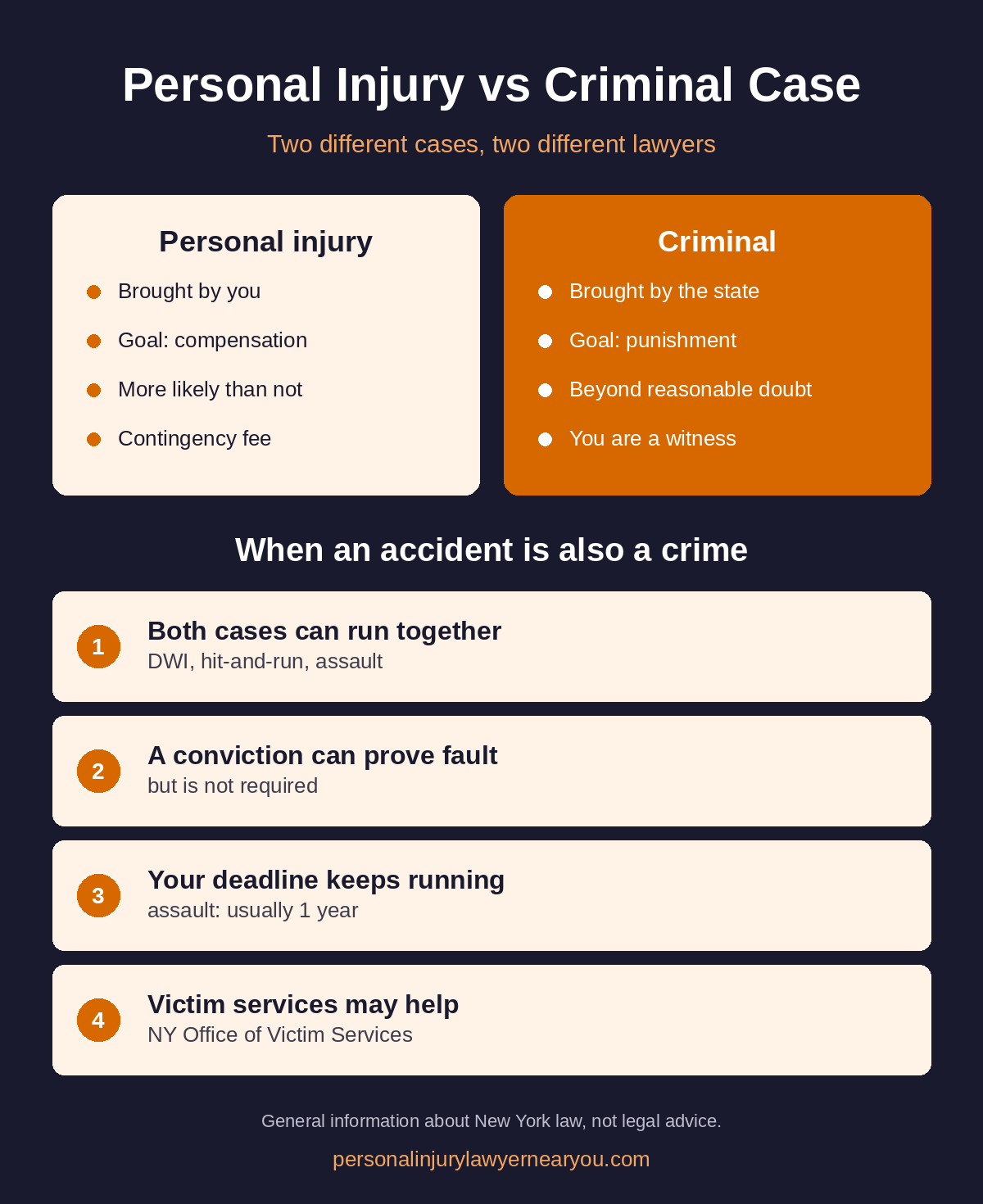
When an Accident Is Also a Crime
Some accidents lead to both a criminal case and an injury claim:
- Drunk or drugged driving crashes
- Hit-and-run accidents. See what to do in our guide to a hit and run accident on Staten Island.
- Assaults, including attacks in bars, stores or apartment buildings
- Reckless driving that causes serious injury or death
The two cases can run side by side. The criminal case can help yours: police reports, video and a guilty plea or conviction can be strong evidence of fault. But you do not have to wait for the criminal case to end, and your injury claim can succeed even if the criminal case fails, because the civil burden of proof is lower.
Restitution vs Compensation
| Criminal restitution | Personal injury compensation | |
|---|---|---|
| Ordered by | The criminal court | Settlement or civil court |
| Usually covers | Out-of-pocket losses | Medical bills, lost wages, pain and suffering |
| Pain and suffering | Not usually | Yes |
| Depends on | A conviction and the defendant’s ability to pay | Proving fault and available insurance |
New York’s Office of Victim Services can also help eligible crime victims with costs such as medical care, counseling and lost earnings. It is a separate program from both the criminal case and your injury claim.
Deadlines Still Apply
Claims for intentional harm such as assault generally have just one year in New York, compared with three years for most negligence claims. A criminal case can extend that one-year window: under CPLR § 215(8), if the same person is prosecuted for the same incident, you have at least one year after the criminal case ends, and CPLR § 213-b gives crime victims longer to sue a defendant who is convicted. Negligence deadlines, such as the three years after a car crash, are not paused, so do not wait on the criminal case. Check every deadline in our guide to the New York statute of limitations.
Who Pays an Injury Claim Against Someone Charged With a Crime?
In a crash, the at-fault driver’s auto insurance usually pays, even if the driver was charged with a crime. Intentional acts such as assault are often excluded from insurance, so the claim may need to look to others, such as a property owner who failed to provide reasonable security. If the driver had no insurance or fled, see how uninsured and hit-and-run claims work in NYC.
Which Lawyer Do You Need?
If you were injured, you need a personal injury lawyer. If you were charged with a crime, you need a criminal defense lawyer. If you were hurt in a crash in Manhattan that led to an arrest, a Manhattan personal injury lawyer can follow the criminal case while building your claim.
Frequently Asked Questions
What is the difference between a personal injury lawyer and a criminal lawyer?
A personal injury lawyer represents injured people in civil cases to win compensation. A criminal lawyer defends people accused of crimes, while the state prosecutes them. If you were hurt, you need a personal injury lawyer.
Can I sue someone who was charged with a crime for hurting me?
Yes. A civil injury claim is separate from the criminal case and can proceed at the same time. A conviction can help prove fault, but you can win a civil case even without one.
Do I need to wait for the criminal case to finish?
No, and for most claims you should not, because your injury deadline keeps running. Your lawyer can use evidence from the criminal case as it becomes available.
Will criminal restitution pay for my injuries?
Restitution usually covers some out-of-pocket losses if the defendant is convicted and can pay, but it does not usually include pain and suffering. A personal injury claim covers far more.
How long do I have to sue for an assault in New York?
Claims for intentional harm such as assault generally must be filed within one year, much shorter than the three years for most negligence claims. If the attacker is prosecuted, CPLR § 215(8) gives you at least one year after the criminal case ends, and a conviction can allow more time under CPLR § 213-b.
Does the at-fault driver’s insurance pay if they were drunk?
Usually yes. Auto insurance generally still covers injuries caused by a drunk driver, although intentional acts such as assault are often excluded from insurance coverage.
Key Takeaways
✅ Personal injury cases win compensation; criminal cases punish offenders
✅ If you were hurt, you need a personal injury lawyer
✅ Both cases can run at the same time
✅ A conviction can help your claim, but is not required
✅ Assault claims generally have a one-year deadline, which a criminal case can extend
Hurt by Someone Who Was Arrested?
The criminal case will not pay your bills. A free case review explains how your injury claim works alongside the criminal case and which deadlines apply.
Injured in a Crime or a DWI Crash? Talk to Us Today
Free case review. No win, no fee. No upfront cost.
Want more NYC injury guides and legal news from PILNY in your Google results?
