
TL;DR — Quick Summary
Special damages are the measurable money losses caused by an injury: medical bills, lost wages, future treatment, and out-of-pocket costs like travel and home help. They are also called economic damages and are proven with bills, receipts and records. They differ from general damages such as pain and suffering, which have no receipt. In New York lawsuits, special damages are itemized in the bill of particulars.
What are special damages in a personal injury case? They are the part of a claim you can add up with a calculator: the hospital bill, the physical therapy invoices, the paychecks you missed, the taxi rides to appointments. Because they come with paperwork, they are usually the foundation of a settlement and often influence how the rest of the claim is valued.
This guide explains exactly what counts as special damages, how they differ from general damages, how to prove them and how New York handles them. For the full picture of every kind of compensation, see our main guide to personal injury damages in New York; this page focuses on the special damages part.
What Are Special Damages in a Personal Injury Case? The Definition
Special damages, sometimes called “specials” by lawyers and adjusters, are the specific financial losses that flow from an injury and can be measured in dollars. They cover money you have already spent or lost, and money you are reasonably certain to spend or lose in the future because of the injury.
They are “special” because they are particular to you. Two people with the same broken leg may have very different special damages depending on their medical bills, their jobs and how long they were out of work.
Special vs General Damages
| Special (economic) damages | General (non-economic) damages | |
|---|---|---|
| What they cover | Specific money losses | Losses with no price tag |
| Examples | Medical bills, lost wages, future care, out-of-pocket costs | Pain and suffering, emotional distress, loss of enjoyment of life |
| How they’re proven | Bills, receipts, pay stubs, records | Testimony, medical opinions, daily-life evidence |
| How they’re calculated | Add up the actual and projected costs | Judgment of an insurer, judge or jury |
| Car crash rule in NY | No-fault pays the first $50,000 of basic economic loss | Requires a “serious injury” to sue |
Types of Special Damages
Past medical expenses
Emergency care, hospital stays, surgery, doctor visits, imaging, physical therapy, medication and medical equipment. Keep every bill and explanation of benefits. The amount billed and the amount actually paid by insurance are often different, and that difference can matter when the claim is valued.
Future medical expenses
Treatment you are reasonably certain to need later, such as another surgery, ongoing therapy, injections or long-term medication. These need medical support, and in serious cases a life care plan prepared by an expert.
Lost wages
Pay lost while you were unable to work: salary, hourly wages, overtime, tips, bonuses and self-employment income. Pay stubs, tax returns and an employer letter usually prove it. If you used sick days or vacation time to cover your absence, that time has value too and can usually be claimed, because you lost the benefit of time you would otherwise have kept for later.
Lost earning capacity
If the injury permanently reduces what you can earn, the difference over your working life can be claimed. This usually needs a vocational expert or economist.
Out-of-pocket costs
Travel to appointments, parking, home help, childcare you had to pay for while recovering, and changes to your home or car, such as a ramp or hand controls.
Property damage
Your damaged vehicle, phone, glasses or clothing are measurable losses too, though in car crashes they are often handled as a separate property damage claim.
How Special Damages Are Proven
| Type of special damage | Best evidence |
|---|---|
| Medical bills | Itemized bills, records, explanation of benefits statements |
| Future medical care | Doctor’s opinion, life care plan, cost estimates |
| Lost wages | Pay stubs, W-2s or tax returns, employer letter |
| Lost earning capacity | Vocational expert and economist reports |
| Travel and other costs | Receipts, mileage log, invoices |
In a New York lawsuit, special damages are also set out formally. Under CPLR Section 3043, the bill of particulars in a personal injury action can require the total amounts claimed as special damages for physicians’ services and medical supplies, loss of earnings, hospital expenses and nurses’ services.
Special Damages After a New York Car Accident
Car crashes work differently. New York no-fault insurance pays your basic economic loss, meaning medical bills and part of your lost wages, up to $50,000, regardless of fault. You generally can’t recover those same no-fault benefits again from the at-fault driver, but you can claim economic losses above them. Our guide to New York no-fault insurance explains what it covers, and our step-by-step guide to calculating a car accident settlement in New York shows where special damages fit.
Motorcyclists are an exception: they are outside the no-fault system, so their medical bills are claimed directly, as covered in our guide to medical bills after a Brooklyn motorcycle accident.
How Special Damages Affect the Value of Your Claim
Special damages do more than repay bills. Insurers often use them as a starting point when valuing the whole claim, and serious medical costs usually signal a serious injury, which pushes pain and suffering higher as well. Large, well-documented specials make a claim easier to value and harder to dismiss. Our guide to average personal injury settlement amounts in New York shows how this plays out across different injuries.
That cuts both ways. Gaps in treatment, unexplained bills or treatment that seems excessive for the injury can lead an insurer to discount both the specials and the rest of the claim.
Can Special Damages Be Reduced?
- Shared fault. In New York, your recovery is reduced by your percentage of fault.
- Failure to mitigate. If you skip recommended treatment or don’t return to work when you could, the other side may argue some losses weren’t caused by the accident.
- Other payments. New York law allows some awards to be reduced for certain costs already paid by other sources, and no-fault benefits can’t be recovered twice.
- Disputed bills. The defense may challenge whether treatment was necessary or whether charges were reasonable.
- Liens. Even when specials are recovered in full, health insurers or Medicaid may need to be repaid from the settlement.
Special Damages in Wrongful Death Cases
When an injury is fatal, the family’s claim also includes measurable losses: medical bills before death, funeral and burial costs, and the financial support the person would have provided. New York wrongful death law focuses heavily on these economic losses, so careful documentation of income and household contributions matters even more.
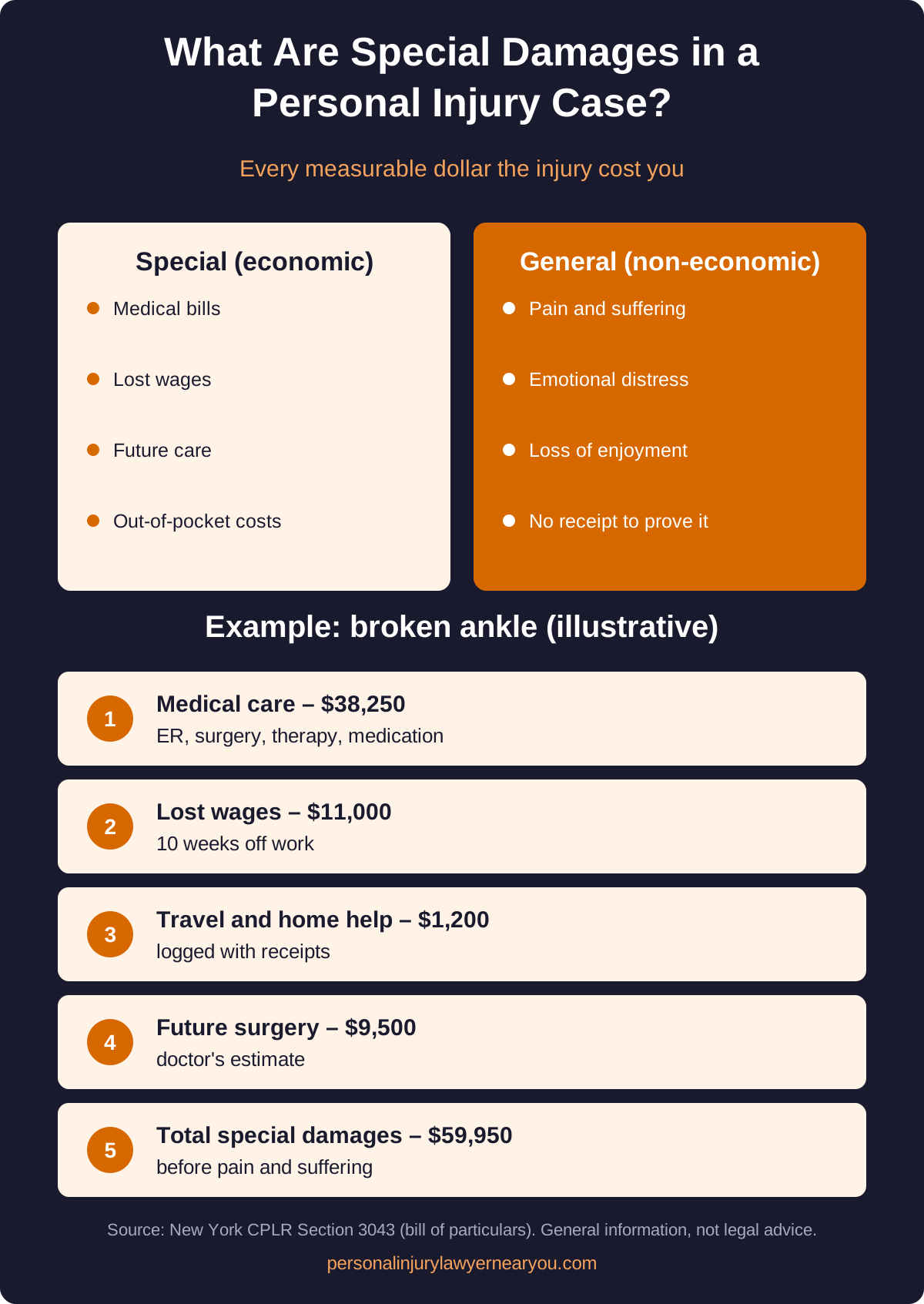
Example: Adding Up Special Damages
An illustrative example with made-up numbers, for a slip and fall that caused a broken ankle:
| Special damage | Amount |
|---|---|
| Emergency room and imaging | $4,800 |
| Surgery and hospital stay | $28,500 |
| Physical therapy (24 sessions) | $4,300 |
| Medication and walking boot | $650 |
| Lost wages (10 weeks) | $11,000 |
| Travel and home help | $1,200 |
| Future hardware removal surgery (estimated) | $9,500 |
| Total special damages | $59,950 |
General damages for pain and suffering would be claimed on top of this. For a rough sense of how both parts combine, try the personal injury settlement calculator.
What Are Special Damages in a Personal Injury Case Worth to You? How to Avoid Leaving Money Out
Special damages are the easiest part of a claim to prove and the easiest to undercount. These habits help make sure every dollar is included.
Keep a single folder for everything
Bills, receipts, explanation of benefits forms, pay stubs and letters from your employer all belong in one place, paper or digital. Missing paperwork is the most common reason special damages come up short.
Track the small costs
Parking at the hospital, rides to physical therapy, over-the-counter supplies and paid help around the house add up over months. A simple log with dates and amounts is enough, and a photo of each receipt on your phone works just as well as the paper copy.
Don’t forget future costs
If your doctor expects more treatment, make sure it is written in your records. Future care that isn’t documented is hard to claim later.
Document lost income properly
Hourly workers, gig workers and the self-employed often have trouble proving lost income. Tax returns, invoices and bank records from before the injury help show what you normally earned.
Get itemized bills, not summaries
A one-line hospital balance isn’t enough. Ask every provider for an itemized bill showing dates of service and charges, and keep the explanation of benefits from your insurer. Itemized records make it far harder for an insurer to question what was spent.
Ask about liens
If a health insurer or Medicaid paid your bills, they may want to be repaid from the settlement. Knowing this early helps you understand what you’ll actually keep.
Update the numbers before you settle
Special damages keep growing while you treat. Before any settlement, make sure the latest bills, wage losses and future-care estimates are included. A demand built on numbers from three months ago can leave real money out, and once you sign a release you usually can’t go back for more.
So, what are special damages in a personal injury case? They are every measurable dollar the injury cost you, past and future, backed by paperwork. Getting them right builds the strongest base for the whole claim.
Frequently Asked Questions
What are special damages in a personal injury case?
Special damages are the specific, measurable financial losses caused by an injury, such as medical bills, lost wages, future treatment costs and out-of-pocket expenses. They are proven with bills, receipts and records, which is why they are also called economic damages.
What is the difference between special and general damages?
Special damages are losses with a dollar figure attached, like hospital bills and lost pay. General damages are losses without a receipt, such as pain and suffering, emotional distress and loss of enjoyment of life. Both are part of a personal injury claim.
Are lost wages special damages?
Yes. Wages, salary, overtime, bonuses and self-employment income lost because of the injury are special damages. Future lost earning capacity, if the injury affects your ability to work long term, can be claimed as well, usually with expert support.
How do you prove special damages?
With documents: medical bills and records, pharmacy receipts, pay stubs, tax returns, employer letters, mileage logs and receipts for any other expense. Future special damages are usually supported by doctors, life care planners or economists.
Are special damages capped in New York?
Special damages are generally measured by the losses you can actually prove rather than a fixed dollar limit. Your recovery can still be reduced by your share of fault, by the insurance available, and by rules that stop no-fault benefits being recovered twice. The 2026 reforms also changed some rules for motor vehicle cases, so check how they apply to yours.
Do special damages include future medical costs?
Yes. Reasonably certain future medical expenses, such as surgery, therapy, medication or home care, are special damages. They need medical evidence showing the care is likely to be needed and what it will cost.
Key Takeaways
✅ Special damages are measurable money losses: medical bills, lost wages, future care, costs
✅ They differ from general damages like pain and suffering, which have no receipt
✅ They are proven with bills, receipts, pay stubs and expert reports for future losses
✅ In NY car cases, no-fault pays the first $50,000 of basic economic loss
✅ Keep every receipt and log small costs so nothing is left out
Not Sure Your Losses Are Fully Counted?
A free case review can check your bills, lost income and future costs, so the special damages in your claim reflect everything the injury has really cost you.
Make Sure Every Loss Is Counted: Free Review
Free case review. No win, no fee. No upfront cost.
Want more NYC injury guides and legal news from PILNY in your Google results?
