
TL;DR — Quick Summary
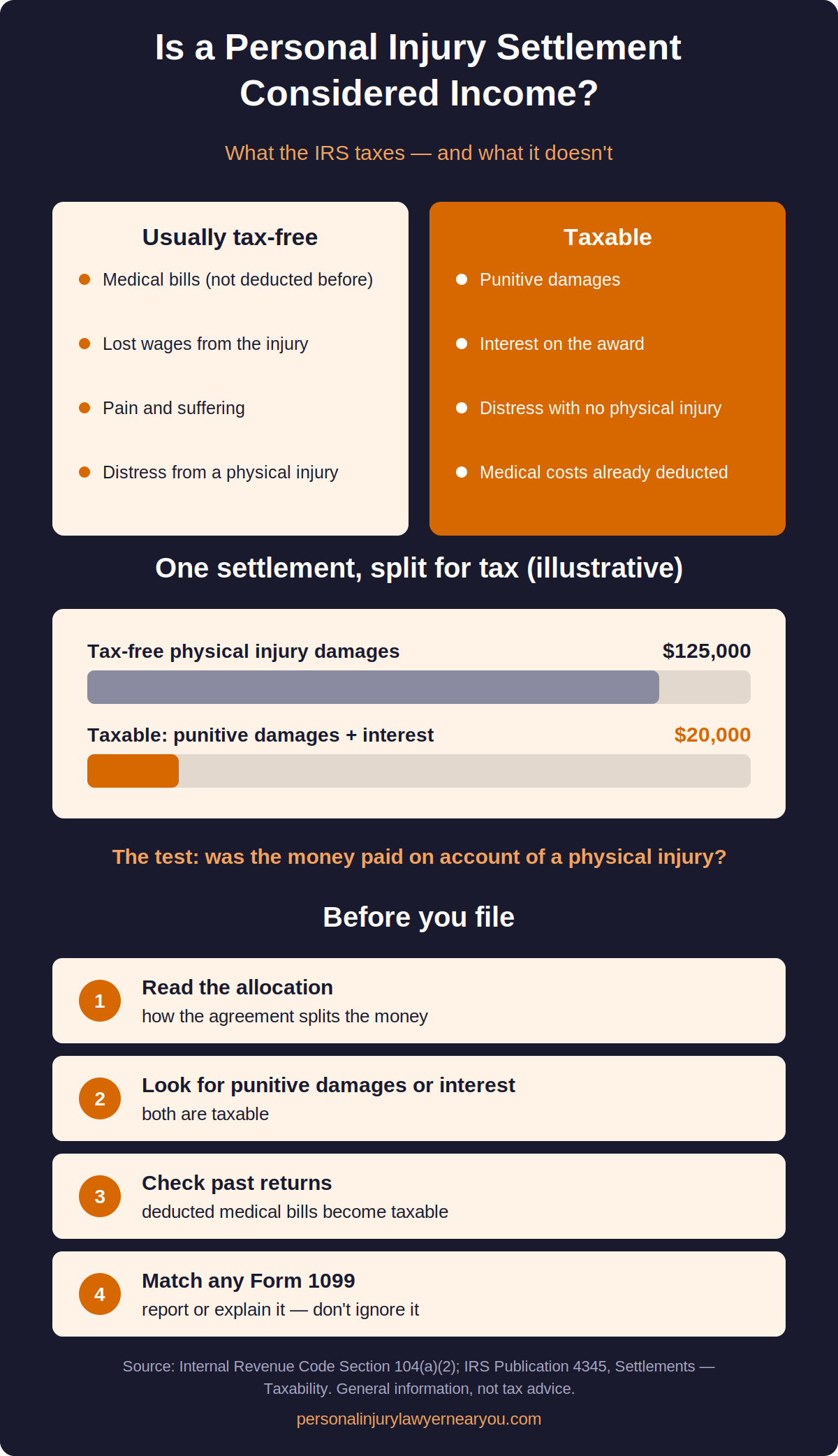
In most cases, no. Money you receive for a physical injury or physical sickness — medical bills, lost wages and pain and suffering that flow from it — is excluded from federal income under Internal Revenue Code Section 104(a)(2). The parts that are taxed are punitive damages, interest, emotional distress with no physical injury behind it, and any medical costs you already deducted in an earlier year. How the settlement agreement allocates the money matters, so read it before you sign.
Is a personal injury settlement considered income? For most people hurt in a car crash, a fall or another accident, the answer is no — the money that compensates you for a physical injury is not taxed by the IRS. But “most” is doing real work in that sentence. A single settlement check can be partly tax-free and partly taxable, depending on what each dollar was paid for.
This guide explains how the taxation of personal injury settlements works, which parts the IRS taxes, and the questions to ask before you sign. It is general information, not tax advice — for a large or complicated settlement, talk to a CPA or tax attorney before filing.
Is a Personal Injury Settlement Considered Income Under Federal Law?
The rule comes from Section 104(a)(2) of the Internal Revenue Code. It excludes from gross income any damages, other than punitive damages, received “on account of personal physical injuries or physical sickness” — whether paid through a settlement or a court judgment, and whether paid as a lump sum or in installments. The IRS summarises the rule on its page on the tax implications of settlements and judgments.
The key phrase is on account of a physical injury. If the injury is physical — a broken bone, a spinal injury, a concussion, cuts and bruises — the compensatory damages that flow from it are tax-free. That includes the categories most people think of as the “real” claim: medical expenses, lost earnings and pain and suffering. Our guide to economic and non-economic damages explains each category in detail.
What Is Taxable and What Isn’t: Quick Reference
| Part of the settlement | Taxable? | Why |
|---|---|---|
| Medical expenses (physical injury) | No* | Excluded under Section 104(a)(2) — *unless you deducted them in an earlier year |
| Lost wages (from a physical injury) | No | Treated as damages received on account of the physical injury |
| Pain and suffering (from a physical injury) | No | Part of the physical injury damages |
| Emotional distress with a physical injury | No | Distress that originates in the physical injury is excluded |
| Emotional distress with no physical injury | Yes* | *Except the amount paid for medical care related to the distress |
| Punitive damages | Yes | Excluded from Section 104(a)(2) by its own wording |
| Interest on a judgment or late settlement | Yes | Taxed as interest income |
| Property damage (e.g. your car) | Usually no | Not taxable up to your adjusted basis in the property |
Most ordinary accident settlements sit almost entirely in the top half of that table. For a sense of what typical claims actually pay, see our guide to average personal injury settlement amounts.
Physical vs Emotional Injuries: The Line That Decides It
Before 1996, damages for almost any “personal injury” — including defamation or emotional harm — could be tax-free. Congress narrowed the rule that year to physical injuries and sickness. Since then, the question the IRS asks is simple: did the money come from a physical injury?
When emotional distress is tax-free
If you were hit by a car, broke your leg and now suffer anxiety every time you get behind the wheel, the emotional distress grows out of the physical injury. It is compensated “on account of” that injury and is excluded along with the rest.
When emotional distress is taxable
If the claim has no physical injury at all — harassment, discrimination, defamation — damages for emotional distress are taxable. That stays true even if the distress causes physical symptoms like headaches, insomnia or stomach problems. The one carve-out is the amount you actually paid for medical care related to the distress, which can be excluded as long as you did not deduct it before.
This is why a slip and fall or car accident settlement is usually tax-free, while a settlement from an employment lawsuit usually is not, even if both mention “pain and suffering”.
The Parts of a Personal Injury Settlement the IRS Does Tax
Punitive damages
Punitive damages are meant to punish the defendant, not to repay you for a loss, so Section 104(a)(2) expressly leaves them out. They are taxable even in a case built on a serious physical injury. There is a narrow exception for some wrongful death cases in states whose law allows only punitive damages, but it rarely applies. Punitive awards are uncommon in ordinary accident cases — they show up mostly in cases of especially reckless conduct, like the famous verdicts discussed in our article on million-dollar personal injury settlement examples.
Interest
If a court judgment includes pre-judgment or post-judgment interest, or a settlement pays interest for late payment, that interest is taxable as ordinary interest income — even when the underlying damages are tax-free.
Medical expenses you already deducted
If you itemised and deducted medical expenses for the injury in an earlier tax year, and that deduction lowered your tax, the part of the settlement that reimburses those same expenses is taxable in the year you receive it. You cannot get a tax break twice for the same cost. Most people never deducted their accident bills, so this rarely bites — but check before you file.
How the Settlement Agreement Changes Your Tax Bill
Many settlements are paid as one number with no breakdown. Others split the money into categories — so much for medical costs, so much for lost wages, so much for pain and suffering. According to IRS Publication 4345, the IRS generally will not disturb an allocation made by the parties if it is consistent with the substance of the claims that were settled.
That gives you two practical points. First, if the case involves both physical and non-physical claims, a reasonable written allocation can protect the tax-free portion. Second, the allocation has to match reality — labelling everything “physical injury” in a case that was really about lost business profits will not hold up.
Your lawyer is paid out of the same check. In a typical contingency fee arrangement, the fee comes off the gross settlement. When the whole settlement is tax-free physical injury damages, the fee causes no tax issue. When part of it is taxable, ask a tax professional how the fee is treated on that portion — the answer can surprise people.
Example: How One Settlement Splits for Tax Purposes
An illustrative example only, with made-up numbers:
| Settlement component | Amount | Taxable? |
|---|---|---|
| Medical expenses (never deducted) | $40,000 | No |
| Lost wages while recovering | $25,000 | No |
| Pain and suffering | $60,000 | No |
| Punitive damages | $15,000 | Yes |
| Post-judgment interest | $5,000 | Yes |
| Total: $145,000 | $20,000 taxable | $125,000 tax-free |
Without the punitive damages and interest, this entire settlement would be tax-free. With them, $20,000 is reported as income. For a rough sense of what your own claim might be worth before tax questions even come up, the personal injury settlement calculator gives a starting range.
Are Personal Injury Settlements Taxable in Florida and Other States?
Federal law is only half the picture — your state may tax income too. The good news is that most states follow the federal treatment of physical injury settlements.
- Florida: Florida has no state personal income tax, so a personal injury settlement is not taxed by the state at all. Federal rules still apply to punitive damages and interest. Our Florida personal injury guide covers the state’s claim rules and deadlines.
- New York: New York’s income tax starts from your federal adjusted gross income, so money excluded federally is generally not taxed by the state either.
- Other states: Most income-tax states start from federal income in the same way. A few have their own adjustments, so check your state’s rules if part of your settlement is taxable.
Structured Settlements, Form 1099 and Reporting
Structured settlements. If a physical injury settlement is paid in instalments over years instead of a lump sum, the payments keep their tax-free status. Section 104(a)(2) applies whether damages are paid as lump sums or as periodic payments.
Form 1099. Insurers generally do not issue a Form 1099 for damages paid on account of a physical injury. You may receive one for taxable parts such as interest or punitive damages. If you get a 1099 you believe is wrong, do not ignore it — ask the payer to correct it or have a tax professional explain the exclusion on your return.
Keep the paperwork. Save the settlement agreement, the closing statement from your lawyer and any medical bills. If the IRS ever asks why you did not report the money, those documents show what it was paid for.
Is a Personal Injury Settlement Considered Income in Your Case? A Pre-Filing Checklist
The general rules are clear, but your own settlement is what matters at tax time. Run through these questions before you file — or before you sign, if you still can.
1. Was there a physical injury?
If the claim is for a bodily injury — from a car crash, a fall, a dog bite, a defective product — the compensatory damages are generally tax-free. If the claim was mainly about emotional harm, reputation or money with no physical injury, expect most of it to be taxable.
2. Does the agreement allocate the money?
Read the settlement agreement for a breakdown by category. A clear allocation between physical injury damages and anything else makes the tax treatment easier to support. If there is no allocation and the case involved mixed claims, ask your lawyer about one before you sign.
3. Are punitive damages or interest included?
Look for either word in the agreement, judgment or closing statement. Both are taxable even when the rest of the settlement is not, and they are the most common reason an injury settlement creates a tax bill.
4. Did you deduct medical bills in an earlier year?
Check your past returns. If you itemised and deducted accident-related medical costs that reduced your tax, the part of the settlement that repays those costs is taxable now.
5. Is any of it for property or business losses?
Payment for your damaged car is usually not taxable up to what you paid for it, less depreciation. Payment for lost business profits outside a physical injury claim is a different matter and is often taxable.
6. Did you receive a 1099?
A Form 1099 does not automatically make money taxable, but the IRS will match it against your return. Make sure what you report — or exclude — lines up with the paperwork.
So, is a personal injury settlement considered income? For a straightforward physical injury claim, the compensatory part almost never is. For anything with punitive damages, interest, non-physical claims or a large dollar amount, a one-hour meeting with a tax professional is cheap insurance against a surprise IRS notice later.
Frequently Asked Questions
Is a personal injury settlement considered income?
Usually not. Under federal tax law, compensatory damages received on account of a personal physical injury or physical sickness are excluded from gross income. That covers medical bills, lost wages and pain and suffering tied to the physical injury. Punitive damages and interest are the main exceptions and are taxable.
Are personal injury settlements taxable if they include lost wages?
Not when the lost wages flow from a physical injury. The IRS treats them as part of the damages received on account of that injury, so they are tax-free. Lost wages paid in a claim with no physical injury, such as an employment dispute, are generally taxable.
Is pain and suffering taxable?
Pain and suffering and emotional distress are tax-free when they come from a physical injury, such as a car crash or a fall. Emotional distress damages with no physical injury behind them are generally taxable, except for the amount you paid for medical care related to that distress.
Are punitive damages from a personal injury case taxable?
Yes. Punitive damages are taxable income even when the underlying case involves a physical injury. A narrow exception applies to certain wrongful death cases in states whose law allows only punitive damages.
Are personal injury settlements taxable in Florida?
Florida has no state personal income tax, so there is no state tax on a personal injury settlement there. Federal rules still apply: compensation for a physical injury is tax-free, while punitive damages and interest are taxable.
Do I have to report a personal injury settlement on my tax return?
You generally do not report the tax-free part of a physical injury settlement. You do report taxable parts, such as punitive damages, interest, or a recovery of medical expenses you deducted in an earlier year. A tax professional can confirm how to report your specific settlement.
Key Takeaways
✅ Compensation for a physical injury is generally not taxable income
✅ That includes medical bills, lost wages and pain and suffering from the injury
✅ Punitive damages and interest are taxable
✅ Emotional distress with no physical injury is generally taxable
✅ Florida has no state income tax; most other states follow the federal rule
Get the Settlement Right Before You Worry About Tax
The tax question only matters once you know what your claim is worth and how it will be paid. If you were hurt in an accident, a free case review can tell you what your claim may be worth and how the settlement should be structured.
Hurt in an Accident? Find Out What Your Claim Is Worth
Free case review. No win, no fee. No upfront cost.
Want more NYC injury guides and legal news from PILNY in your Google results?
