
TL;DR — Quick Summary
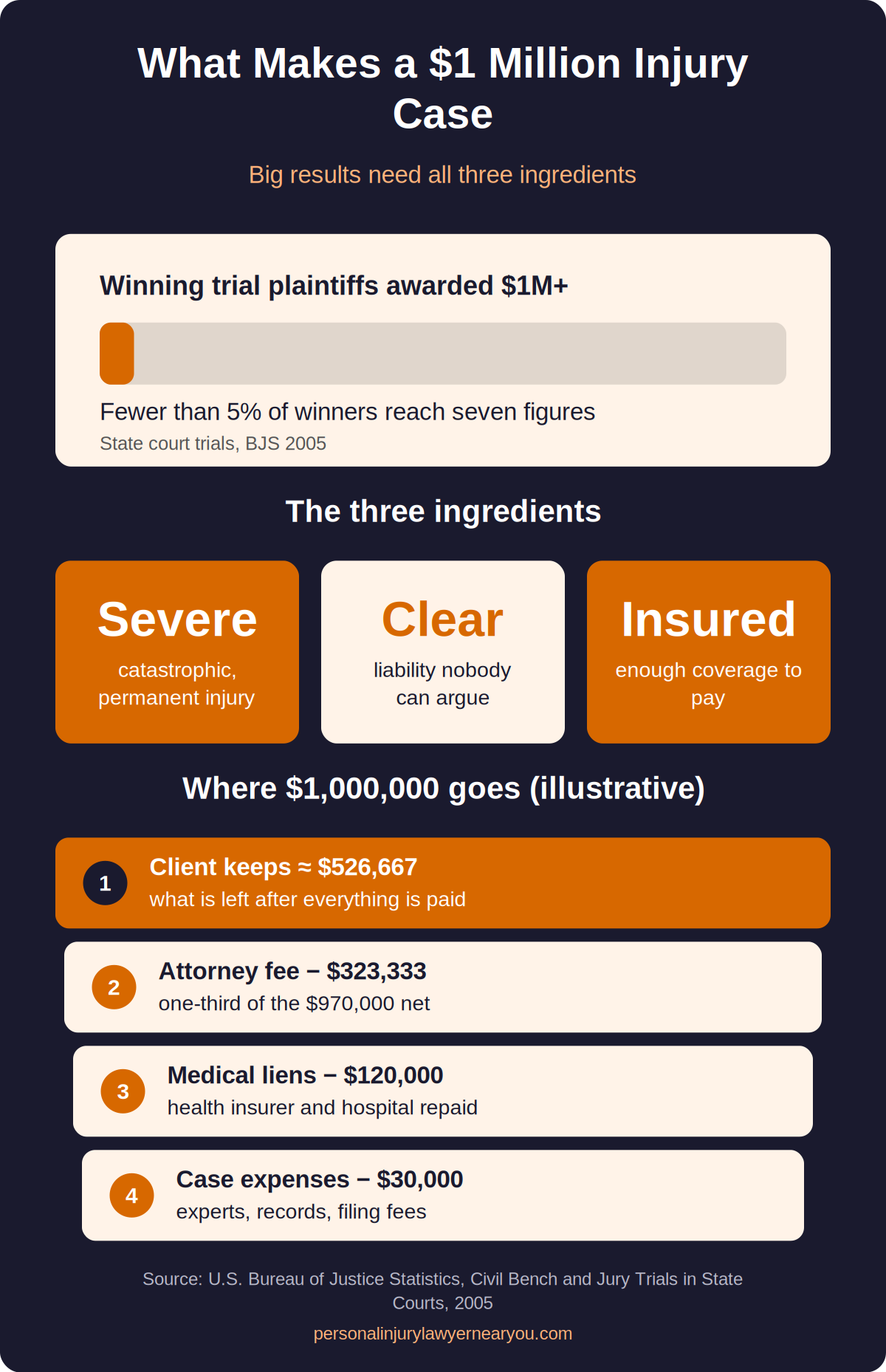
Million-dollar personal injury settlements are real but rare. Even among plaintiffs who win at trial, fewer than 5% are awarded more than $1 million. Every seven-figure case has the same three ingredients: a catastrophic, permanent injury, clear liability, and enough insurance or assets to pay. Without all three, the number does not happen. And a $1 million settlement is not $1 million in your pocket — after the fee, expenses and medical liens, the client often keeps around half.
Search for a million dollar personal injury settlement example and you will find headline after headline. What the headlines rarely explain is why that case reached seven figures — and why most cases, even serious ones, never come close.
This guide walks through realistic personal injury case examples, one famous case most people get wrong, and the arithmetic of what a seven-figure result actually pays the injured person.
How Rare Is a Million-Dollar Personal Injury Settlement?
Rarer than the advertising suggests. In its national study of state court trials, the Bureau of Justice Statistics found that fewer than 5% of winning plaintiffs received more than $1 million, and the median award was $28,000. For motor vehicle cases the median was lower still, at $15,000.
Those are trial figures, and trials are the minority — most claims settle. But the pattern holds for settlements too: the large majority of personal injury claims resolve in the thousands or tens of thousands. Seven figures belong to a narrow band of cases where the losses are enormous and someone with deep pockets is clearly responsible.
The Three Things Every Seven-Figure Case Has in Common
| Ingredient | What it looks like | Why the case stalls without it |
|---|---|---|
| Catastrophic damages | Permanent injury, years of future care, a lost career | The losses simply do not add up to $1 million |
| Clear liability | A rear-end crash, a safety-law violation, video evidence | Disputed fault gets discounted — or reduced by your share of blame |
| Collectible money | A commercial policy, an umbrella policy, a business or several defendants | A $25,000 auto policy cannot pay a $2 million injury |
The first ingredient is measured through economic and non-economic damages — medical costs, lost earnings, future care, and pain and suffering. The third ingredient is the one injured people most often overlook. New York’s minimum auto liability coverage is just $25,000 per person. That is why so many seven-figure cases involve a commercial vehicle: interstate trucking companies must carry at least the $750,000 federal minimum, and many carry far more.
Personal Injury Case Examples That Can Reach Seven Figures
The five examples below are illustrative composites, not real cases. Each shows how the three ingredients combine.
Example 1: Tractor-trailer rear-ends a car on the expressway
A 42-year-old electrician is stopped in traffic when a tractor-trailer hits him from behind. He needs a two-level spinal fusion and cannot return to physical work. Fault is not seriously disputed, the carrier holds a commercial policy with excess coverage, and his lost lifetime earnings alone run well into six figures. All three ingredients are present.
Example 2: Construction worker falls from a scaffold
A laborer falls two stories when an unsecured plank gives way, fracturing his pelvis and both wrists. In New York, the Scaffold Law places absolute liability on the owner and general contractor for gravity-related falls when safety devices fail — and those defendants carry large general liability policies.
Example 3: Pedestrian hit by a delivery van
A woman in a crosswalk with the walk signal is struck by a commercial van making a turn. She suffers a traumatic brain injury that affects memory and concentration permanently. Brain injury cases often reach seven figures because the cost of lifetime care and lost earning capacity is so large.
Example 4: Wrongful death of a working parent
A father of two in his thirties is killed by a driver who ran a red light. The family’s claim is built mostly on the income and support he would have provided over decades. The number depends heavily on the at-fault driver’s coverage and any additional policies.
Example 5: Surgical error
A patient suffers nerve damage after a surgeon operates on the wrong level of the spine. Medical malpractice is expensive to prove, but awards are high when it succeeds — the same BJS study put the median medical malpractice jury award at $682,000.
Famous Personal Injury Cases: What the McDonald’s Coffee Case Really Paid
The best-known personal injury case in America is also the most misunderstood. In Liebeck v. McDonald’s Restaurants (1994), 79-year-old Stella Liebeck suffered third-degree burns from coffee served at around 180–190°F. She needed skin grafts and was hospitalized for over a week. She first asked McDonald’s to cover her medical costs — about $20,000.
- The jury verdict: $200,000 in compensatory damages, cut to $160,000 because she was found 20% at fault, plus $2.7 million in punitive damages.
- What the judge did: reduced the punitive damages to $480,000.
- How it ended: a confidential settlement before any appeal was decided.
The lesson for personal injury case studies is that the headline number is often not the final number. Verdicts get reduced, appealed and settled for less — and the facts behind them usually explain the size far better than the headline does.
What You Actually Keep From a $1 Million Settlement
Here is an illustrative breakdown. Real figures vary with the fee agreement, the cost of the case and the size of the liens.
| Item | Amount |
|---|---|
| Gross settlement | $1,000,000 |
| Case expenses (experts, records, filing fees) | − $30,000 |
| Attorney fee (one-third of the $970,000 net) | − $323,333 |
| Medical liens (health insurer, hospital) | − $120,000 |
| Paid to the client | $526,667 |
Whether expenses come out before or after the lawyer’s percentage changes the result, so read that clause in any contingency fee agreement before you sign. A good lawyer will also negotiate the medical liens down, which can add tens of thousands to what you take home.
Why Big Examples Don’t Predict Your Case
Published verdicts are a highlight reel. They show what is possible when everything lines up, not what a typical claim pays. For realistic ranges by injury and accident type, see our guide to average personal injury settlement amounts in New York.
What moves your number is your own file: how serious and permanent the injury is, how much work you have lost, how clear fault is, and how much insurance stands behind the person who hurt you. The personal injury settlement calculator gives a rough starting range from those inputs in about a minute.
A Million Dollar Personal Injury Settlement Example, Step by Step
Headlines show the final number. They never show how it was built. Here is how the tractor-trailer case from Example 1 might move from the crash to a seven-figure result — again, an illustrative composite, not a real case.
1. Locking down liability (first weeks)
The lawyer sends a preservation letter to the trucking company the same week, demanding the truck’s electronic logging data, dashcam video and the driver’s records before they can be overwritten. A rear-end crash on a congested expressway leaves little room to argue fault, and the data confirms the truck was following too closely.
2. Measuring the damages (first year)
Nothing is valued until the electrician’s doctors know how far he will recover. After the spinal fusion, his surgeon confirms he cannot return to physical work. That single opinion changes the case: an economist calculates decades of lost earnings, and a life-care planner prices future injections, therapy and a likely second surgery. Pain and suffering is then argued on top of those hard numbers.
3. Finding all the insurance
The trucking company’s primary policy is only the first layer. Discovery reveals an excess policy sitting above it, and the broker that arranged the load is added as a defendant. Without that work, the case would be capped at whatever the first policy allowed.
4. Pressure, then resolution
Depositions of the driver and the safety manager go badly for the defense. With a trial date set, the insurers agree to mediate, and the case settles in the seven figures. The client then receives a written closing statement showing the fee, expenses and medical liens deducted before his share is paid.
Every million dollar personal injury settlement example you read about follows some version of this path: early evidence, a properly measured loss, and enough insurance found to pay it. Miss any step and the number shrinks — which is why the work done in the first months matters as much as the negotiation at the end.
Frequently Asked Questions
How rare is a million-dollar personal injury settlement?
Rare. Most personal injury claims settle for far less. Even among plaintiffs who won at trial, a Bureau of Justice Statistics study found that fewer than 5% were awarded more than $1 million. Seven-figure results are concentrated in catastrophic injury and wrongful death cases.
What injuries lead to million-dollar settlements?
Usually permanent, life-changing injuries: traumatic brain injury, spinal cord injury and paralysis, amputations, severe burns, injuries needing multiple surgeries, and the wrongful death of a working parent. The common thread is a large lifetime cost of care and lost earnings.
Can a car accident settlement be worth $1 million?
Yes, but only if the injury is catastrophic and there is enough insurance to pay it. Many drivers carry low liability limits, so million-dollar car accident cases usually involve a commercial vehicle, an umbrella policy, or more than one at-fault party.
How much do you keep from a $1 million settlement?
Often roughly half to two-thirds. The lawyer’s contingency fee, commonly about a third, case expenses and medical liens are paid first. In one illustrative breakdown, a $1 million settlement leaves the client about $527,000.
Did the McDonald’s coffee case really pay millions?
No. The jury awarded about $2.86 million in 1994, but the judge cut the punitive damages to $480,000, and the case then settled confidentially. Stella Liebeck had third-degree burns that needed skin grafts and had first asked McDonald’s for about $20,000.
Does a big settlement in the news mean my case is worth the same?
No. Published verdicts and settlements reflect the facts, injuries, insurance and location of that specific case. They show what is possible, not what your claim is worth. Your own medical records, lost income and the available coverage drive your number.
Key Takeaways
✅ Fewer than 5% of winning trial plaintiffs are awarded more than $1 million
✅ Seven-figure cases need catastrophic damages, clear liability and collectible insurance
✅ Commercial vehicles and businesses are behind most big results because they carry big policies
✅ Headline verdicts are often reduced — the McDonald’s case settled for far less than $2.86 million
✅ After fees, expenses and liens, a $1 million settlement may leave the client around half
Find Out What Your Own Case Is Worth
Headlines cannot value your claim — but a lawyer looking at your injuries, your lost income and the insurance involved can. If you were seriously hurt, a free case review tells you which of the three ingredients your case has, and what it could realistically be worth.
Seriously Injured? Find Out What Your Case Is Worth
Free case review. No win, no fee. No upfront cost.
Want more NYC injury guides and legal news from PILNY in your Google results?
